
Hyperbola Equation and Graph Calculator
Enter the hyperbola equation or the known data to get its equations (standard and general form), its elements (center, foci, vertices, semi-axes, asymptotes, eccentricity, etc.), and its graph.
Quick Examples
How to Use This Calculator
This online hyperbola calculator is an analytical tool designed to process multiple combinations of data and return a complete report with the equations and all the geometric elements of the curve.
To get started, use the main dropdown menu to choose what information you know about your problem. The calculator supports the following input modes:
- Hyperbola equation: The solver interprets the equation in any of its forms. You do not need to simplify, group, or write it in a specific order; you can enter the general form, standard form, or an unarranged expression.
- Foci and one vertex: Enter the coordinates of the two foci and one of the vertices. With this information, the algorithm will determine the orientation and center of the conic section.
- One focus and both vertices: Similarly to the previous case, input the coordinates of the two vertices and one of the foci so the finder can deduce the rest of the graph's parameters.
- Center, focus, and vertex: Provide the coordinates of the center point (h, k), along with a focus and a vertex aligned with the center.
- Foci and one asymptote: Write the coordinates of the two foci and the equation of one of the asymptotic lines. The system will relate the slope of the asymptote to the semi-axis lengths to construct the hyperbola.
- Vertices and one asymptote: Enter both vertices and the equation of an asymptote. Just like in the previous mode, the solver will analyze the slopes and distances to get the exact solution.
Once you input your data and click the calculate button, the tool will analyze the figure and present the results divided into two main boxes:
- Equations: At the top, you will see the hyperbola expressed in its two most important mathematical forms: the standard form, which allows you to quickly identify the center and semi-axes, and the general form set equal to zero (Ax2 + Cy2 + Dx + Ey + F = 0).
- Geometric elements: A detailed breakdown listing all the properties of your figure. Here you will find the orientation (horizontal or vertical transverse axis), the coordinates of the center, foci, vertices, and endpoints of the conjugate axis (co-vertices). It also includes the exact equations for both asymptotes, the lengths of the semi-axes (a and b), the latus rectum, the eccentricity value, and the points of intersection with the x- and y-axes.
- Interactive graph: Below the results, the solver generates a visual representation on the Cartesian plane. You will clearly see the two branches of the hyperbola, verify the slant of the asymptotes, and spatially locate the center. The canvas allows you to zoom in, zoom out, or pan to explore the curve's geometry.
All numerical fields accept integers, decimals, and exact fractions. To maintain maximum geometric and algebraic precision, irrational numerical results are presented both as decimal approximations and in their exact symbolic form, preserving the radicals.
Step-by-Step Examples
The following are examples of problems solved by the calculator.
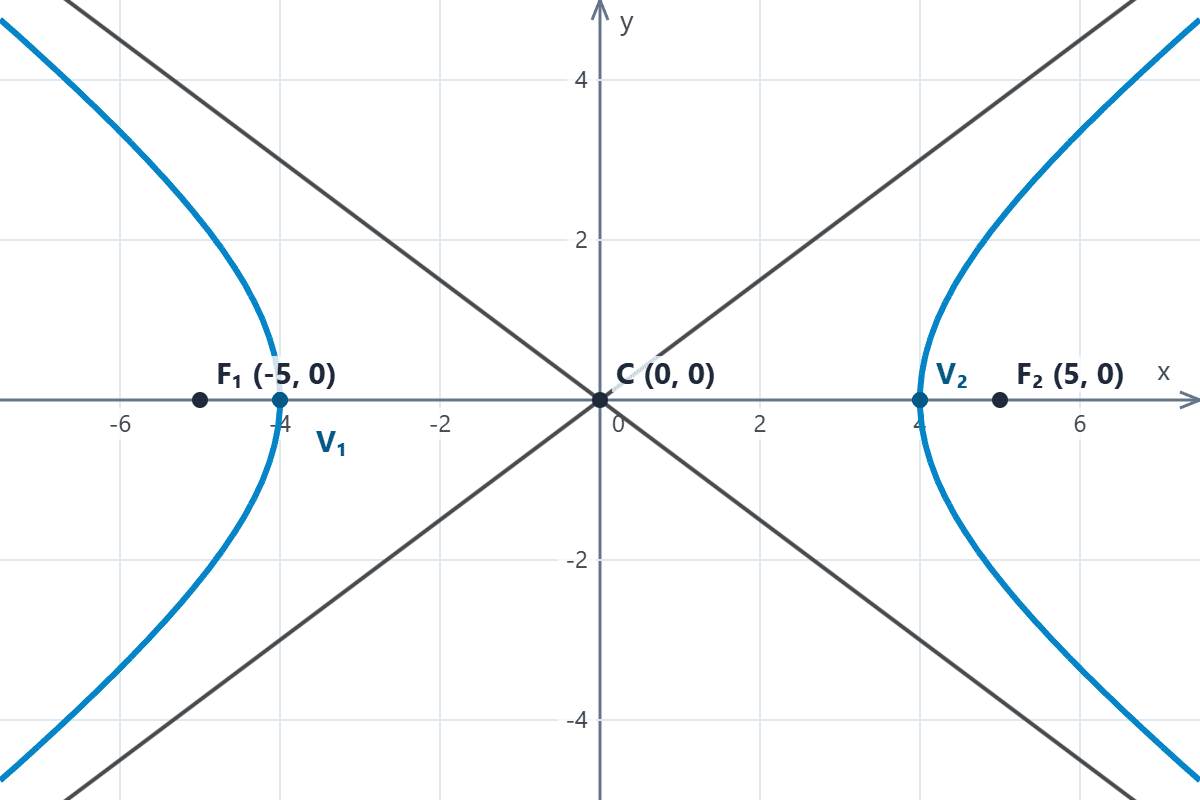
Determine the general form and elements of the hyperbola \( \dfrac{x^2}{16}-\dfrac{y^2}{9}=1. \)
Hyperbola equations
Equation in standard form
Equation in general form
Hyperbola elements
Orientation: Horizontal (transverse axis parallel to the x-axis, branches opening left and right).
Center: \( C \left(0, 0\right) \)
Foci
Vertices (endpoints of the transverse axis)
Co-vertices (endpoints of the conjugate axis)
Equations of the asymptotes
Semi-transverse axis: \( a = 4 \)
Semi-conjugate axis: \( b = 3 \)
Focal distance: \( c = 5 \)
Latus rectum: \( L_R = \dfrac{9}{2} = 4.5 \)
Eccentricity: \( e = \dfrac{5}{4} = 1.25 \)
Axes of symmetry: \( x = 0, \quad y = 0 \)
x-intercepts
y-intercepts
There are no real intercepts.
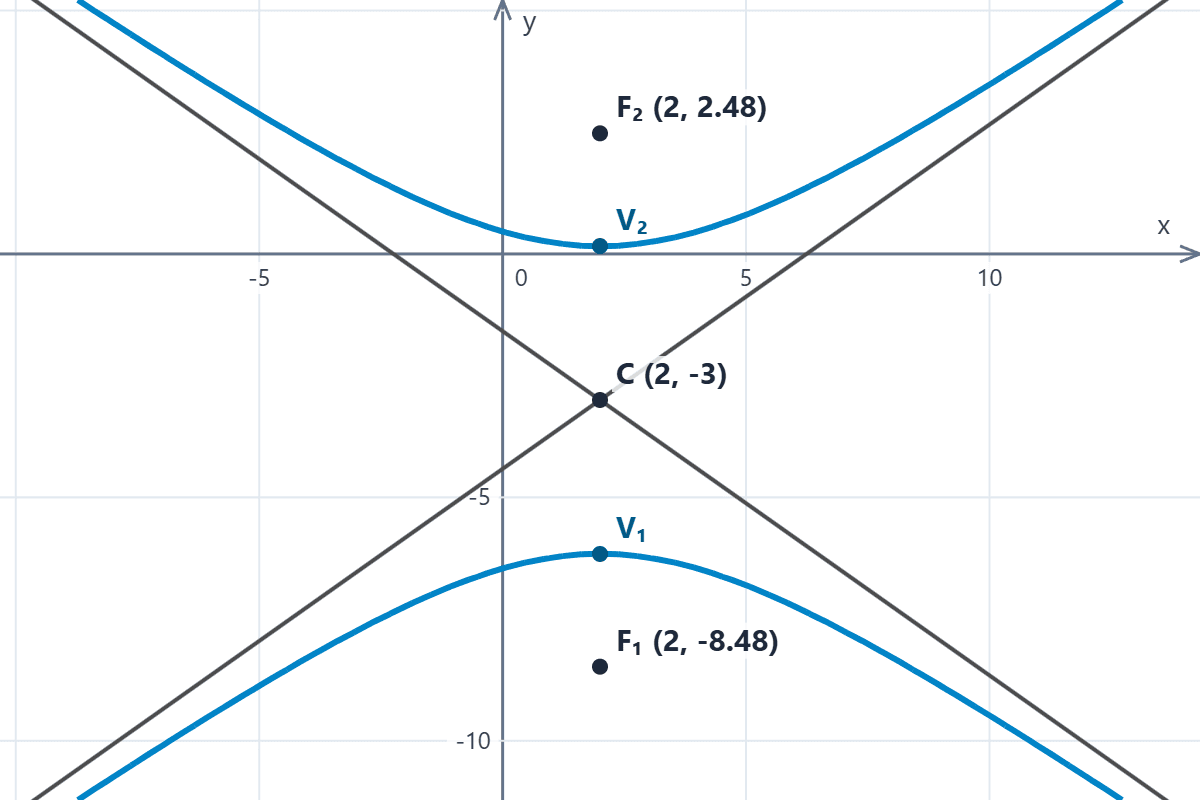
Calculate the elements of the hyperbola with center not at the origin \( \dfrac{(y+3)^2}{10}-\dfrac{(x-2)^2}{20}=1. \)
Equations
Equation in standard form
Equation in general form
Hyperbola elements
Orientation: Vertical (transverse axis parallel to the y-axis, branches opening up and down).
Center: \( C \left(2, -3\right) \)
Foci
Vertices (endpoints of the transverse axis)
Co-vertices (endpoints of the conjugate axis)
Equations of the asymptotes
Semi-transverse axis: \( a = \sqrt{10} \approx 3.16 \)
Semi-conjugate axis: \( b = 2 \sqrt{5} \approx 4.47 \)
Focal distance: \( c = \sqrt{30} \approx 5.48 \)
Latus rectum: \( L_R = \dfrac{40}{\sqrt{10}} \approx 12.65 \)
Eccentricity: \( e = \dfrac{\sqrt{30}}{\sqrt{10}} \approx 1.73 \)
Axes of symmetry: \( x = 2, \quad y = -3 \)
x-intercepts
There are no real intercepts.
y-intercepts
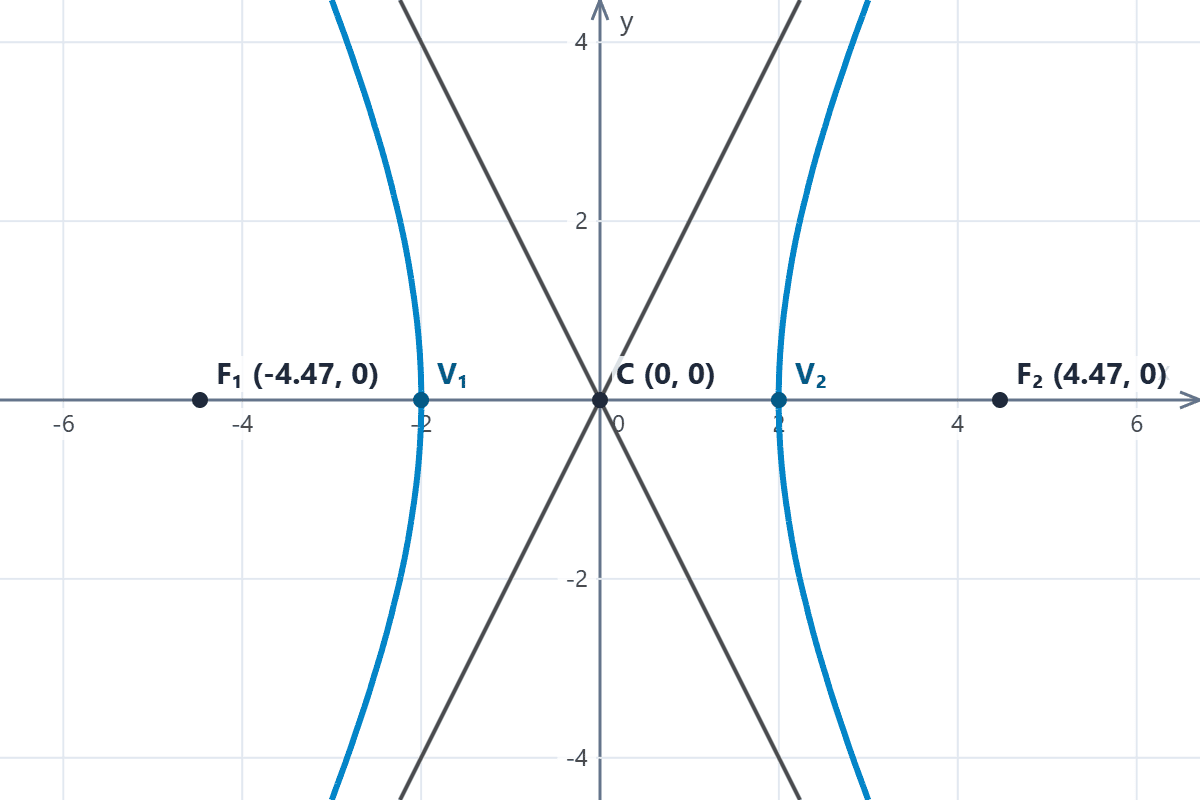
Obtain the standard form and the elements of the hyperbola \( 4x^2-y^2=16. \)
Equations
Equation in standard form
Equation in general form
Elements
Orientation: Horizontal (transverse axis parallel to the x-axis, branches opening left and right).
Center: \( C \left(0, 0\right) \)
Foci
Vertices (endpoints of the transverse axis)
Co-vertices (endpoints of the conjugate axis)
Asymptotes
Semi-transverse axis: \( a = 2 \)
Semi-conjugate axis: \( b = 4 \)
Focal distance: \( c = 2 \sqrt{5} \approx 4.47 \)
Latus rectum: \( L_R = 16 \)
Eccentricity: \( e = \sqrt{5} \approx 2.24 \)
Axes of symmetry: \( x = 0, \quad y = 0 \)
x-intercepts
y-intercepts
There are no real intercepts.
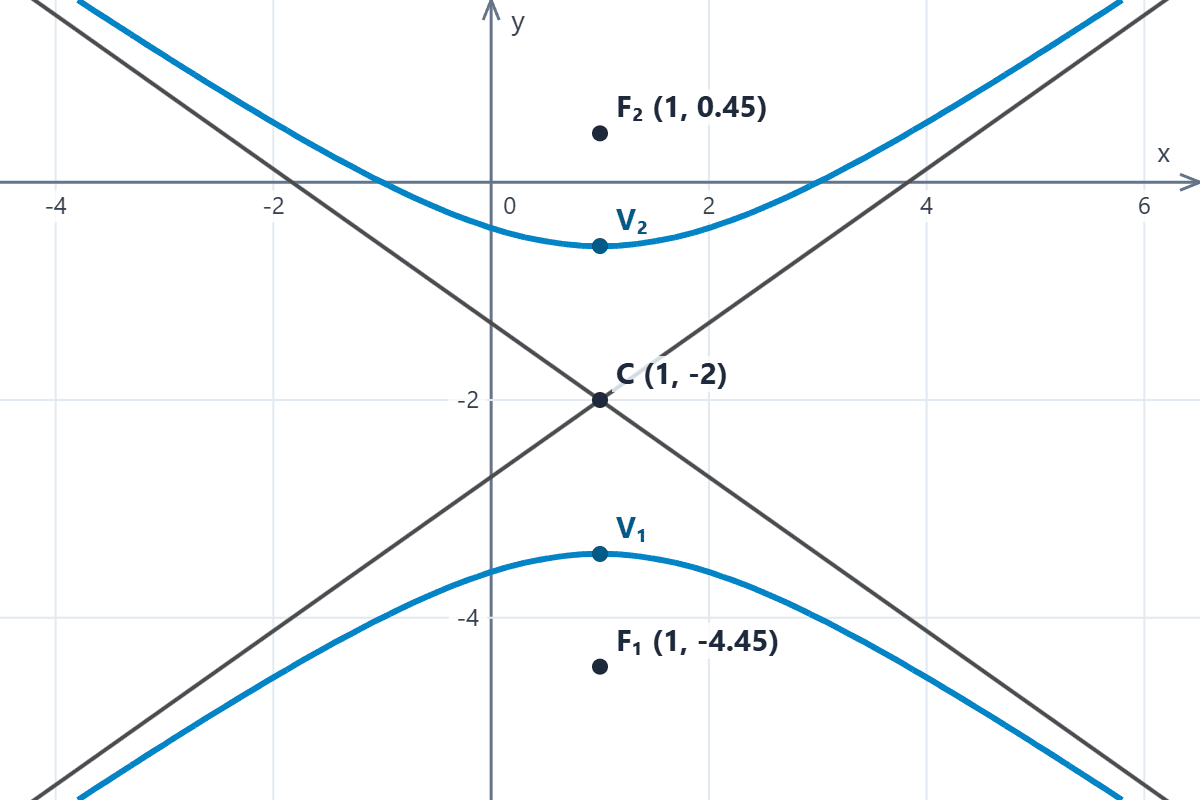
Calculate the equation in standard form of the hyperbola \( 2y^2-x^2+2x+8y+3=0 \) and its elements.
Hyperbola equations
Equation in standard form
Equation in general form
Elements
Orientation: Vertical (transverse axis parallel to the y-axis, branches opening up and down).
Center: \( C \left(1, -2\right) \)
Foci
Vertices (endpoints of the transverse axis)
Co-vertices (endpoints of the conjugate axis)
Equations of the asymptotes
Semi-transverse axis: \( a = \sqrt{2} \approx 1.41 \)
Semi-conjugate axis: \( b = 2 \)
Focal distance: \( c = \sqrt{6} \approx 2.45 \)
Latus rectum: \( L_R = \dfrac{8}{\sqrt{2}} \approx 5.66 \)
Eccentricity: \( e = \dfrac{\sqrt{6}}{\sqrt{2}} \approx 1.73 \)
Axes of symmetry: \( x = 1, \quad y = -2 \)
x-intercepts
y-intercepts
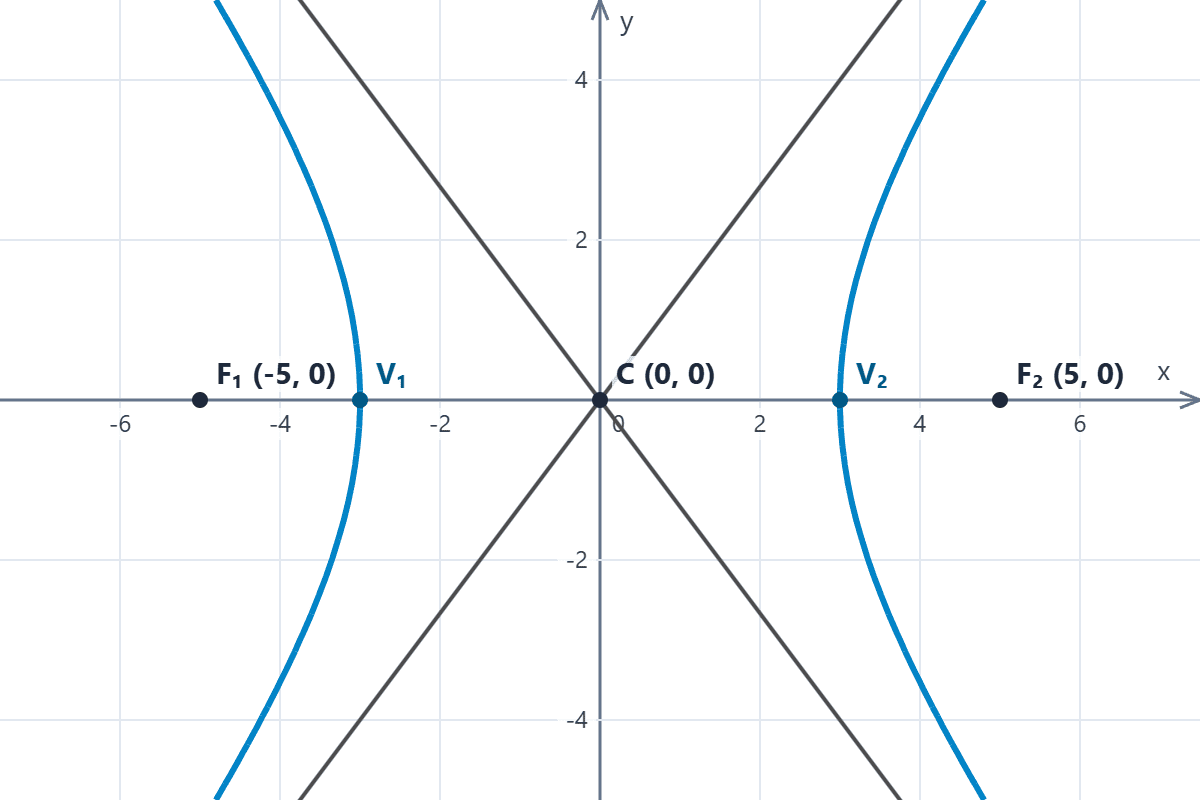
Find the equations and elements of the hyperbola with foci at (±5, 0) and a vertex at (3, 0).
Equations
Equation in standard form
Equation in general form
Hyperbola elements
Orientation: Horizontal (transverse axis parallel to the x-axis, branches opening left and right).
Center: \( C \left(0, 0\right) \)
Foci
Vertices (endpoints of the transverse axis)
Co-vertices (endpoints of the conjugate axis)
Asymptotes
Semi-transverse axis: \( a = 3 \)
Semi-conjugate axis: \( b = 4 \)
Focal distance: \( c = 5 \)
Latus rectum: \( L_R = \dfrac{32}{3} \approx 10.67 \)
Eccentricity: \( e = \dfrac{5}{3} \approx 1.67 \)
Axes of symmetry: \( x = 0, \quad y = 0 \)
x-intercepts
y-intercepts
There are no real intercepts.
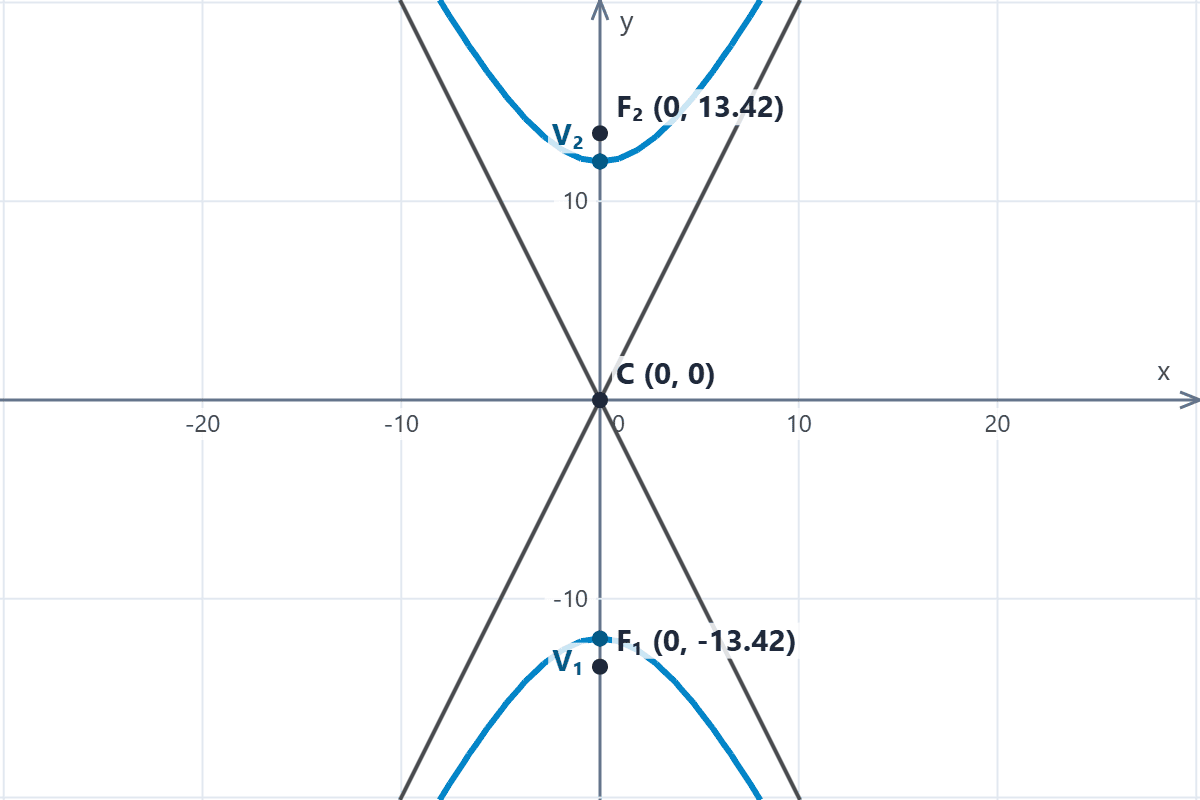
Determine the equations and elements of the hyperbola with vertices at (0, ±12) and asymptote y = -2x.
Equations
Equation in standard form
Equation in general form
Elements
Orientation: Vertical (transverse axis parallel to the y-axis, branches opening up and down).
Center: \( C \left(0, 0\right) \)
Foci
Vertices (endpoints of the transverse axis)
Co-vertices (endpoints of the conjugate axis)
Equation of the asymptotes
Semi-transverse axis: \( a = 12 \)
Semi-conjugate axis: \( b = 6 \)
Focal distance: \( c = 6 \sqrt{5} \approx 13.42 \)
Latus rectum: \( L_R = 6 \)
Eccentricity: \( e = \dfrac{\sqrt{5}}{2} \approx 1.12 \)
Axes of symmetry: \( x = 0, \quad y = 0 \)
x-intercepts
There are no real intercepts.
y-intercepts
Related Tools
