
Ellipse Equation and Graph Calculator
Enter the ellipse equation or the known data to get its equations (standard and general forms), its elements (center, foci, vertices, semi-axes, latus rectum, eccentricity, area, etc.), and its graph.
Quick Examples
How to Use the Calculator
This online ellipse calculator is a geometry solver that not only gives you the final answer but also generates the step-by-step solution, works with exact fractions or roots, and acts as an interactive graph calculator to plot the curve.
Use the main selector to tell the system what data you know about your problem. The supported finding modes are as follows:
- Ellipse equation: The engine is ready to work with equations in any of their forms. You don't need to format it or write it in a specific order; you can enter the general form, the standard form, or unsimplified and jumbled expressions. The calculator will take care of grouping terms and completing the square automatically, acting as an equation converter.
- Center and axes (or semi-axes): Enter the center coordinates and the lengths associated with the axes. Mixed data combinations are allowed: major axis (2a) and semi-minor axis (b), semi-major axis (a) and minor axis (2b), or both semi-axes. In this mode, you must indicate the orientation of the ellipse (horizontal or vertical) in the additional selector.
- Center, one focus, and one vertex: Enter the coordinates of these three points. The algorithm will automatically detect the orientation of the ellipse by checking if they share the x or y coordinate. You can explicitly select whether the given vertex is a vertex (on the focal axis) or a co-vertex (on the minor axis).
- Center, vertex, and co-vertex: By entering these three points, the solver will validate the perpendicularity of the axes, calculate distances 'a' and 'b', and instantly deduce which way the focal axis is oriented.
- Foci and one point on the ellipse: Based on the pure geometric definition of the ellipse, the finder will add the distances from point P to each of the foci to find the constant 2a (length of the major axis) and build the equation.
- Foci and vertex: The center will be calculated analytically as the midpoint of the foci. Just like in other modes, you can specify via a drop-down menu whether the vertex provided by your problem is a vertex or a co-vertex.
- Foci and axis (or semi-axis): Enter both foci and choose from the menu which magnitude data you have: the full major axis, the semi-major axis, the minor axis, or the semi-minor axis. The equation generator will use the fundamental relationship a2 = b2 + c2 to solve for the missing variable.
- Four points: A useful feature for college-level problems. Enter the coordinates of four non-collinear points that the curve passes through. The solver will evaluate the system and find the equation of the conic section.
Regardless of the input method you use, the algorithm will geometrically analyze the figure to provide you with a comprehensive report that includes: the general form equation of the ellipse, the standard form equation, center coordinates (h, k), coordinates of the two foci, vertices, co-vertices, lengths of the semi-axes (a and b), focal distance (c), axes of symmetry, latus rectum, eccentricity, x and y-intercepts, area, and perimeter.
Note: All input fields support the use of integers, decimals, and exact fractions. Irrational roots will be preserved symbolically during the step-by-step resolution to avoid rounding errors.
Step-by-Step Examples
The following are examples of problems completely solved by the ellipse calculator in its different finding modes.
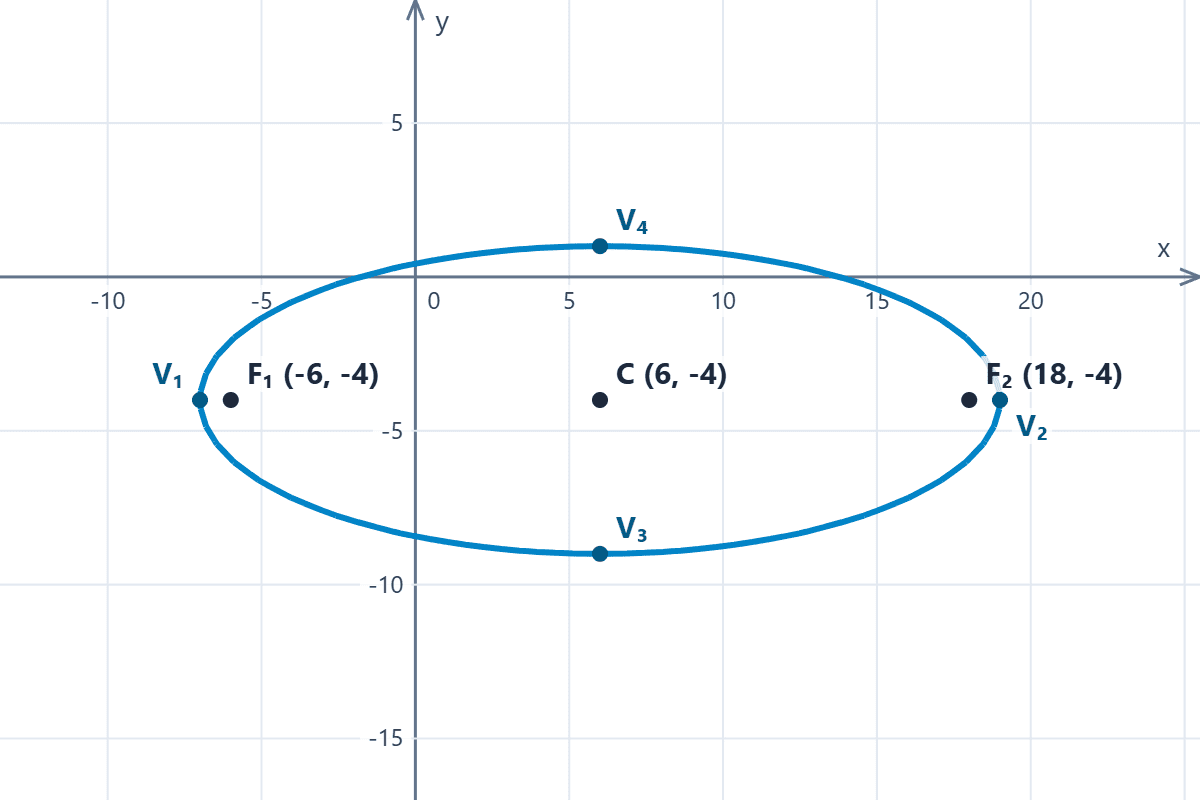
Determine the equation of the ellipse with foci (18,−4) and (−6,−4), and co-vertices (6,1) and (6,−9).
Ellipse equations
Standard form
General form
Step-by-step solution
Initial data
The problem data are:
- Foci: \( (18, -4), \quad (-6, -4) \)
- Co-vertex: \( (6, 1) \)
1. Identify the orientation of the ellipse
Since the foci have the same y coordinate, the ellipse is horizontal.
2. Calculate the center
The center C(h, k) is the midpoint of the segment connecting the two foci:
3. Calculate the focal distance (c)
The focal distance c is half the distance between the two foci:
4. Calculate the semi-minor axis (b)
The distance from the center to the co-vertex gives us b:
5. Find the missing parameter using the fundamental relationship
Knowing b and c, we calculate the square of the semi-major axis a2 using the relationship a2 = b2 + c2:
6. Build the standard form equation
We already have the key parameters of the ellipse, which are the coordinates of the center C(h, k) and the squares of the semi-axes:
We substitute them into the standard form of the horizontal ellipse and simplify if necessary:
Note: The equation generator tool has been used in the "foci and vertex (or co-vertex)" mode. Given the foci, only one of the co-vertices is necessary to determine an ellipse. In this case, the problem gives us both co-vertices; we can use either of them.
Ellipse elements
Orientation: Horizontal (major axis parallel to the x-axis).
Center: \( C \left(6, -4\right) \)
Foci
Vertices
Co-vertices
Semi-major axis: \( a = 13 \)
Semi-minor axis: \( b = 5 \)
Focal distance (c): \( c = 12 \)
Latus rectum: \( L_R = \dfrac{50}{13} \approx 3.85 \)
Eccentricity: \( e = \dfrac{12}{13} \approx 0.92 \)
Axes of symmetry: \( x = 6, \quad y = -4 \)
Area: \( A = 65 \pi \approx 204.20 \)
Perimeter: \( P \approx 59.38 \)
x-intercepts
y-intercepts
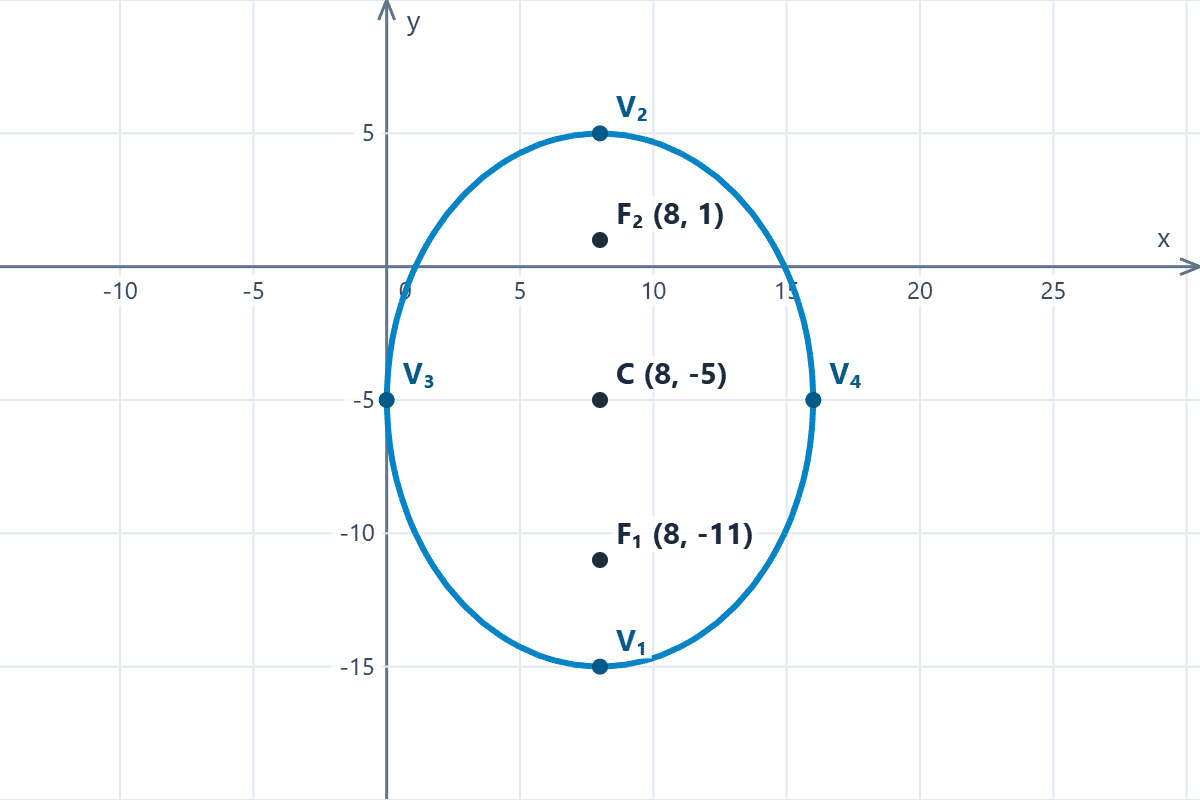
Determine the equation of the ellipse with center (8,−5), a focus at (8,−11), and a vertex at (8,−15).
Ellipse equations
Standard form
General form
Step-by-step solution
Initial data
The problem data are:
- Center: \( (8, -5) \)
- Focus: \( (8, -11) \)
- Vertex: \( (8, -15) \)
1. Identify the orientation of the ellipse
Since the center and focus have the same x coordinate, the ellipse is vertical.
2. Calculate the focal distance (c)
The distance from the center C to either focus F gives us the focal distance c:
3. Calculate the semi-major axis (a)
The distance from the center to the vertex gives us a:
4. Find the missing parameter using the fundamental relationship
Knowing a and c, we calculate the square of the semi-minor axis b2 using the relationship b2 = a2 - c2:
5. Build the standard form equation
We already have the key parameters of the ellipse, which are the coordinates of the center C(h, k) and the squares of the semi-axes:
We substitute them into the standard form of the vertical ellipse and simplify if necessary:
Ellipse elements
Orientation: Vertical (major axis parallel to the y-axis).
Center: \( C \left(8, -5\right) \)
Foci
Vertices
Co-vertices
Semi-major axis: \( a = 10 \)
Semi-minor axis: \( b = 8 \)
Focal distance (c): \( c = 6 \)
Latus rectum: \( L_R = \dfrac{64}{5} = 12.8 \)
Eccentricity: \( e = \dfrac{3}{5} = 0.6 \)
Axes of symmetry: \( x = 8, \quad y = -5 \)
Area: \( A = 80 \pi \approx 251.33 \)
Perimeter: \( P \approx 56.72 \)
x-intercepts
y-intercepts
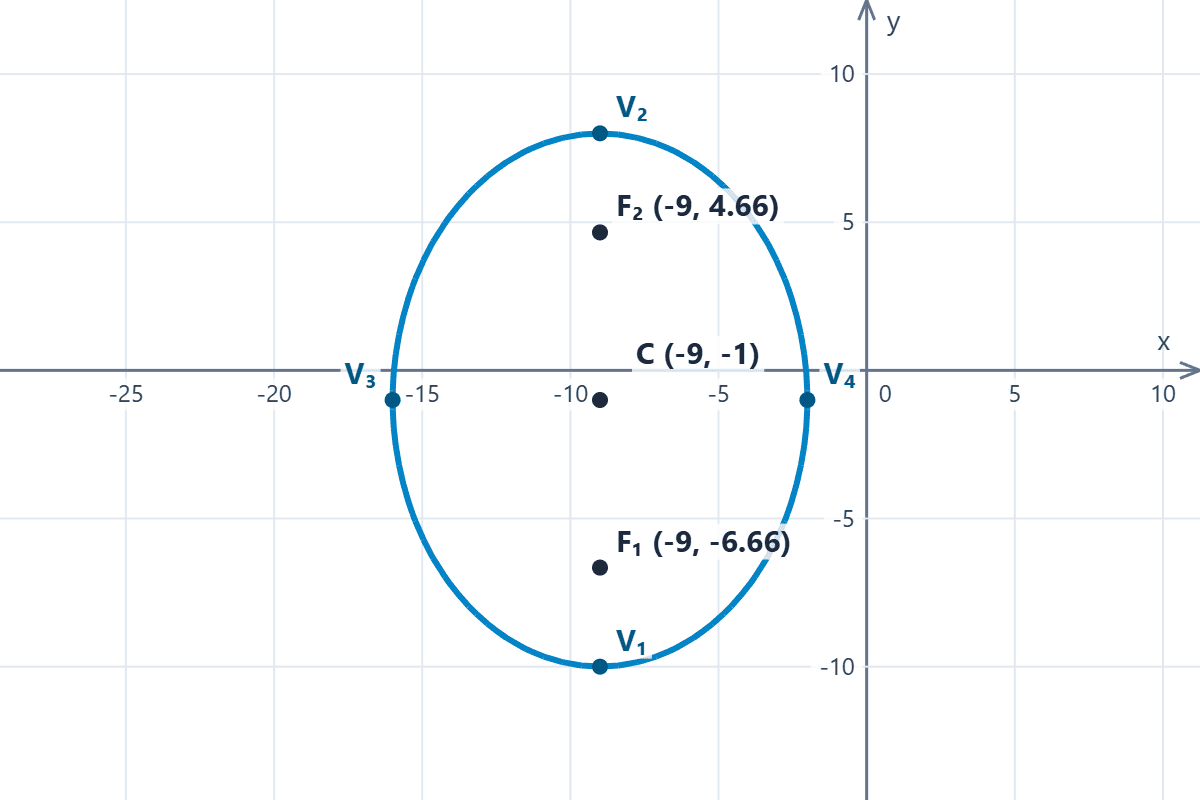
Determine the equation of the ellipse with center (−9,−1), a vertex at (−9,−10), and a co-vertex at (−16,−1).
Ellipse equations
Standard form
General form
Step-by-step solution
Initial data
The problem data are:
- Center: \( (-9, -1) \)
- Vertex: \( (-9, -10) \)
- Co-vertex: \( (-16, -1) \)
1. Identify the orientation of the ellipse
The vertex and the center share the x coordinate; therefore, the ellipse is vertical.
2. Calculate the semi-major axis (a)
The distance from the center to the vertex gives us a:
3. Calculate the semi-minor axis (b)
The distance from the center to the co-vertex gives us b:
4. Build the standard form equation
We already have the key parameters of the ellipse, which are the coordinates of the center C(h, k) and the squares of the semi-axes:
We substitute them into the standard form of the vertical ellipse and simplify if necessary:
Ellipse elements
Orientation: Vertical (major axis parallel to the y-axis).
Center: \( C \left(-9, -1\right) \)
Foci
Vertices
Co-vertices
Semi-major axis: \( a = 9 \)
Semi-minor axis: \( b = 7 \)
Focal distance (c): \( c = 4 \sqrt{2} \approx 5.66 \)
Latus rectum: \( L_R = \dfrac{98}{9} \approx 10.89 \)
Eccentricity: \( e = \dfrac{4 \sqrt{2}}{9} \approx 0.63 \)
Axes of symmetry: \( x = -9, \quad y = -1 \)
Area: \( A = 63 \pi \approx 197.92 \)
Perimeter: \( P \approx 50.46 \)
x-intercepts
y-intercepts
There are no real intercepts.
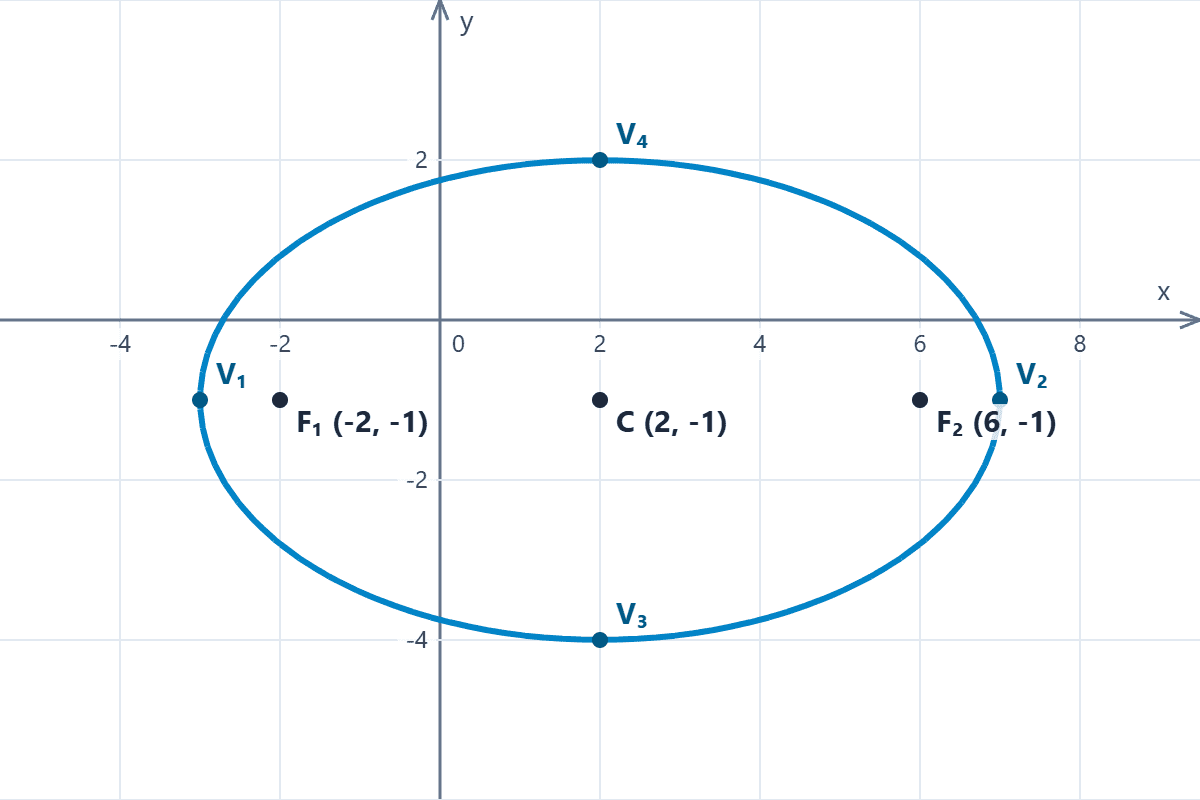
Find the equations and elements of the horizontal ellipse with center at C(2, -1), major axis 10, and minor axis 6.
Ellipse equations
Standard form
General form
Step-by-step solution
Initial data
The problem data are:
- Center: \( (2, -1) \)
- Major axis: \( 2a = 10 \to a = 5 \to a^2 = 25 \)
- Minor axis: \( 2b = 6 \to b = 3 \to b^2 = 9 \)
1. Identify the orientation of the ellipse
The problem indicates that the orientation of the ellipse is horizontal.
2. Build the standard form equation
We already have the key parameters of the ellipse, which are the coordinates of the center C(h, k) and the squares of the semi-axes:
We substitute them into the standard form of the horizontal ellipse and simplify if necessary:
Elements
Orientation: Horizontal (major axis parallel to the x-axis).
Center: \( C \left(2, -1\right) \)
Foci
Vertices
Co-vertices
Semi-major axis: \( a = 5 \)
Semi-minor axis: \( b = 3 \)
Focal distance (c): \( c = 4 \)
Latus rectum: \( L_R = \dfrac{18}{5} = 3.6 \)
Eccentricity: \( e = \dfrac{4}{5} = 0.8 \)
Axes of symmetry: \( x = 2, \quad y = -1 \)
Area: \( A = 15 \pi \approx 47.12 \)
Perimeter: \( P \approx 25.53 \)
x-intercepts
y-intercepts
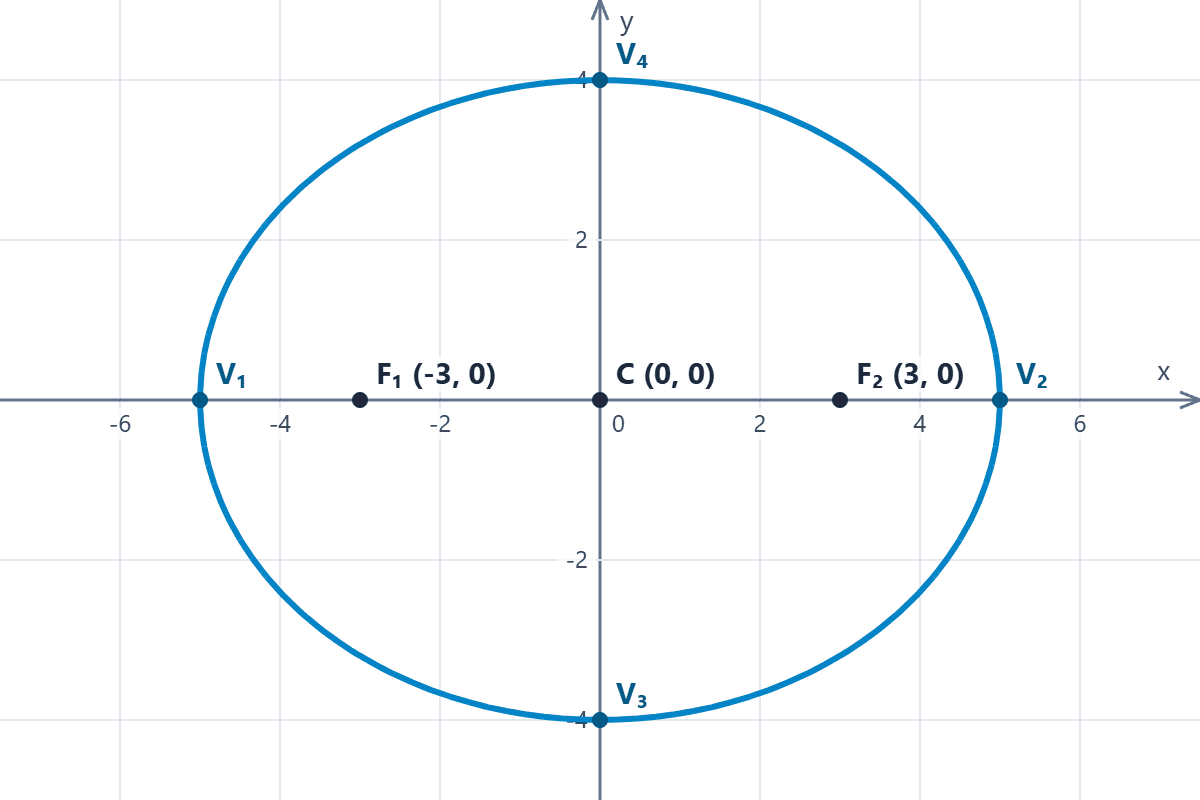
Find the standard form of the equation of the ellipse with the given characteristics: foci at (±3, 0) and point (0, 4).
Equations
Standard form
General form
Step-by-step solution
Initial data
The problem data are:
- Foci: \( (-3, 0), \quad (3, 0) \)
- Point: \( (0, 4) \)
1. Identify the orientation of the ellipse
Since the foci have the same y coordinate, the ellipse is horizontal.
2. Calculate the center
The center C(h, k) is the midpoint of the segment connecting the two foci:
3. Calculate the focal distance (c)
The focal distance c is half the distance between the two foci:
4. Calculate the semi-major axis (a)
The sum of the distances from point P to the two foci is always equal to 2a:
5. Find the missing parameter using the fundamental relationship
Knowing a and c, we calculate the square of the semi-minor axis b2 using the relationship b2 = a2 - c2:
6. Build the standard form equation
We already have the key parameters of the ellipse, which are the coordinates of the center C(h, k) and the squares of the semi-axes:
We substitute them into the standard form of the horizontal ellipse and simplify if necessary:
Elements
Orientation: Horizontal (major axis parallel to the x-axis).
Center: \( C \left(0, 0\right) \)
Foci
Vertices
Co-vertices
Semi-major axis: \( a = 5 \)
Semi-minor axis: \( b = 4 \)
Focal distance (c): \( c = 3 \)
Latus rectum: \( L_R = \dfrac{32}{5} = 6.4 \)
Eccentricity: \( e = \dfrac{3}{5} = 0.6 \)
Axes of symmetry: \( x = 0, \quad y = 0 \)
Area: \( A = 20 \pi \approx 62.83 \)
Perimeter: \( P \approx 28.36 \)
x-intercepts
y-intercepts
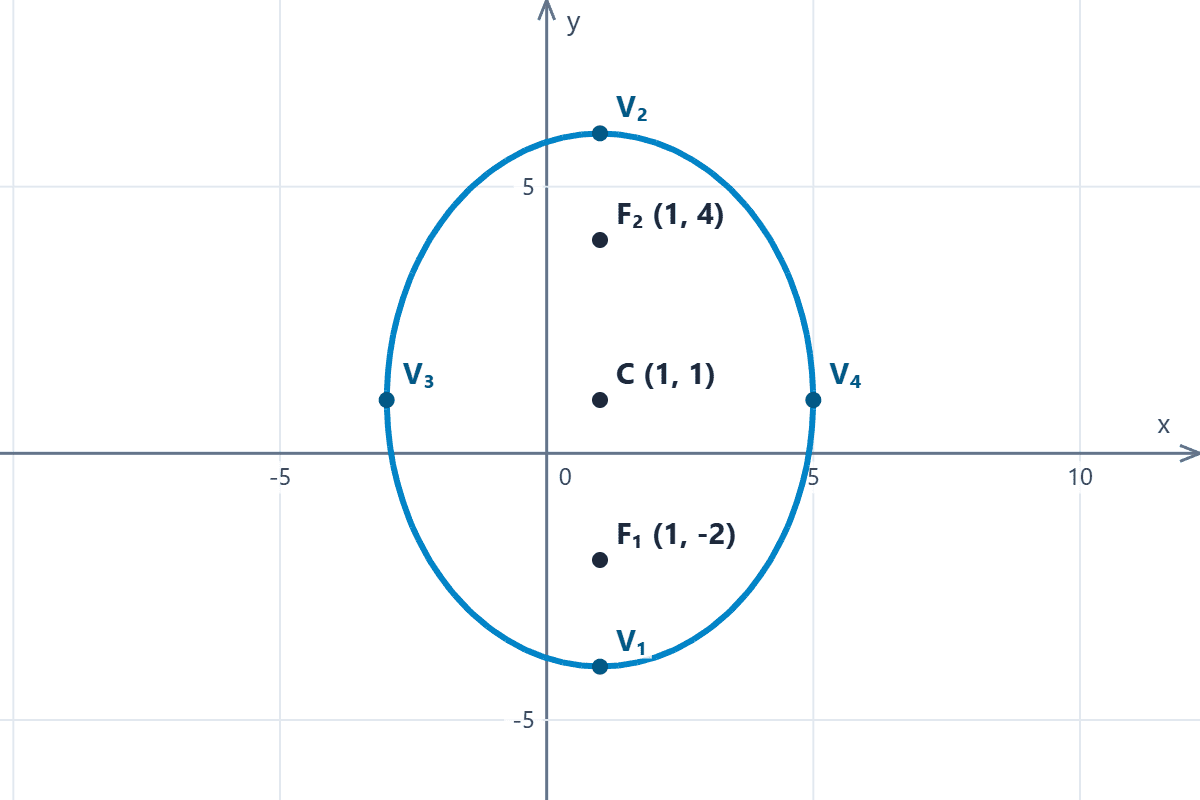
Determine the equations and elements of the ellipse with foci at (1, -2) and (1, 4), and vertex at (1, 6).
Ellipse equations
Standard form
General form
Step-by-step solution
Initial data
The problem data are:
- Foci: \( (1, -2), \quad (1, 4) \)
- Vertex: \( (1, 6) \)
1. Identify the orientation of the ellipse
Since the foci have the same x coordinate, the ellipse is vertical.
2. Calculate the center
The center C(h, k) is the midpoint of the segment connecting the two foci:
3. Calculate the focal distance (c)
The focal distance c is half the distance between the two foci:
4. Calculate the semi-major axis (a)
The distance from the center to the vertex gives us a:
5. Find the missing parameter using the fundamental relationship
Knowing a and c, we calculate the square of the semi-minor axis b2 using the relationship b2 = a2 - c2:
6. Build the standard form equation
We already have the key parameters of the ellipse, which are the coordinates of the center C(h, k) and the squares of the semi-axes:
We substitute them into the standard form of the vertical ellipse and simplify if necessary:
Ellipse elements
Orientation: Vertical (major axis parallel to the y-axis).
Center: \( C \left(1, 1\right) \)
Foci
Vertices
Co-vertices
Semi-major axis: \( a = 5 \)
Semi-minor axis: \( b = 4 \)
Focal distance (c): \( c = 3 \)
Latus rectum: \( L_R = \dfrac{32}{5} = 6.4 \)
Eccentricity: \( e = \dfrac{3}{5} = 0.6 \)
Axes of symmetry: \( x = 1, \quad y = 1 \)
Area: \( A = 20 \pi \approx 62.83 \)
Perimeter: \( P \approx 28.36 \)
x-intercepts
y-intercepts
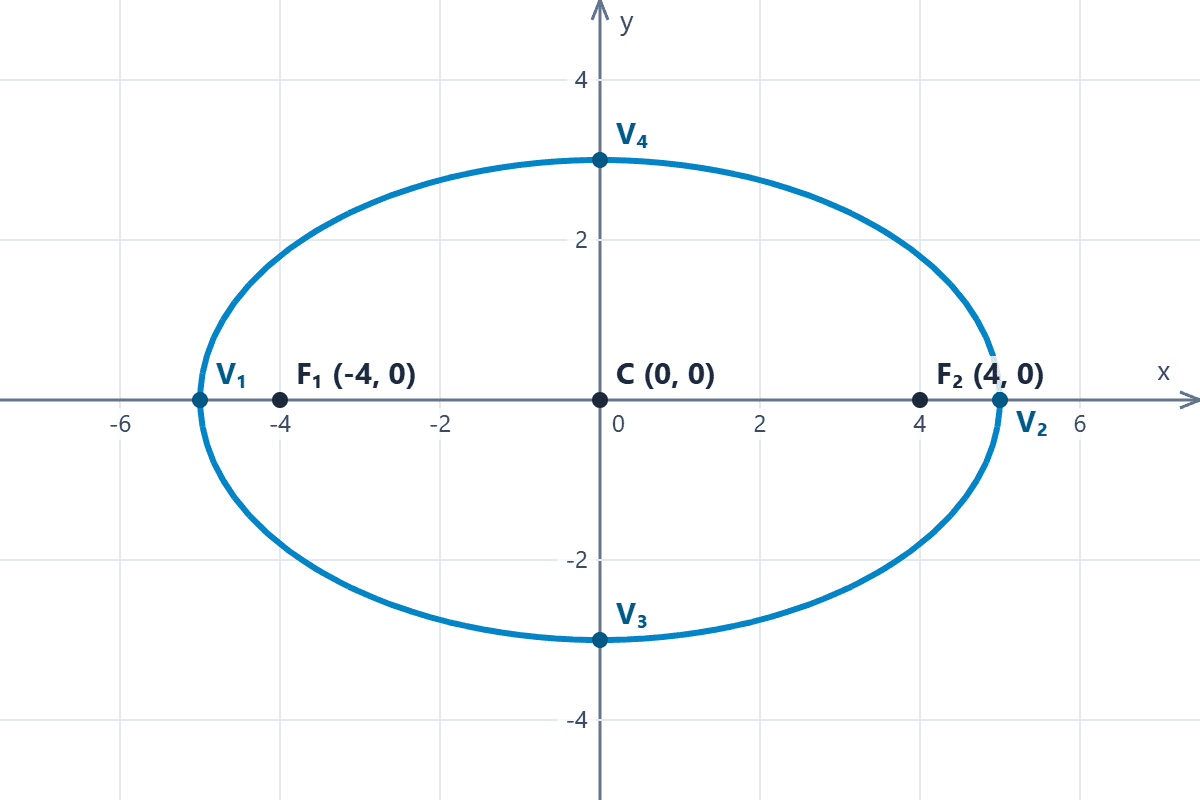
Determine the general form and the elements of the ellipse \( \dfrac{x^2}{25} + \dfrac{y^2}{9} = 1. \)
Ellipse equations
Equation in standard form
Equation in general form
Ellipse elements
Orientation: Horizontal (major axis parallel to the x-axis).
Center: \( C \left(0, 0\right) \)
Foci
Major vertices
Minor vertices (co-vertices)
Semi-major axis: \( a = 5 \)
Semi-minor axis: \( b = 3 \)
Focal distance: \( c = 4 \)
Latus rectum: \( L_R = \dfrac{18}{5} = 3.6 \)
Eccentricity: \( e = \dfrac{4}{5} = 0.8 \)
Axes of symmetry: \( x = 0, \quad y = 0 \)
Area: \( A = 15 \pi \approx 47.12 \)
Perimeter: \( P \approx 25.53 \)
x-intercepts
y-intercepts
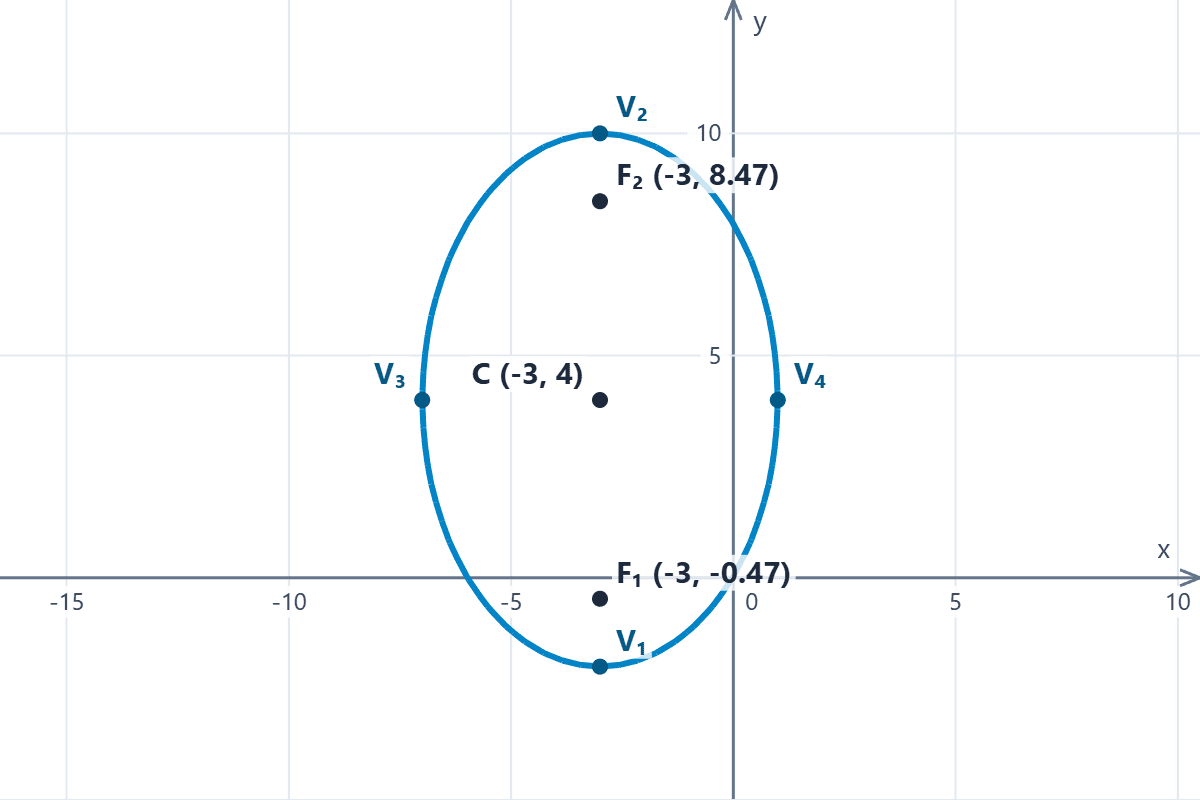
Calculate the elements of the ellipse with center not at the origin \( \dfrac{(x+3)^2}{16}+\dfrac{(y-4)^2}{36}=1. \)
Equations
Standard form
General form
Ellipse elements
Orientation: Vertical (major axis parallel to the y-axis).
Center: \( C \left(-3, 4\right) \)
Foci
Major vertices
Minor vertices (co-vertices)
Semi-major axis: \( a = 6 \)
Semi-minor axis: \( b = 4 \)
Focal distance: \( c = 2 \sqrt{5} \approx 4.47 \)
Latus rectum length: \( L_R = \dfrac{16}{3} \approx 5.33 \)
Eccentricity: \( e = \dfrac{\sqrt{5}}{3} \approx 0.75 \)
Axes of symmetry: \( x = -3, \quad y = 4 \)
Area of the ellipse: \( A = 24 \pi \approx 75.40 \)
Perimeter: \( P \approx 31.73 \)
x-intercepts
y-intercepts
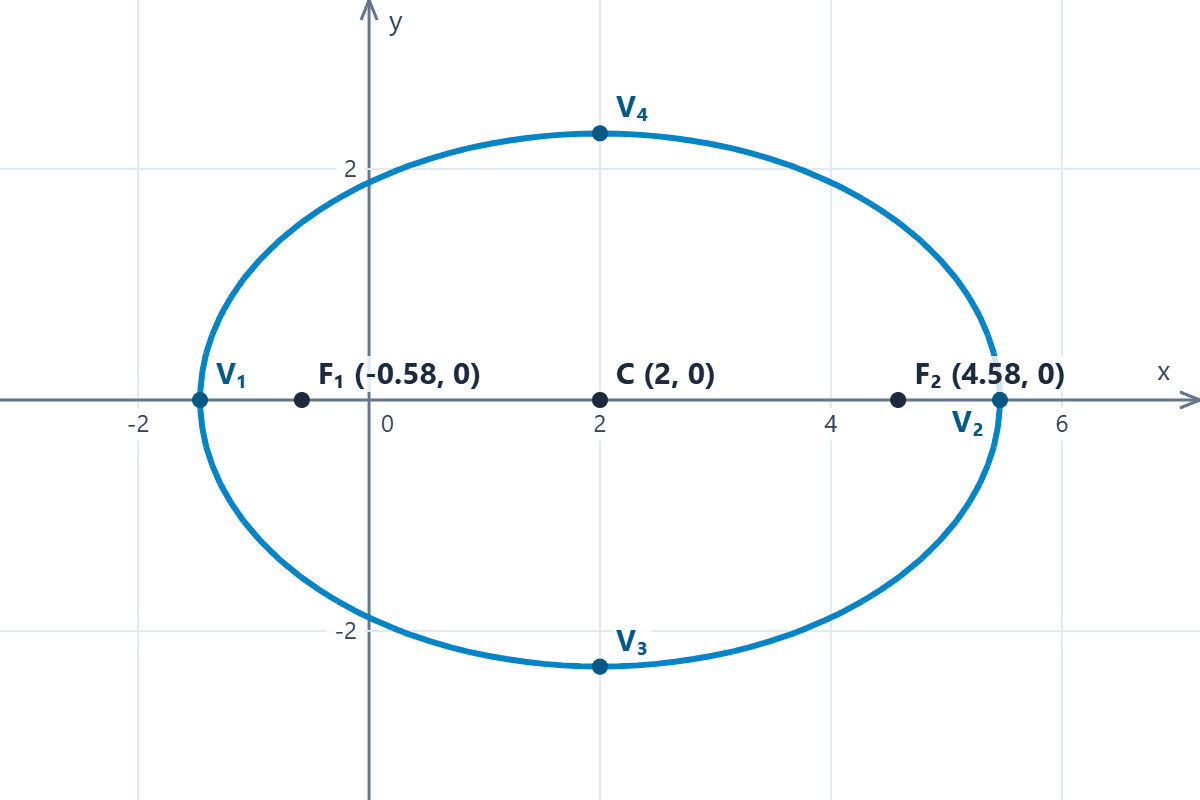
Obtain the elements and the standard form of the ellipse \( 4x^2+9y^2-16x-32=0. \)
Ellipse equations
Equation in standard form
Equation in general form
Elements
Orientation: Horizontal (major axis parallel to the x-axis).
Center: \( C \left(2, 0\right) \)
Foci
Major vertices
Minor vertices (co-vertices)
Semi-major axis: \( a = 2 \sqrt{3} \approx 3.46 \)
Semi-minor axis: \( b = \dfrac{4}{\sqrt{3}} \approx 2.31 \)
Focal distance: \( c = \dfrac{2 \sqrt{5}}{\sqrt{3}} \approx 2.58 \)
Latus rectum: \( L_R = \dfrac{16}{3 \sqrt{3}} \approx 3.08 \)
Eccentricity: \( e = \dfrac{\sqrt{5}}{3} \approx 0.75 \)
Axes of symmetry: \( x = 2, \quad y = 0 \)
Area: \( A = 8 \pi \approx 25.13 \)
Perimeter: \( P \approx 18.32 \)
x-intercepts
y-intercepts
Related Tools
