
Circle Equation from 3 Points Calculator
Enter the coordinates of the three points to get the equation of the circle passing through them (standard and general form), center, radius, and the step-by-step resolution with a graph.
Quick Examples
Solved Exercises
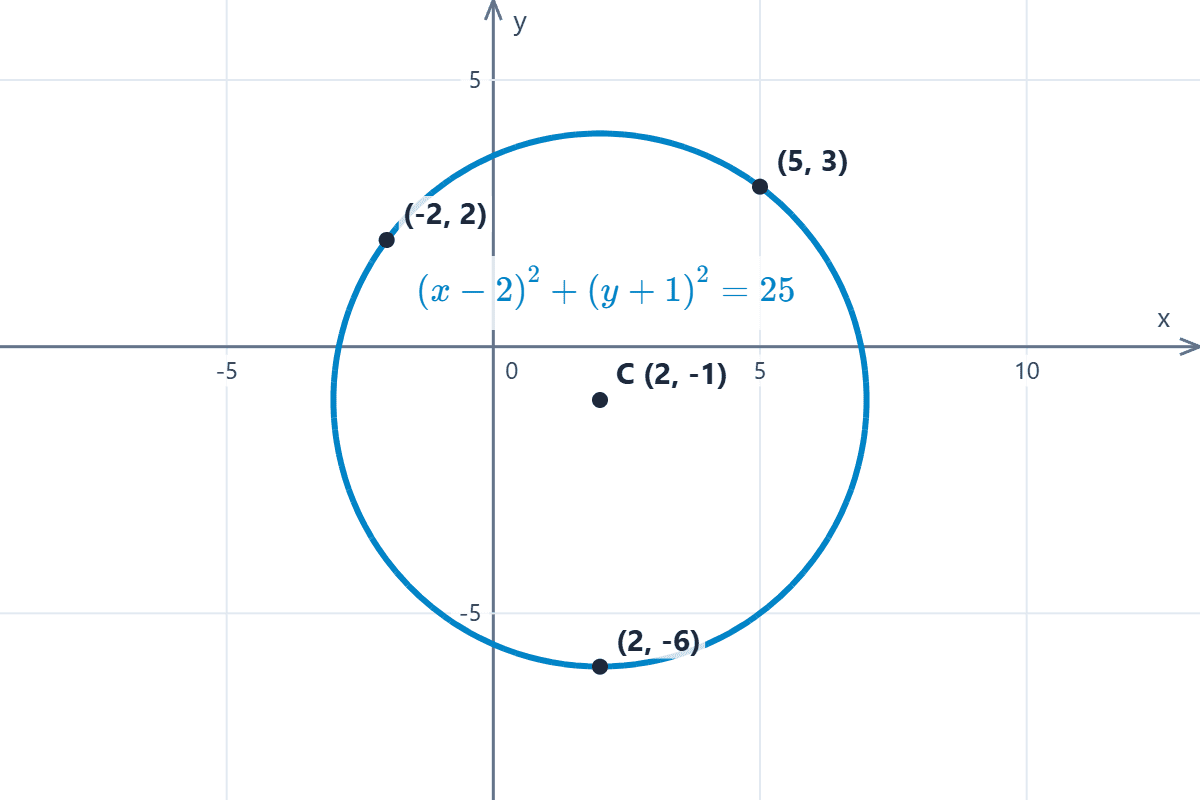
Find the equation, center, and radius of the circle given the 3 points (5, 3), (-2, 2) and (2, -6).
Answer
Standard form equation
General form equation
Center: \( C (2, -1) \)
Radius: \( r = 5 \)
Step-by-step resolution
1. Set up the system of equations.
The general form of the circle is:
We evaluate each given point \( (x, y) \) in the equation:
By simplifying and rearranging, we get the following system of 3 equations:
2. Solve the linear system (Cramer's rule).
We calculate the main determinant (\( \Delta \)) of the coefficients:
We calculate the determinants for each variable by replacing the corresponding column with the constant terms (-34, -8, -40):
We divide each determinant by \( \Delta \) to get the coefficients:
3. Determine the general form, the center, and the radius.
We substitute the found coefficients into the general form:
We calculate the center \( C(h, k) \) by dividing -D and -E by 2:
The center is \( C (2, -1) \).
With the center and the value of F, we apply the formula \( r = \sqrt{h^2 + k^2 - F} \):
Therefore, the radius is \( r = 5 \).
With these values, we can form the standard form of the circle:
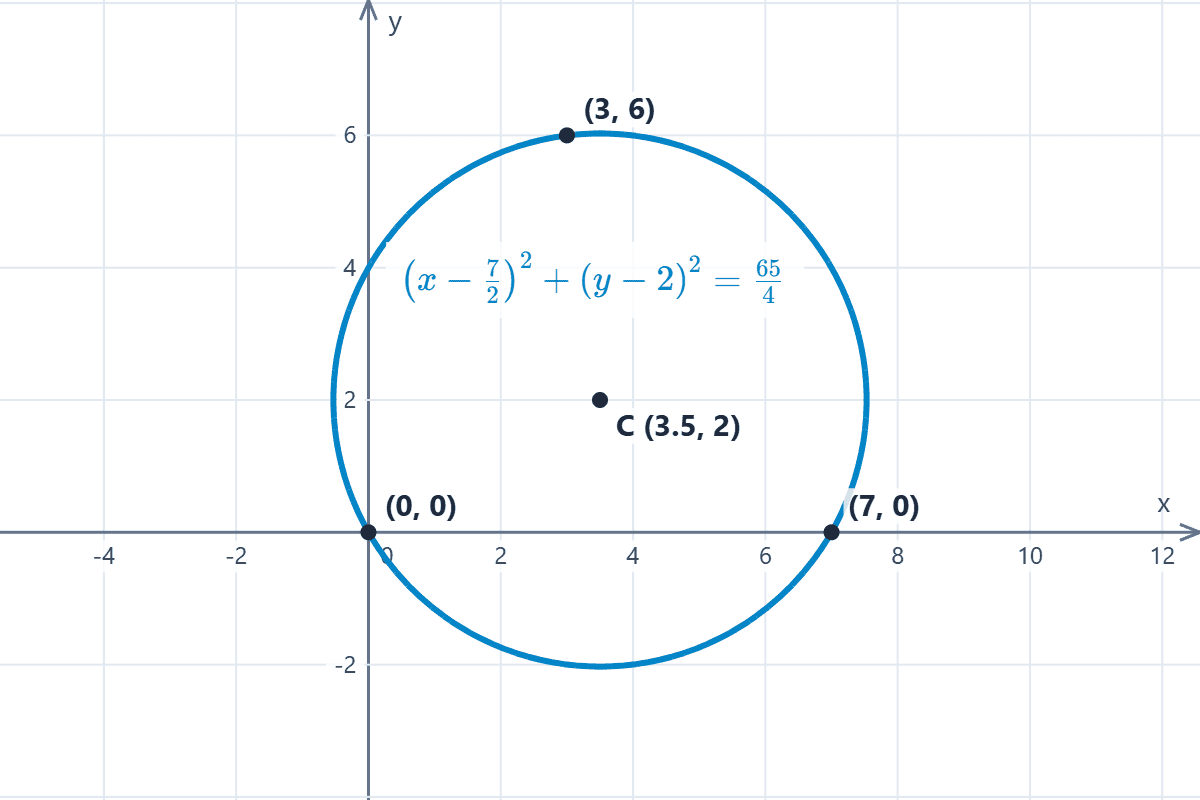
Determine the general and standard form equations of the circle given three of its points: (0, 0), (3, 6) and (7, 0).
Solution
Standard form equation
General form equation
Center: \( C \left(\dfrac{7}{2}, 2\right) = (3.5, 2) \)
Radius: \( r = \dfrac{\sqrt{5} \sqrt{13}}{2} \approx 4.03 \)
Step-by-step resolution
1. Set up the system of equations.
The general form of the circle is:
We evaluate each given point \( (x, y) \) in the equation:
By simplifying and rearranging, we get the following system of 3 equations:
2. Solve the linear system (Cramer's rule).
We calculate the main determinant (\( \Delta \)) of the coefficients:
We calculate the determinants for each variable by replacing the corresponding column with the constant terms (0, -45, -49):
We divide each determinant by \( \Delta \) to get the coefficients:
3. Determine the general form, the center, and the radius.
We substitute the found coefficients into the general form:
We calculate the center \( C(h, k) \) by dividing -D and -E by 2:
The center is \( C \left(\dfrac{7}{2}, 2\right) = (3.5, 2) \).
With the center and the value of F, we apply the formula \( r = \sqrt{h^2 + k^2 - F} \):
Therefore, the radius is \( r = \dfrac{\sqrt{5} \cdot \sqrt{13}}{2} \approx 4.03 \).
With these values, we can form the standard form of the circle:
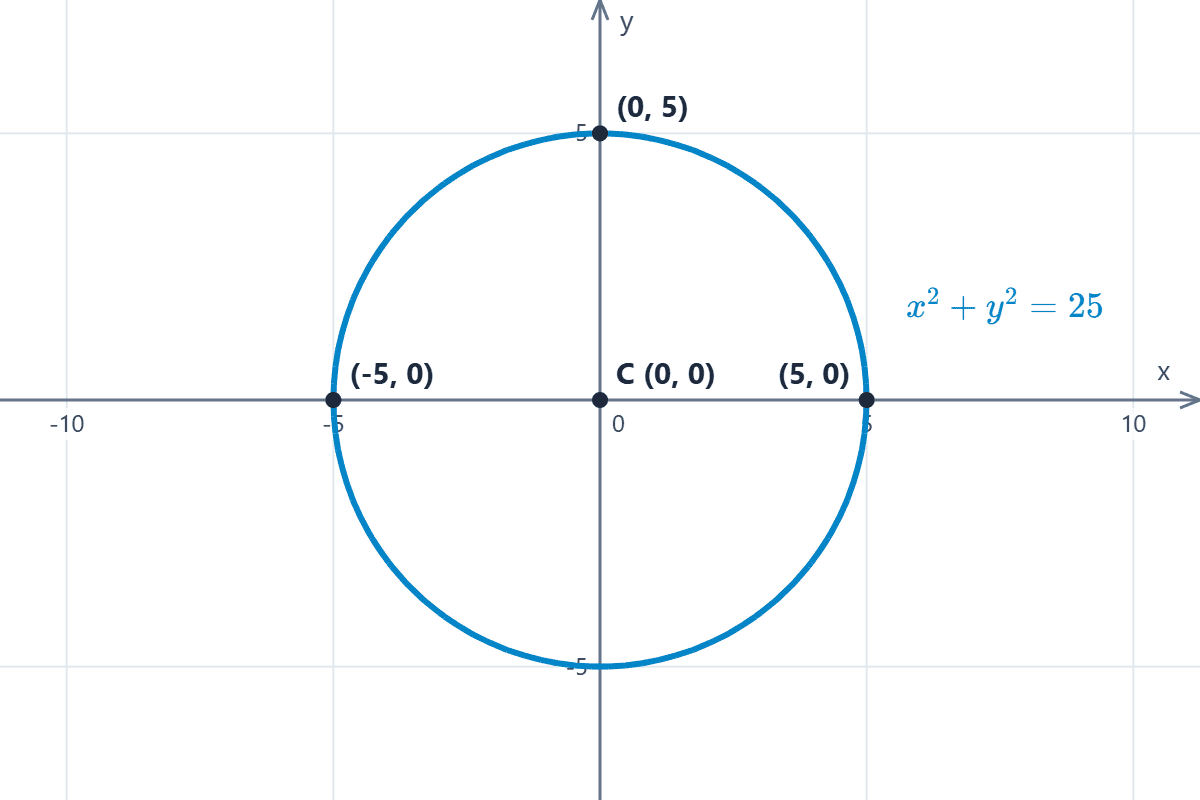
Calculate the equation of the circle passing through the three points (0, 5) (5, 0) and (-5, 0).
Results
Standard form
General form
Center: \( C (0, 0) \)
Radius: \( r = 5 \)
Step-by-step resolution
1. Set up the system of equations.
The general form of the circle is:
We evaluate each given point \( (x, y) \) in the equation:
By simplifying and rearranging, we get the following system of 3 equations:
2. Solve the linear system (Cramer's rule).
We calculate the main determinant (\( \Delta \)) of the coefficients:
We calculate the determinants for each variable by replacing the corresponding column with the constant terms (-25, -25, -25):
We divide each determinant by \( \Delta \) to get the coefficients:
3. Determine the general form, the center, and the radius.
We substitute the found coefficients into the general form:
We calculate the center \( C(h, k) \) by dividing -D and -E by 2:
The center is \( C (0, 0) \).
With the center and the value of F, we apply the formula \( r = \sqrt{h^2 + k^2 - F} \):
Therefore, the radius is \( r = 5 \).
With these values, we can form the standard form of the circle:
Related Tools
