
Intersection of Two Lines Calculator
Enter the equations of both lines to determine their point of intersection, see the step-by-step solution, and the Cartesian graph.
Result
Quick Examples
How to Use This Calculator
This online line intersection calculator is an algebraic tool that allows you to find the exact coordinates where two lines cross on a plane. Not only does this point of intersection solver deliver the direct answer, but it also details the step-by-step procedure and graphs the result.
To use this finder, follow these steps:
- Select the equation form: Use the dropdown menu to indicate the format in which you will enter your data. The system allows you to work with the equations in their general form (Ax + By + C = 0) or slope-intercept form (y = mx + b). Mixed cases are also supported (one general and one slope-intercept).
- Enter the coefficients: Once the format is chosen, input the corresponding values for each line into the input fields. You can use integers, decimals, or exact fractions.
- Main result: Upon processing the data, the solver will instantly show you a box with the exact (x, y) coordinates of the point of intersection. If the lines are parallel or coincident, the system will notify you.
- Step-by-step resolution: Below the final result, you will find the complete analytical breakdown. The algorithm will arrange the entered equations to set up a 2x2 system of linear equations. Then, it will solve the system using Cramer's rule to find the final coordinates.
- Interactive graph: An interactive Cartesian plane will be generated at the bottom of the page. There, you can visualize the plotting of both lines, zoom in or out, and visually verify how both lines cross exactly at the calculated point of intersection.
Solved Exercises
See some examples of problems solved directly with the tool.
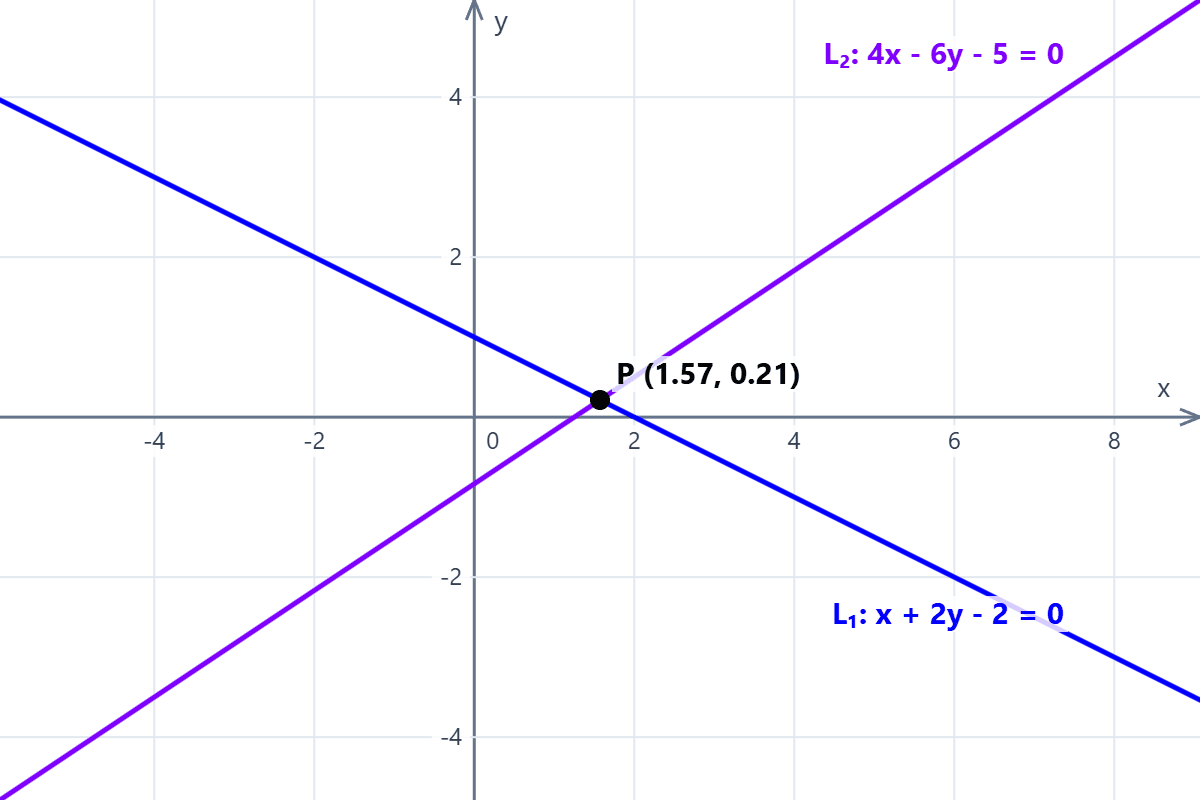
Determine the intersection of x+2y=2 and 4x-6y=5.
Result
The point of intersection of the given lines is:
Step-by-Step Solution
1. Set up the system of equations
The point of intersection, if it exists, is the solution to the following 2x2 system of linear equations. To solve it, we will apply Cramer's Rule.
2. Calculate the main determinant (Δ) and the secondary determinants (Δx and Δy)
Since the main determinant is non-zero (Δ ≠ 0), the system has a unique solution.
3. Find the coordinates of the point of intersection
We apply Cramer's rule to obtain the final coordinates:
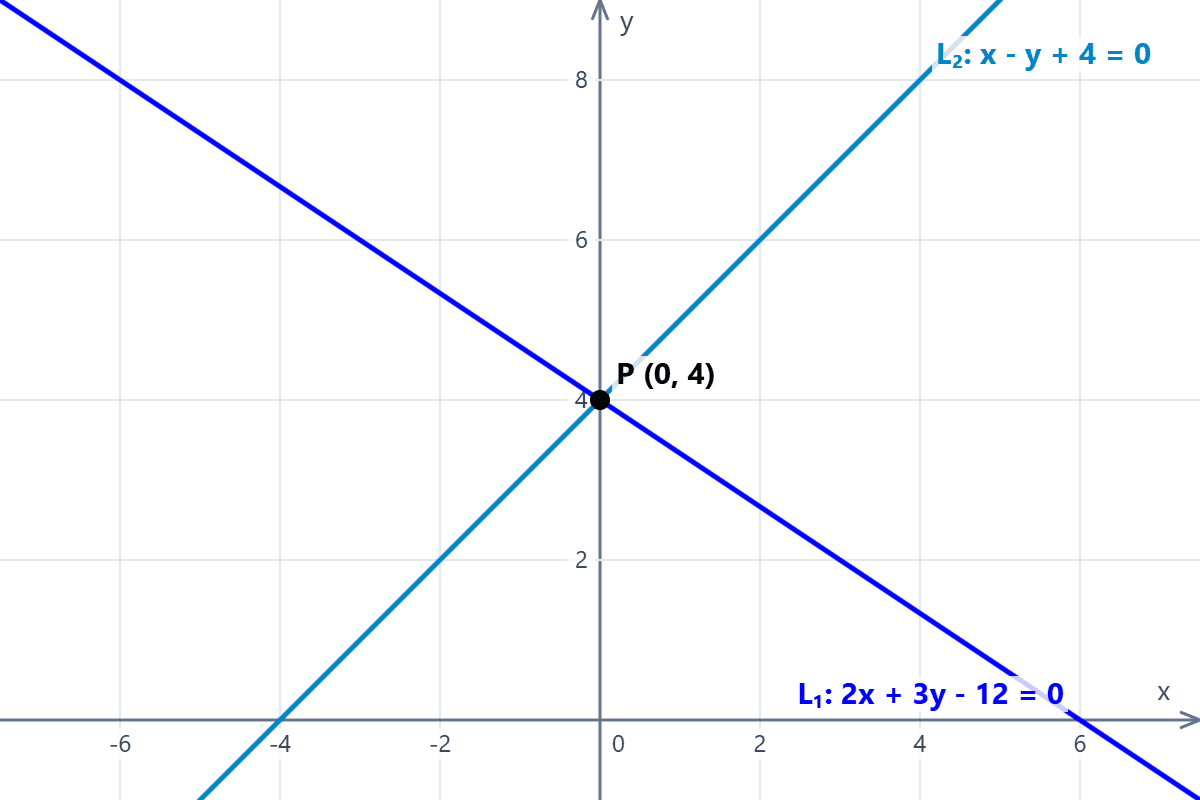
Calculate the point of intersection of the lines 2x + 3y - 12 = 0 and x - y + 4 = 0.
Result
The point of intersection of the given lines is:
Step-by-step solution
1. Set up the system of equations
The point of intersection, if it exists, is the solution to the following 2x2 system of linear equations. To solve it, we will apply Cramer's rule.
2. Calculate the main determinant (Δ) and the secondary determinants (Δx and Δy)
Since the main determinant is non-zero (Δ ≠ 0), the system has a unique solution.
3. Find the coordinates of the point of intersection
We apply Cramer's rule to obtain the final coordinates:
Therefore, the point is:
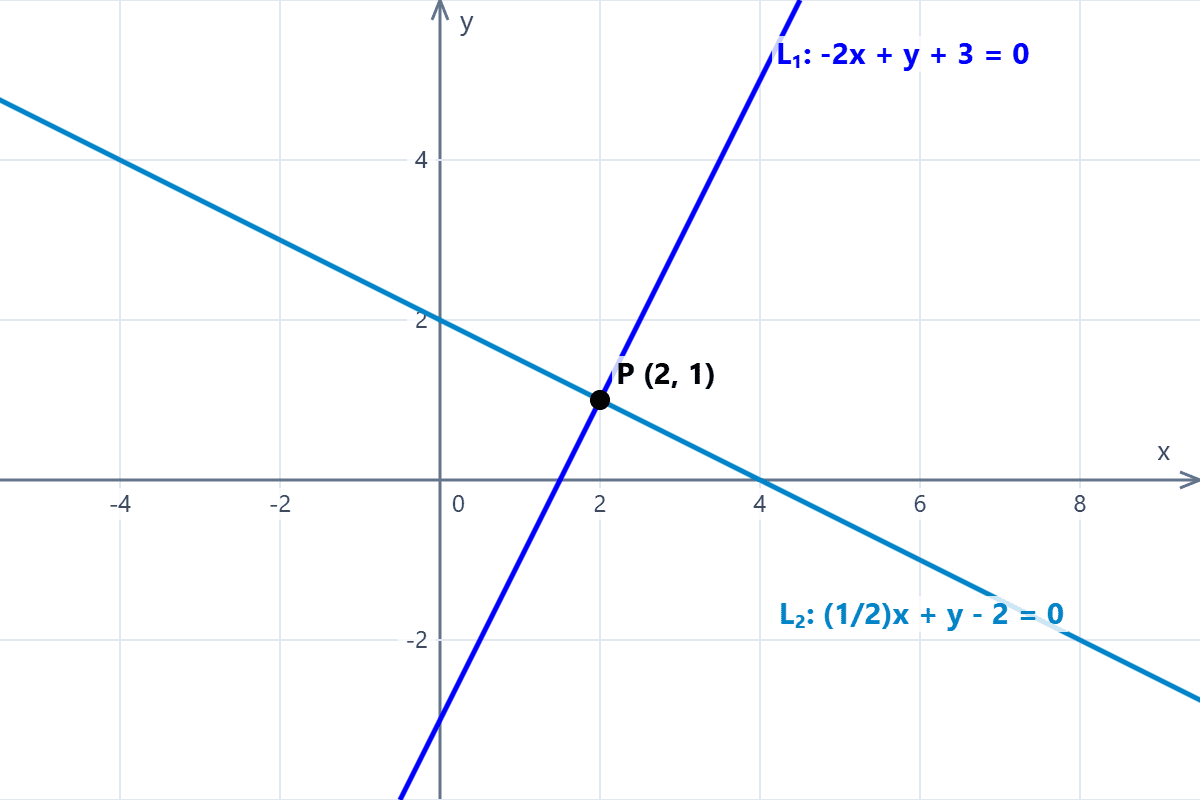
Determine the point of intersection of the straight lines y = 2x + 3 and y = (-1/2)x + 2.
Solution
The point of intersection of the given lines is:
Step-by-step solution
1. Set up the system of equations
The point of intersection, if it exists, is the solution to the following 2x2 system of linear equations. To solve it, we will apply Cramer's rule.
2. Calculate the main determinant (Δ) and the secondary determinants (Δx and Δy)
Since the main determinant is non-zero (Δ ≠ 0), the system has a unique solution.
3. Find the coordinates of the point of intersection
We apply Cramer's rule to obtain the final coordinates:
In conclusion, the point of intersection is:
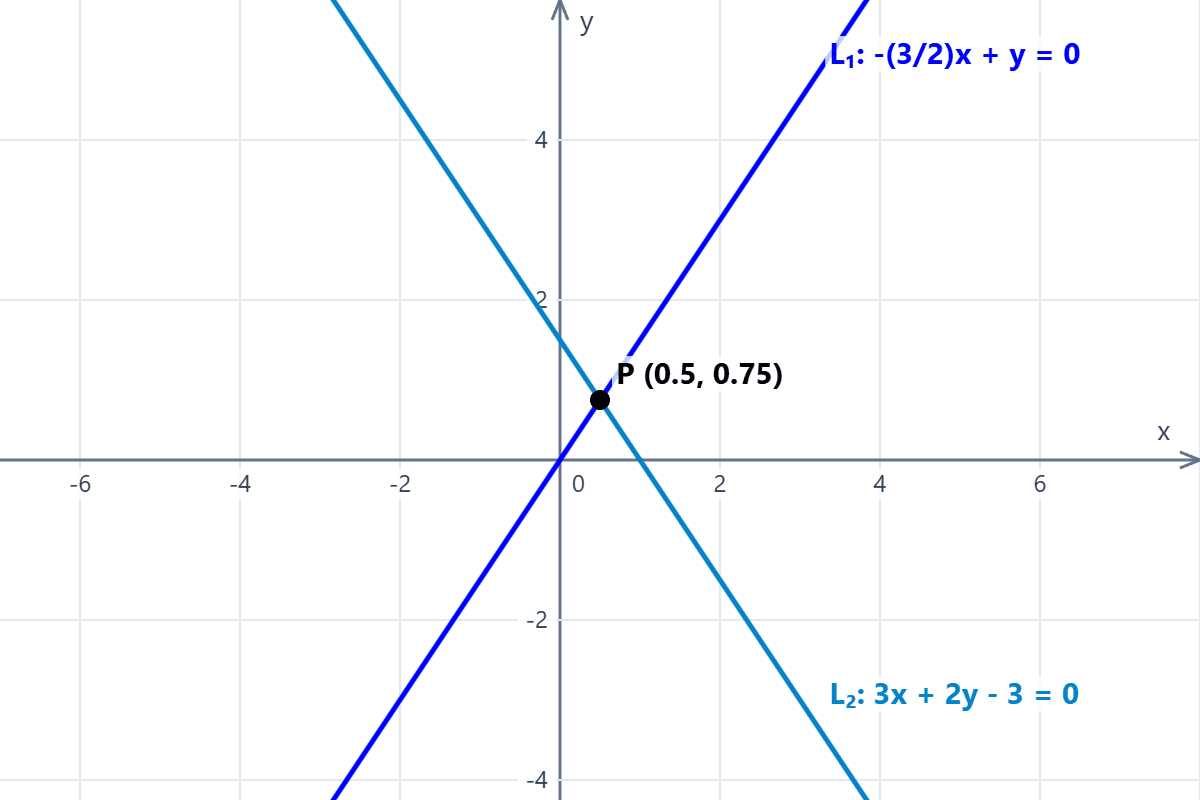
Find the point where the lines y = (3/2)x and 3x + 2y - 3 = 0 intersect.
Answer
The point of intersection of the given lines is:
Step-by-step solution
1. Set up the system of equations
The point of intersection, if it exists, is the solution to the following 2x2 system of linear equations. To solve it, we will apply Cramer's rule.
2. Calculate the main determinant (Δ) and the secondary determinants (Δx and Δy)
Since the main determinant is non-zero (Δ ≠ 0), the system has a unique solution.
3. Find the coordinates of the point of intersection
We apply Cramer's rule to obtain the final coordinates:
Therefore, the point is:
Related Tools
