
Distance Between Two Points Calculator
Enter the coordinates of the points to get the exact distance between them, the step-by-step solution, and a graph of the line segment on the Cartesian plane.
Result
The distance between and is:
Quick examples
How to Use This Calculator
This distance between two points calculator is an analytic geometry tool designed to find the length of the line segment connecting two coordinates on the Cartesian plane. In addition to providing the answer, this solver generates the step-by-step resolution so you can fully understand the mathematical procedure.
Using this finder is very straightforward and is based on a single calculation method:
- Entering coordinates: Input the values for the first point (x1, y1) and the second point (x2, y2) into the corresponding fields. Pay close attention to any negative signs in your data before starting. The input fields accept integers, decimals, and fractions.
- Main result: You will instantly see a results box showing the exact distance between the two points. To ensure total mathematical accuracy and avoid rounding errors, irrational square roots are kept intact in their symbolic form. Next to this exact value, you will also find its decimal equivalent.
- Step-by-step resolution: Right below the final result, the complete breakdown of the problem is displayed. You will be able to see how your values are substituted into the distance formula, how the internal subtractions and squaring are solved, and the final addition inside the radical until the simplified expression is obtained.
- Interactive graph: A Cartesian plane will be drawn at the bottom. There, you can visualize the plotted line segment, verify the exact location of the two endpoints you entered, and interact with the canvas.
What Is the Distance Between Two Points?
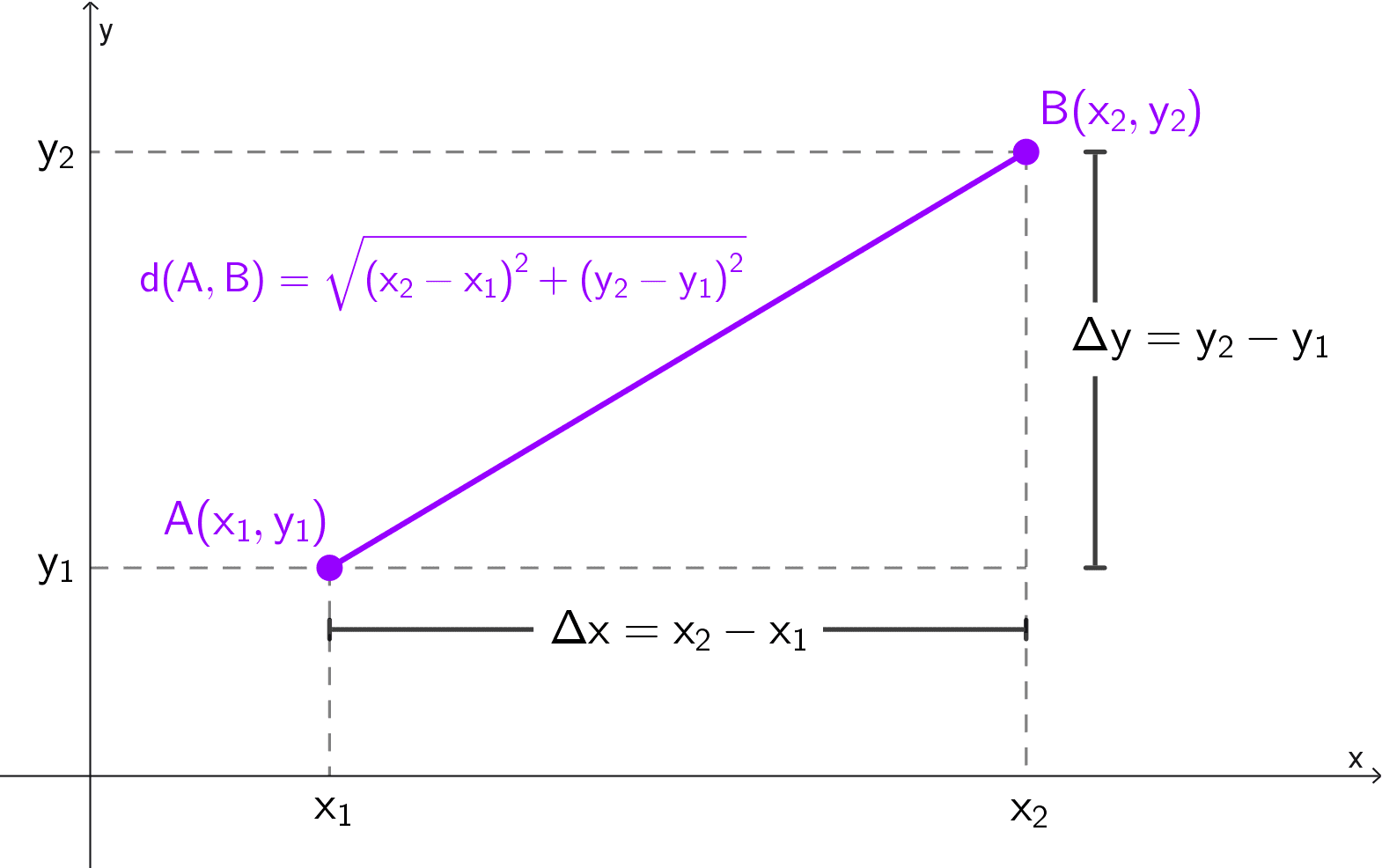
In analytic geometry, the distance between two points is the length of the line segment connecting them. The general formula, or Euclidean distance formula, to calculate the distance between two points A(x1, y1) and B(x2, y2) is:
\(d(A,B)=\sqrt{(x_2-x_1)^2+(y_2-y_1)^2}\)
This formula is derived from the application of the Pythagorean theorem, as the differences in the x and y coordinates define the legs of a right triangle whose hypotenuse is the distance we want to find.
Solved Problems
The following are examples of problems solved by the calculator.
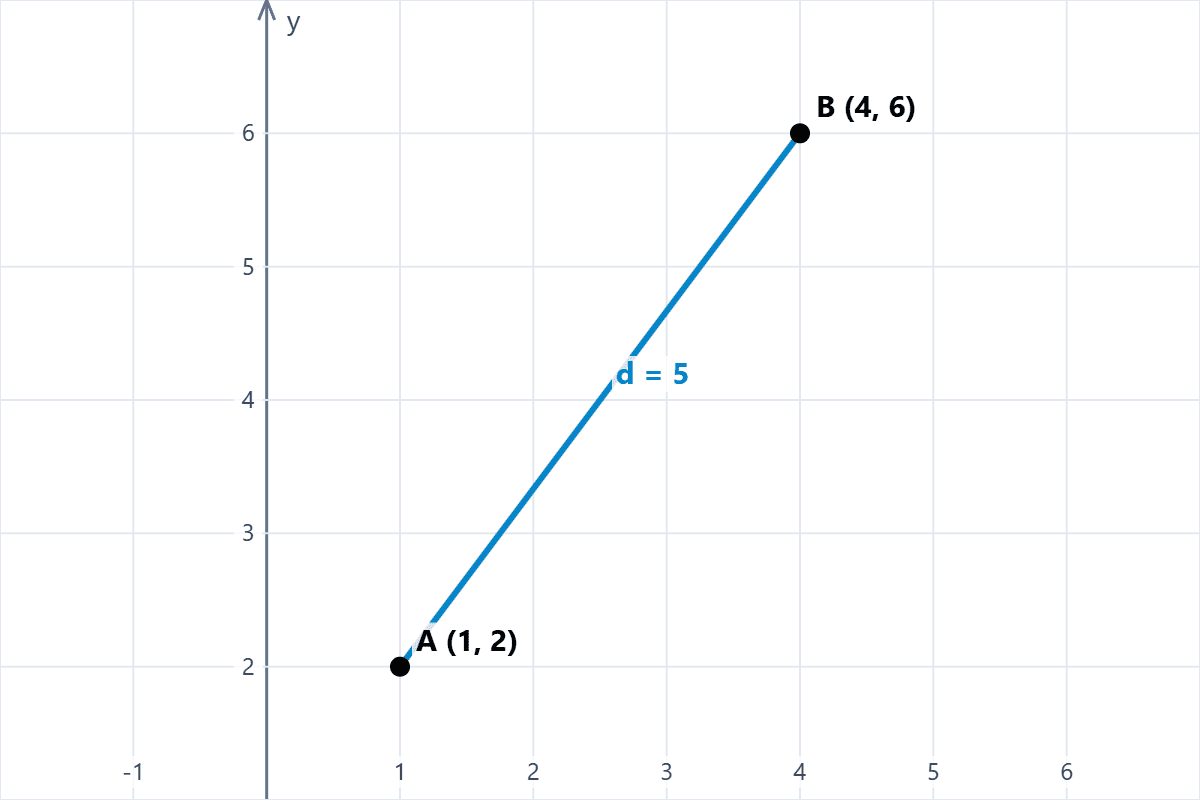
Calculate the exact distance between the points A(1, 2) and B(4, 6).
Result
The distance between \( (1, 2) \) and \( (4, 6) \) is:
Step-by-Step Solution
The formula to use is as follows:
1. Identify the coordinates:
2. Substitute the coordinates into the formula:
3. Calculate the differences inside the parentheses:
4. Calculate the squares:
5. Add the values inside the radicand:
6. Final result:
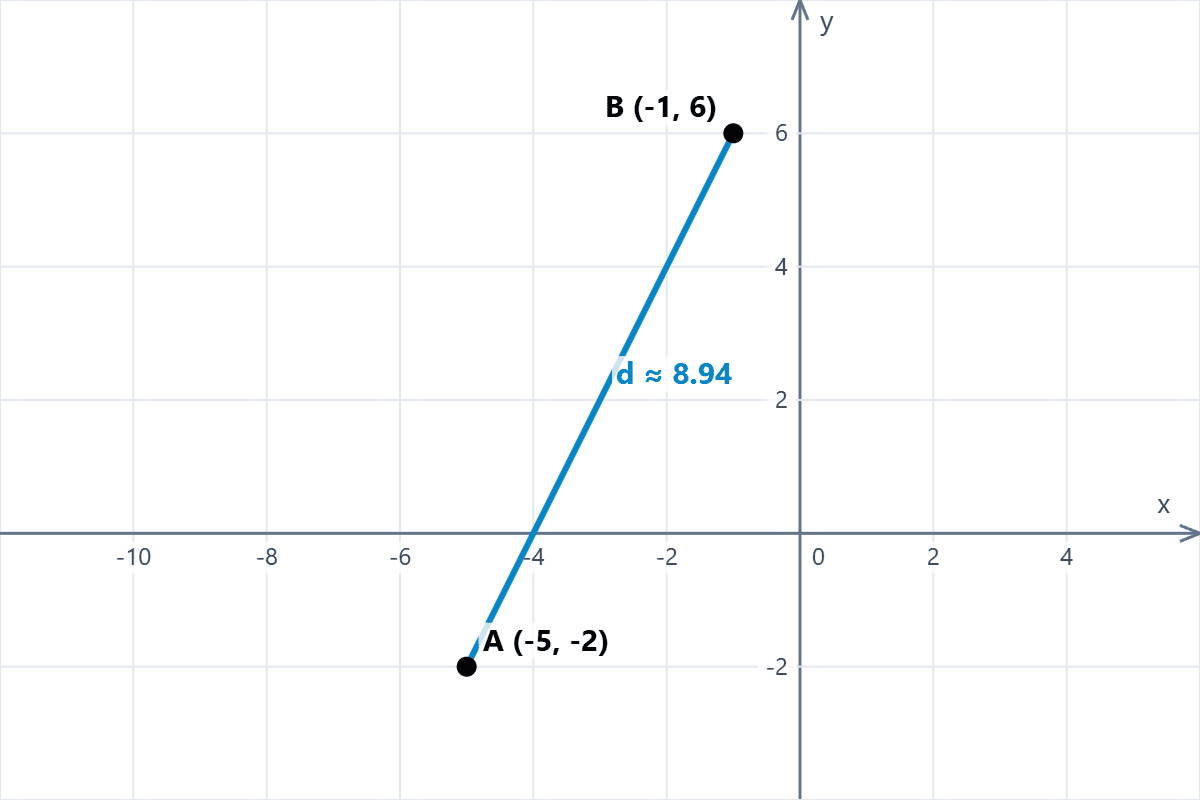
Determine the distance between (-5, -2) and (-1, 6).
Answer
The distance between the points \( (-5, -2) \) and \( (-1, 6) \) is:
Step-by-Step Resolution
The formula to use is this:
1. Identify the coordinates of the points:
2. Substitute the coordinates into the formula:
3. Calculate the differences inside the parentheses:
4. Calculate the squares:
5. Add the values inside the radicand:
6. Exact and approximate final result:
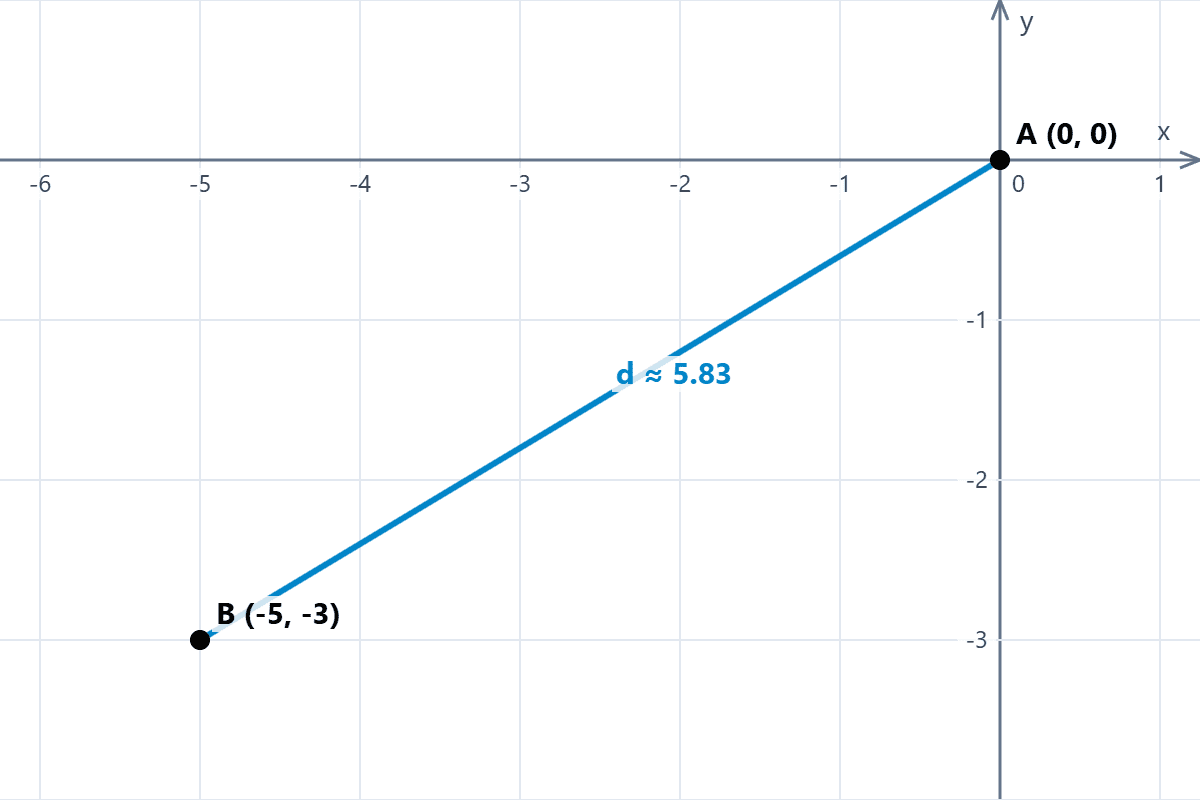
Find the exact distance between the points (-5, -3) and (0, 0).
Result
The distance from the point \( (0, 0) \) to the point \( (-5, -3) \) is:
Step-by-Step Process
The distance formula is as follows:
1. Identify the coordinates:
2. Substitute the coordinates into the formula:
3. Calculate the differences inside the parentheses:
4. Calculate the squares:
5. Add the values inside the radicand:
6. Exact and approximate final result:
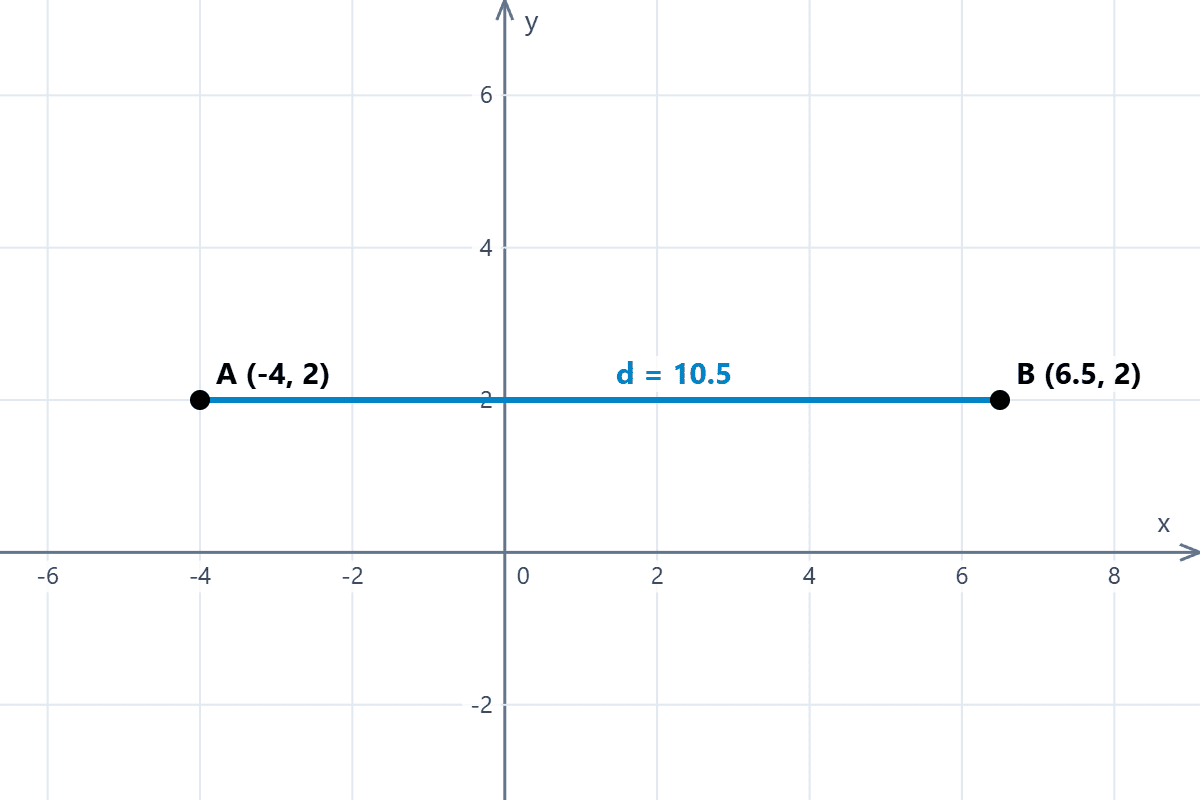
Find the length of the horizontal line segment whose endpoints are (-4, 2) and (6.5, 2).
Answer
The distance between \( (-4, 2) \) and \( (6.5, 2) \) is:
Step-by-Step Solution
The formula to use is as follows:
1. Identify the coordinates:
2. Substitute the coordinates into the distance formula:
3. Calculate the differences inside the parentheses:
4. Calculate the squares:
5. Add the values inside the radicand:
6. Calculate the final result and its decimal approximation:
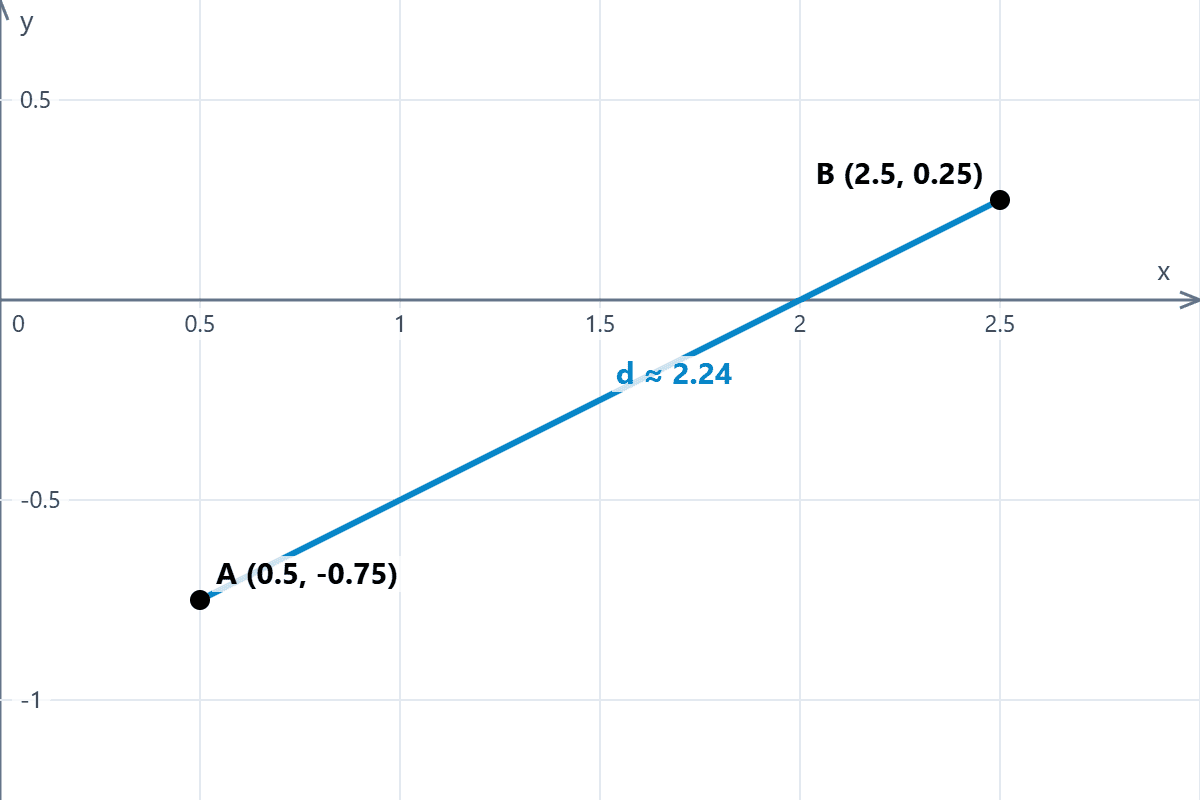
Calculate the exact distance between the points with fractional coordinates (1/2, -3/4) and (5/2, 1/4).
Result
The distance between \( (1/2, -3/4) \) and \( (5/2, 1/4) \) is:
Step-by-Step Work
The distance formula on the Cartesian plane is:
1. Identify the coordinates:
2. Substitute the coordinates into the formula:
3. Calculate the differences inside the parentheses:
4. Calculate the squares:
5. Add the values inside the radicand:
6. Exact final result and its approximation:
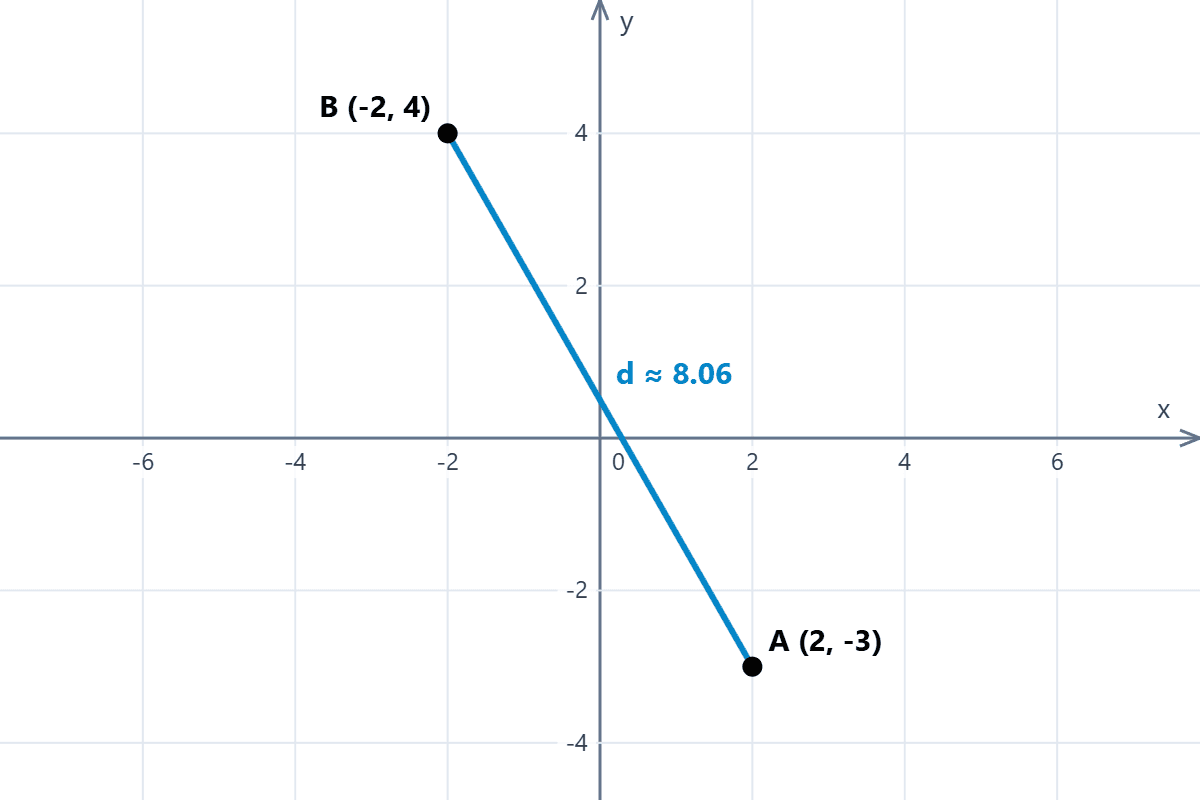
Determine the distance between the point (2, -3) in the fourth quadrant and the point (-2, 4) in the second quadrant.
Result
The distance between \( (2, -3) \) and \( (-2, 4) \) is:
Step-by-Step Solution
The formula to use is as follows:
1. Identify the coordinates:
2. Substitute the coordinates into the formula:
3. Calculate the differences inside the parentheses:
4. Calculate the squares:
5. Add the values inside the radicand:
6. Final result:
Related Tools
