
Vector Calculator
Calculate the properties of a vector (magnitude, direction, polar form, unit vector) from its components, endpoints, or magnitude and angle, with a step-by-step solution and graph.
Quick Examples
How to Use the Calculator
This online vector solver is ideal for solving linear algebra, analytic geometry, or physics problems. The system allows you to thoroughly analyze a single vector quantity, or it redirects you to specific tools if you need to perform operations with multiple vectors.
Use the main menu to choose the type of action you want to perform:
1. Single vector analysis
If you need to break down and study an individual vector, select whether you are working on the plane (2D / R2) or in space (3D / R3). Depending on the dimension, the calculator will offer you different ways to input your data:
- By its components: directly enter the coordinate values (x, y) for 2D, or (x, y, z) for 3D.
- By its endpoints: provide the coordinates of the initial point (origin) and the terminal point. Available in both 2D and 3D.
- By its magnitude and angle: if you have a vector expressed in polar form, enter its total magnitude and the angle of inclination relative to the positive x-axis.
Once the data is entered, the solver will generate a structured response in three blocks:
Comprehensive report block
The system will process the information and provide a detailed technical sheet that includes: the vector expressed in rectangular component form, standard unit vector notation (i, j, k), polar form (for 2D), magnitude (length), direction (angles relative to the axes), and the calculation of the unit vector pointing in the same direction.
Step-by-step solution block
If you inputted the vector by its endpoints or magnitude and direction, the solver will provide the step-by-step process to calculate the rectangular components. You will be able to see how the coordinates are subtracted (terminal point minus initial point) or how the sine and cosine trigonometric functions are applied to find the rectangular components from the polar form.
Graph block
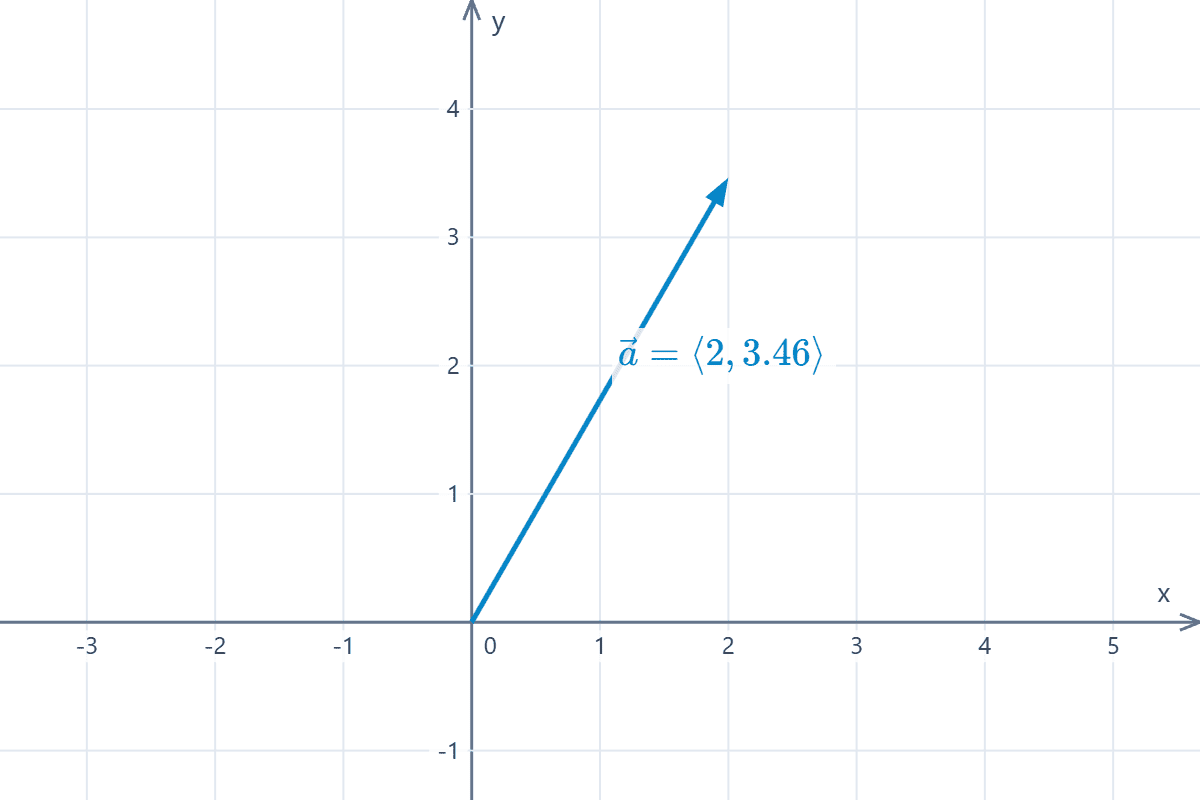
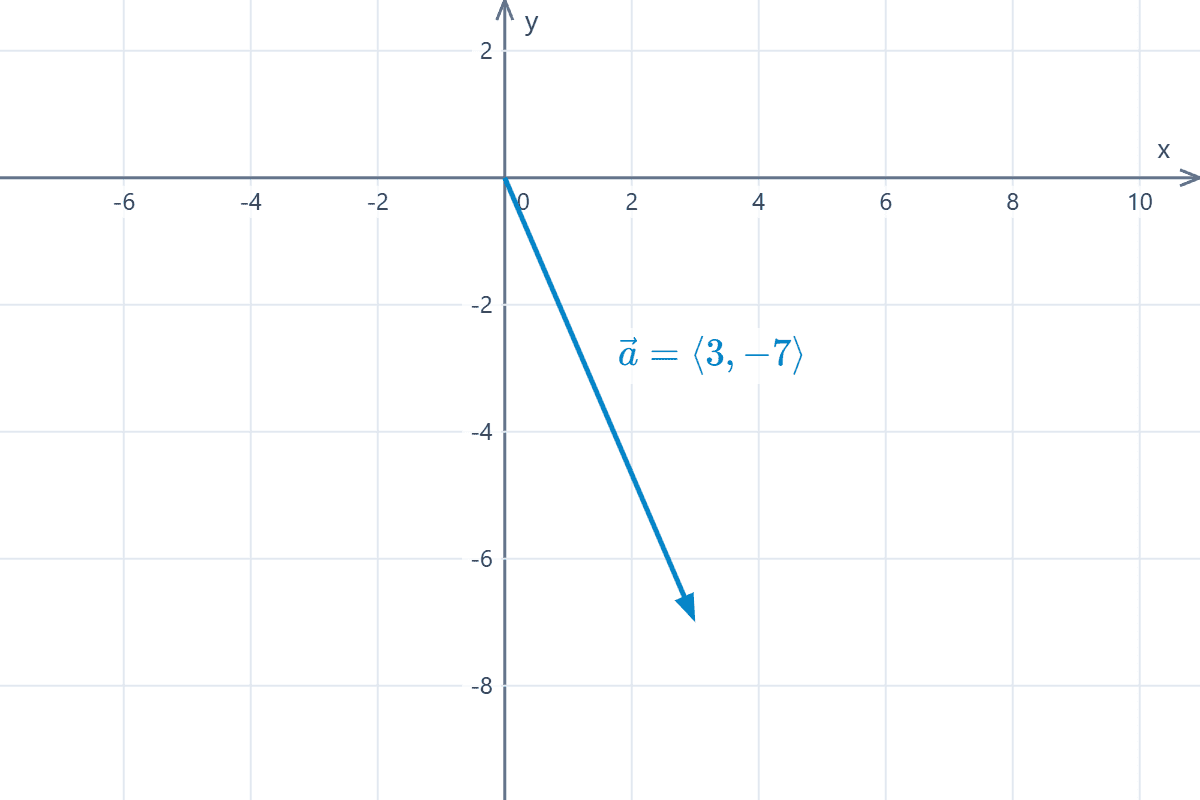
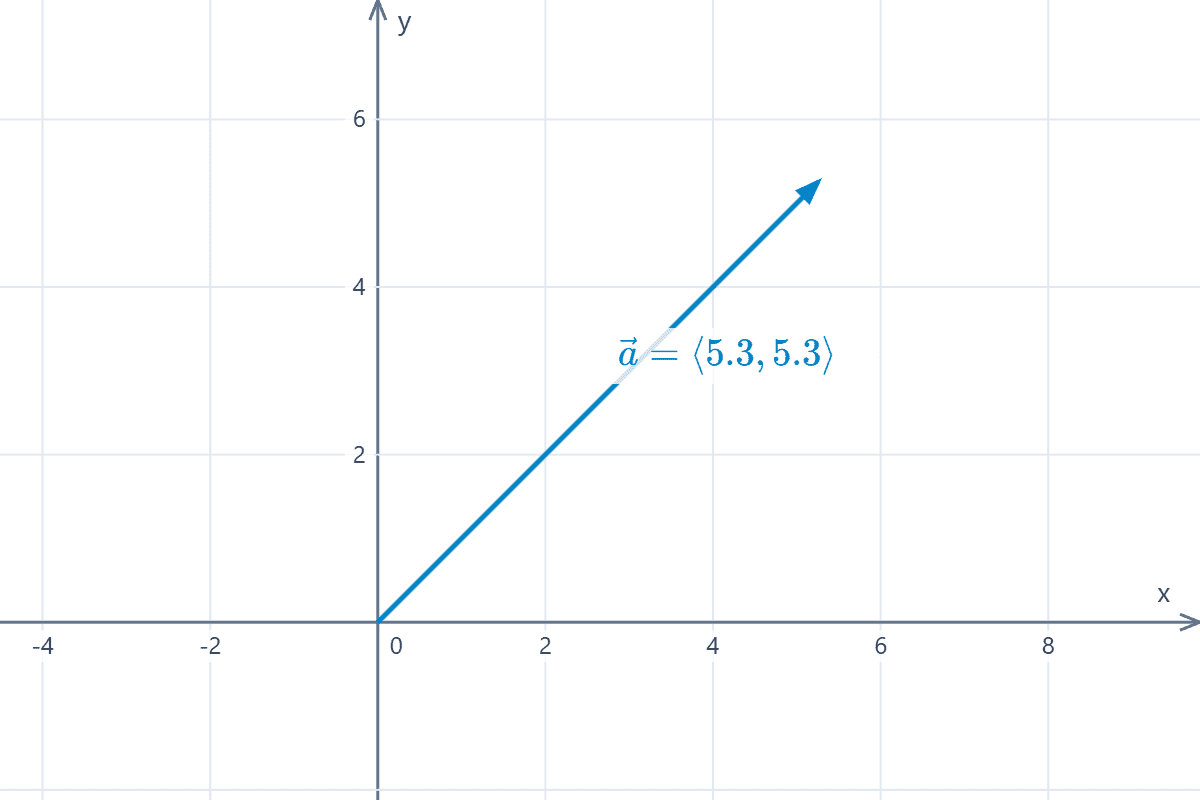
If your analysis is performed in R2, an interactive Cartesian plane will be drawn at the bottom showing the vector positioned from the origin, allowing you to visually verify its magnitude, direction, and the quadrant to which it belongs.
Note: all input fields in this tool support integers, decimals, and the use of exact fractions and roots to avoid rounding errors during the analytical calculation.
2. Operations with two or more vectors
If your problem involves interactions between several vectors, select the "Vector operations" mode. Doing so will display a menu with a set of individual calculators. From there, you can choose what you want to calculate:
Additionally, you have these tools available:
Solved Exercises
The following are examples of problems solved by the calculator.
Find the components of a vector with magnitude |a| = 4 and angle θ = 60°.
Results
Vector in component form:
Unit vector notation:
Polar form:
Step-by-step solution
Calculate components from magnitude and direction.
We use trigonometric functions to resolve the vector into its rectangular components:
The horizontal component (x-axis) is found by multiplying the magnitude by the cosine of the angle:
The vertical component (y-axis) is found by multiplying the magnitude by the sine of the angle:
Therefore, the vector in component form is:
Calculate the components and properties of the vector with endpoints (-1, 3) and (2, -4).
Results
Vector in component form:
Unit vector notation:
Polar form:
Magnitude:
Direction:
Unit vector:
Step-by-step solution
Calculate the components of the vector.
We extract the coordinates of the initial and terminal points:
We find the vector components by subtracting the initial point coordinates from the terminal point coordinates:
Therefore, the vector in component form is:
Analyze the vector with magnitude 15/2 and direction 45°.
Results
Vector in component form:
Unit vector notation:
Polar form:
Magnitude:
Direction:
Unit vector:
Step-by-step solution
Calculate components from magnitude and direction.
We use trigonometric functions to resolve the vector into its rectangular components:
The horizontal component (x-axis) is found by multiplying the magnitude by the cosine of the angle:
The vertical component (y-axis) is found by multiplying the magnitude by the sine of the angle:
Therefore, the vector in component form is:
Find the components of the vector in R3 with initial point at (-10, -5, 2) and terminal point at (-8, -4, 5).
Results
Vector in component form:
Unit vector notation:
Magnitude:
Direction:
Unit vector:
Step-by-step solution
Calculate the components of the vector.
We extract the coordinates of the initial and terminal points:
We find the vector components by subtracting the initial point coordinates from the terminal point coordinates:
Therefore, the vector in component form is:
Related Tools
