
Quadratic Equation Calculator
Enter a quadratic equation to get its solutions (real or complex), the step-by-step procedure, and its Cartesian graph.
Quick Examples
How to Use the Calculator
This online quadratic equation solver is an algebraic tool that processes your expression, simplifies it automatically, generates a step-by-step solution, and graphs the resulting parabola. It is designed to work with both real numbers and complex roots.
How to enter your equation:
- Enter your equation exactly as it appears in your problem. It does not need to be simplified; you can write terms on both sides of the equals sign (for example, 2x2 = 8 - 6x). The solver will automatically group and arrange it into its standard form ax2 + bx + c = 0.
- The calculator supports integer, decimal, fractional, and irrational coefficients. Symbolic values (such as fractions or roots) will be maintained throughout the process to prevent rounding errors.
Once you enter the expression, the program will analyze the coefficients to generate a step-by-step solution using the most efficient mathematical method:
- Incomplete equations with no linear term (b = 0): it will show you how to isolate the squared variable and take the square root of both sides.
- Incomplete equations with no constant term (c = 0): the procedure will factor out the variable x as the greatest common factor and apply the zero product property to solve for both roots using simple linear equations.
- Complete equations: the solver will identify the coefficients a, b, and c to substitute them into the quadratic formula. During the process, it will isolate the value of the discriminant (Δ) to analytically indicate whether the equation has two distinct real roots, a single double root, or complex conjugate solutions.
Results and graphical representation
At the end of the procedure, the calculator will provide the exact value of the solutions along with their decimal approximation, if necessary. If the roots belong to the set of real numbers, you will also get the factored form of the equation. Additionally, a Cartesian graph of the parabola will be generated so you can visualize the points where it intersects the x-axis (if any), which correspond to the solutions of the quadratic equation.
Step-by-Step Examples
The following are examples of quadratic equations solved by the calculator.
Solve the quadratic equation x2 - 5x + 6 = 0
Result
The equation has two distinct real roots:
Factored form of the equation:
Step-by-step solution
1. Identify the equation.
The equation to solve in its standard form is:
2. Identify the coefficients.
Since the equation is complete, we identify the coefficients by comparing it to the standard form ax2 + bx + c = 0:
3. Apply the quadratic formula.
We substitute the values of a, b, and c into the quadratic formula:
We evaluate the initial operations to simplify the expression:
The expression under the square root is known as the discriminant (Δ) of the equation. In this case, since it is greater than zero, it indicates that the equation has two distinct real roots. We continue simplifying to find the solutions:
Therefore, the solutions are:
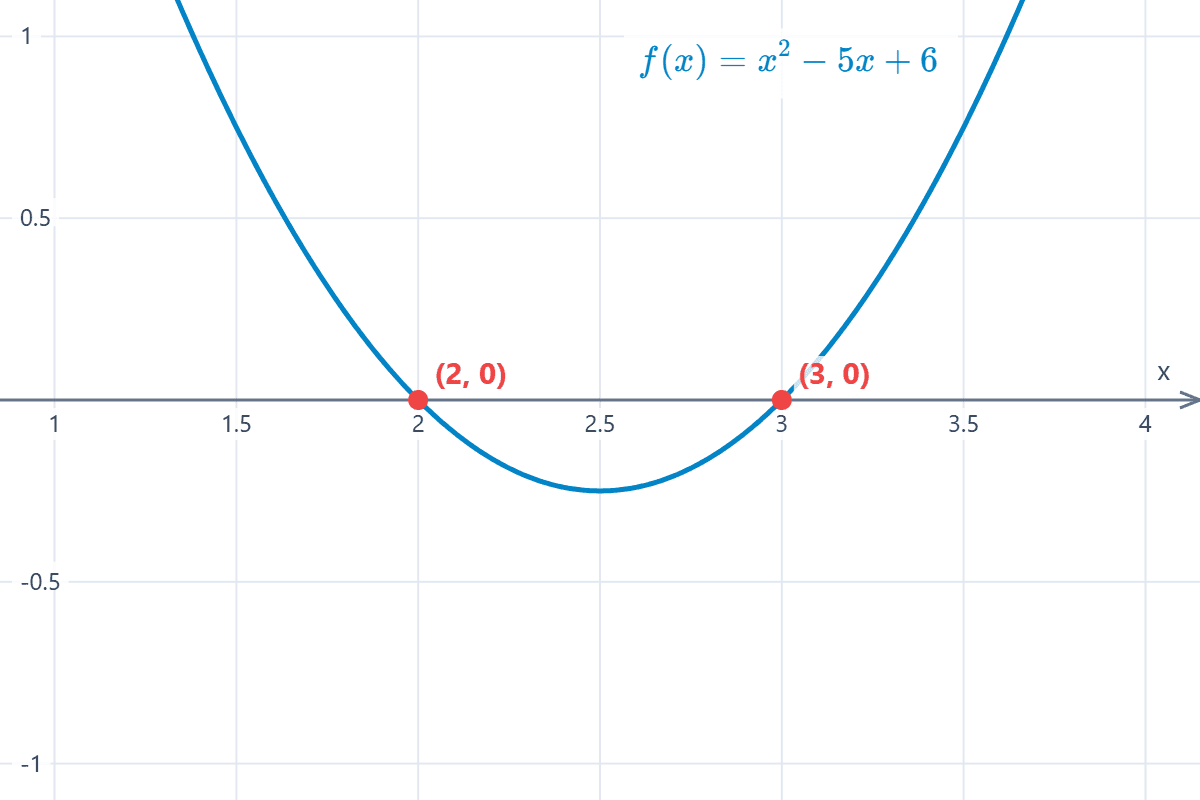
In the Cartesian graph, we can observe that the parabola intersects the x-axis at two distinct points, which correspond to the two real roots found.
Find the solutions of the quadratic equation x2 - 9 = 0
Result
The equation has two distinct real roots:
Factored form of the equation:
Step-by-step solution
1. Identify the equation.
The equation to solve in its standard form is:
2. Isolate the squared variable.
Since the linear term is zero, we directly isolate the squared term and take the square root of both sides:
Therefore, the solutions are:
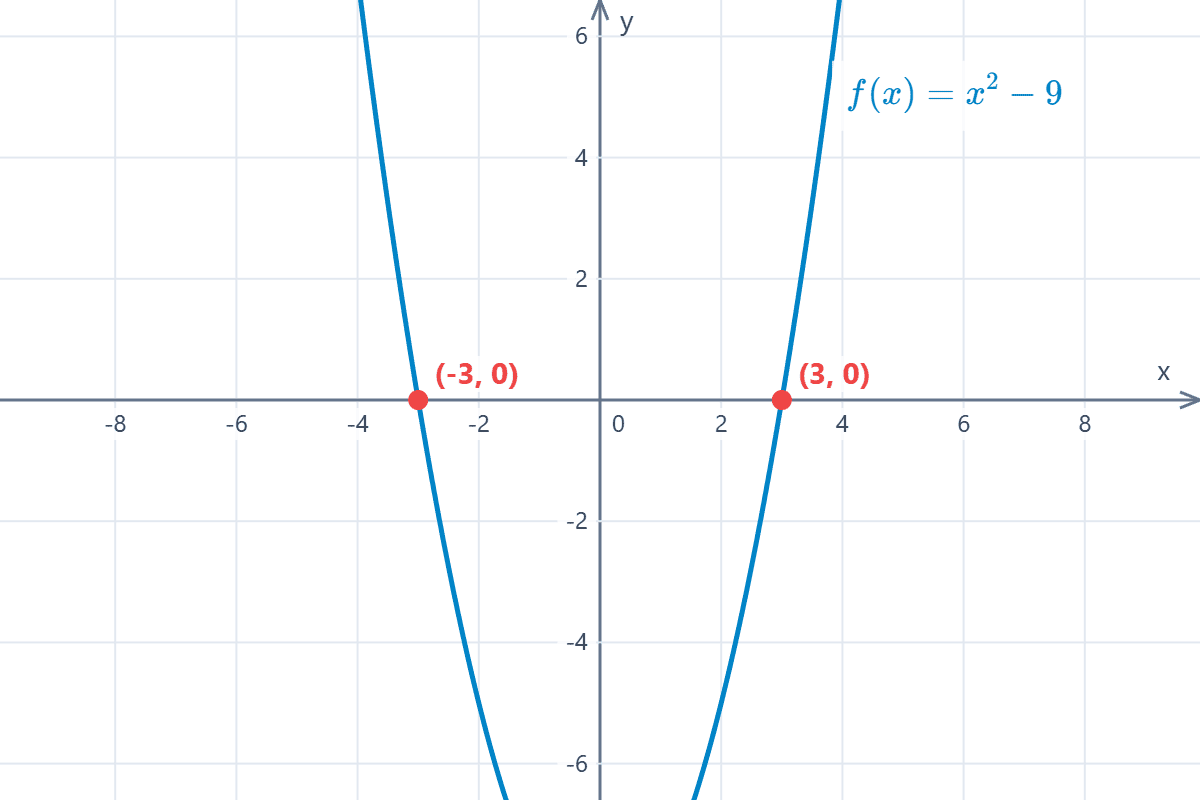
In the Cartesian graph, we can observe that the parabola intersects the x-axis at two distinct points, which correspond to the two real roots found.
Determine the solutions of the equation -2x2 + 4x = 0
Result
The equation has two distinct real roots:
Factored form of the equation:
Step-by-step solution
1. Identify the equation.
The equation to solve in its standard form is:
2. Factor out the greatest common factor.
Since there is no constant term, we factor out the variable with the lowest degree, leaving a product equal to zero:
For a product to equal zero, at least one of its factors must be zero. We set each factor to zero:
The first solution is simply x = 0. For the second, we solve the resulting linear equation:
Therefore, the solutions are:
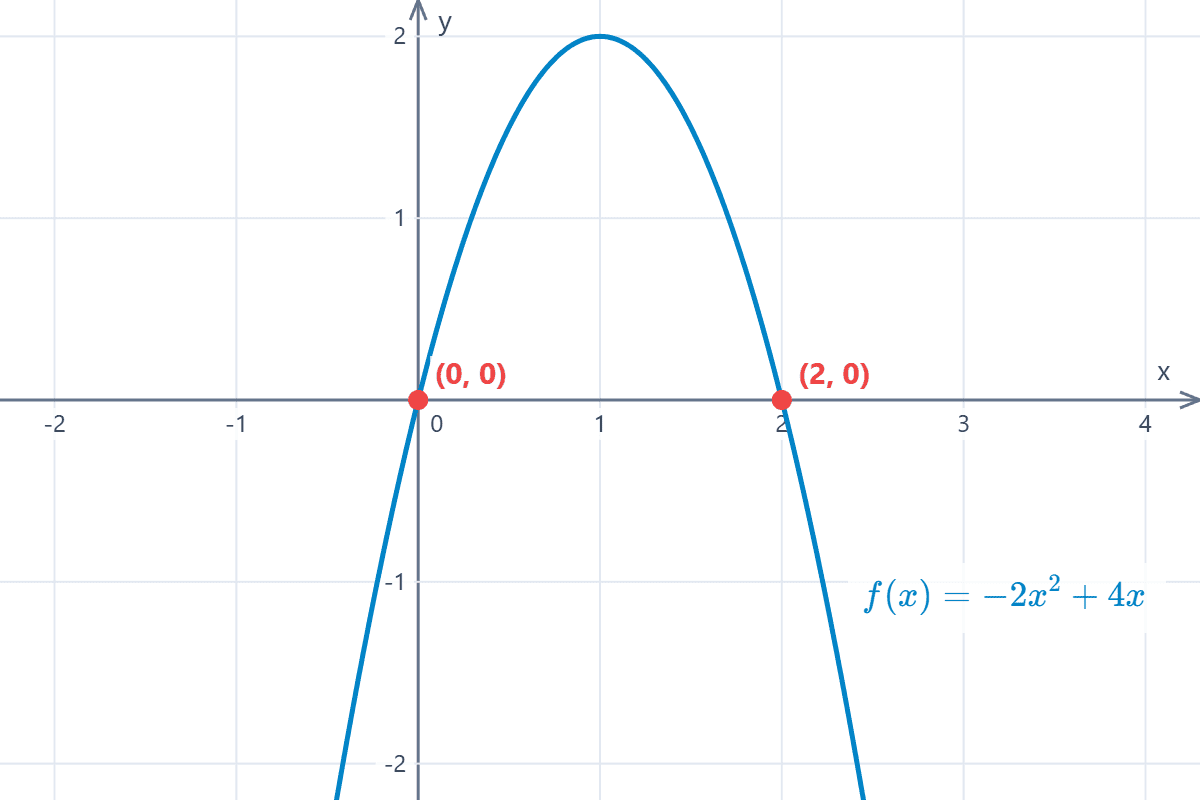
In the Cartesian graph, we can observe that the parabola intersects the x-axis at two distinct points, which correspond to the two real roots found.
Find the values of the variable that satisfy the equation x2 + x + 1 = 0
Result
The equation has two complex conjugate roots:
Step-by-step solution
1. Identify the equation.
The equation to solve in its standard form is:
2. Identify the coefficients.
Since the equation is complete, we identify the coefficients by comparing it to the standard form ax2 + bx + c = 0:
3. Apply the quadratic formula.
We substitute the values of a, b, and c into the quadratic formula:
We evaluate the initial operations to simplify the expression:
The expression under the square root is known as the discriminant (Δ) of the equation. In this case, since it is less than zero, it indicates that the equation has two complex conjugate roots. We continue simplifying to find the solutions:
Therefore, the solutions are:
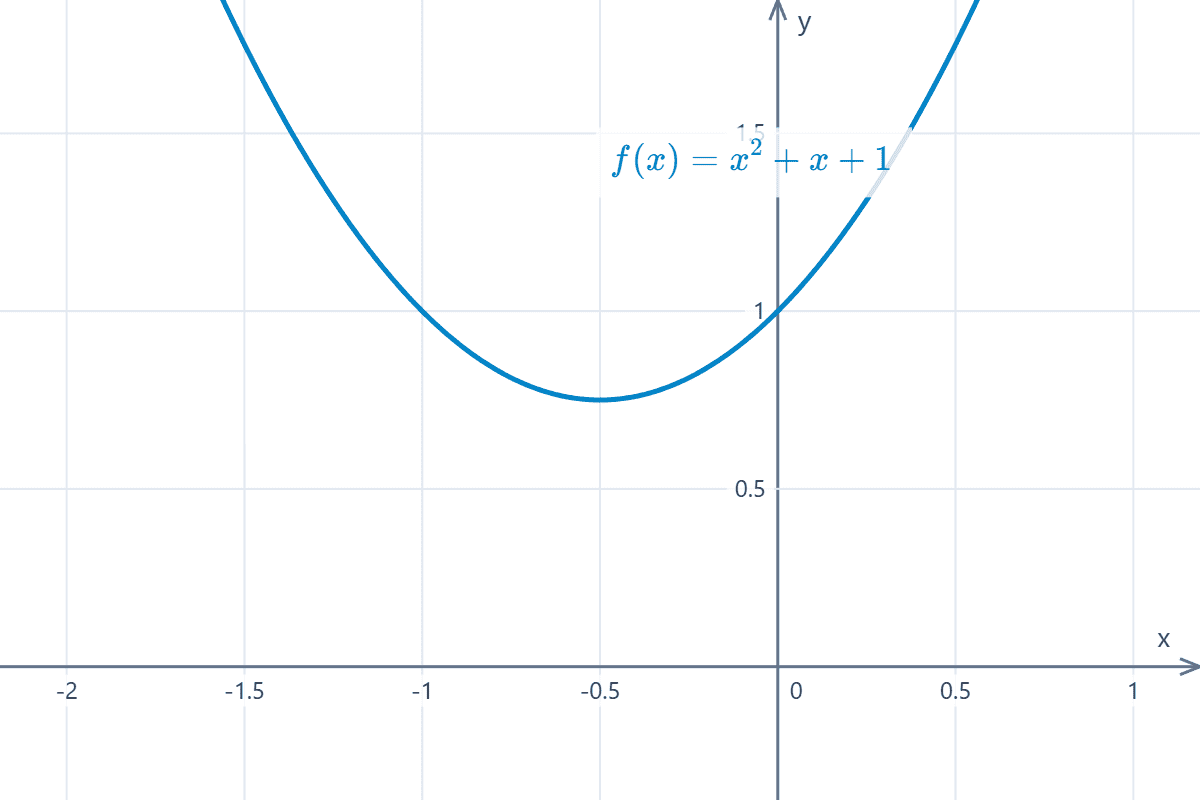
In the Cartesian graph, we can observe that the parabola never intersects the x-axis, which graphically confirms that the solutions to the equation are not real, but complex.
Calculate the solution(s) for the equation x2 - 4x + 4 = 0
Result
The equation has a real double root:
Factored form of the equation:
Step-by-step solution
1. Identify the equation.
The equation to solve in its standard form is:
2. Identify the coefficients.
Since the equation is complete, we identify the coefficients by comparing it to the standard form ax2 + bx + c = 0:
3. Apply the quadratic formula.
We substitute the values of a, b, and c into the quadratic formula:
We evaluate the initial operations to simplify the expression:
The expression under the square root is known as the discriminant (Δ) of the equation. In this case, since it is equal to zero, it indicates that the equation has a single real double root. We continue simplifying to find the solution:
Therefore, the solution is:
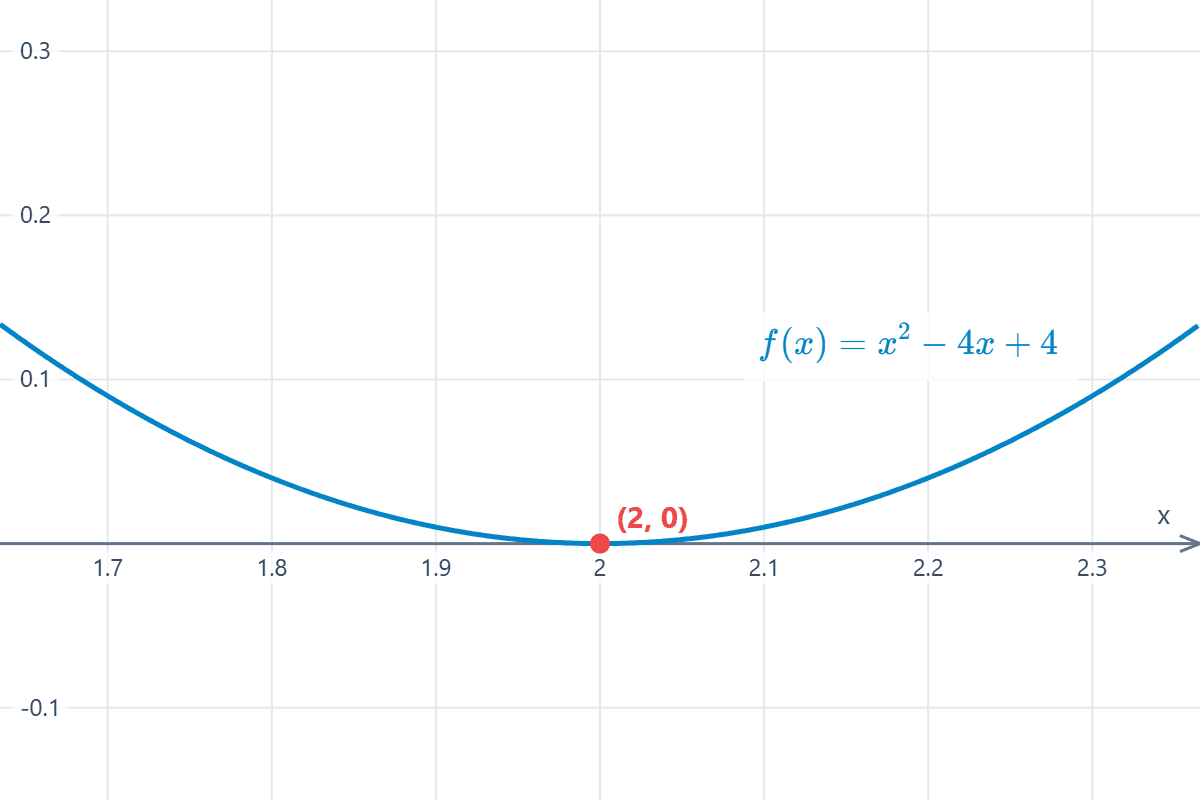
In the Cartesian graph, we can observe that the parabola is tangent to the x-axis (touching it at a single point), which graphically indicates that there is a single real root (double root).
Related Tools
