
Cubic Equation Calculator
Enter a third-degree polynomial equation to get all its solutions (real and complex), the step-by-step resolution, and the Cartesian graph.
Quick Examples
How to Use the Calculator
This online cubic equation solver is an algebraic tool designed to find all the solutions or roots of any third-degree equation. In addition to providing the exact answer, the calculator generates the step-by-step resolution and plots the curve's graph for visual verification.
How to enter your equation:
Use the single input field to write your mathematical expression. The system is flexible and will interpret your problem without requiring a strict format:
- You can write the equation in its standard form set equal to zero (for example: x3 - 4x2 + x + 6 = 0).
- You can enter it out of order or with terms on both sides of the equal sign (for example: x3 - 5x = 2x2). The tool will group and simplify the terms automatically.
- If you only enter a polynomial without the equal sign, the algorithm will default to assuming you want to find its roots and will set it equal to zero internally.
Once the input is processed, the calculator will analyze the coefficients (a, b, c, d) to determine the most efficient path and will show you the procedure using one of the following methods:
- Factoring out a common factor: if the equation lacks a constant term, the solver will factor out the variable with the lowest exponent, reducing the problem to solving a quadratic or linear equation.
- Factoring by grouping: if the coefficients are proportional, the program will group the terms conveniently to factor out common binomials and solve for the roots directly.
- Rational Root Theorem: for most complete polynomials, the solver will apply the Rational Root Theorem. It will look for the divisors of the constant term and the leading coefficient until it finds the first root. Subsequently, it will divide the polynomial, reducing its degree to find the rest of the values.
Upon concluding the analytical development, you will get a clear report with the three solutions to the equation, whether they are pure real roots or complex (conjugate) roots if the problem requires it. The system will always work with exact fractions and symbolic roots to preserve precision.
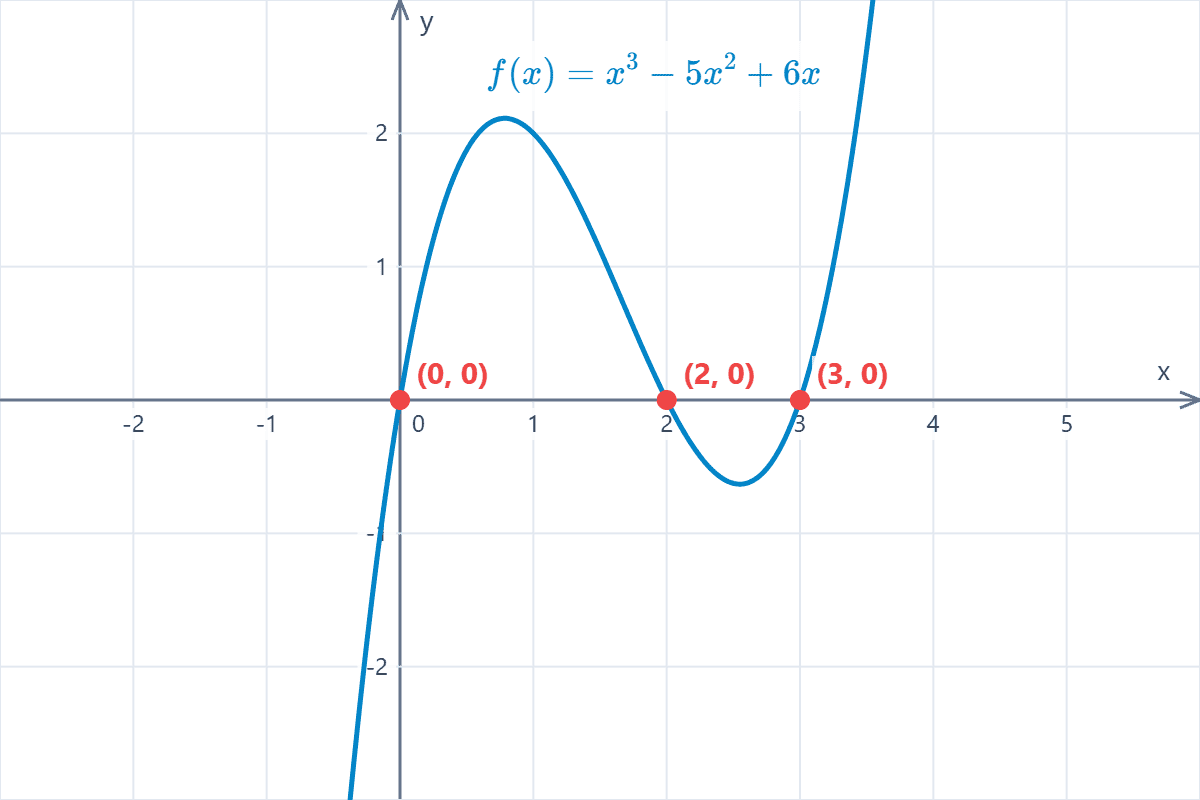
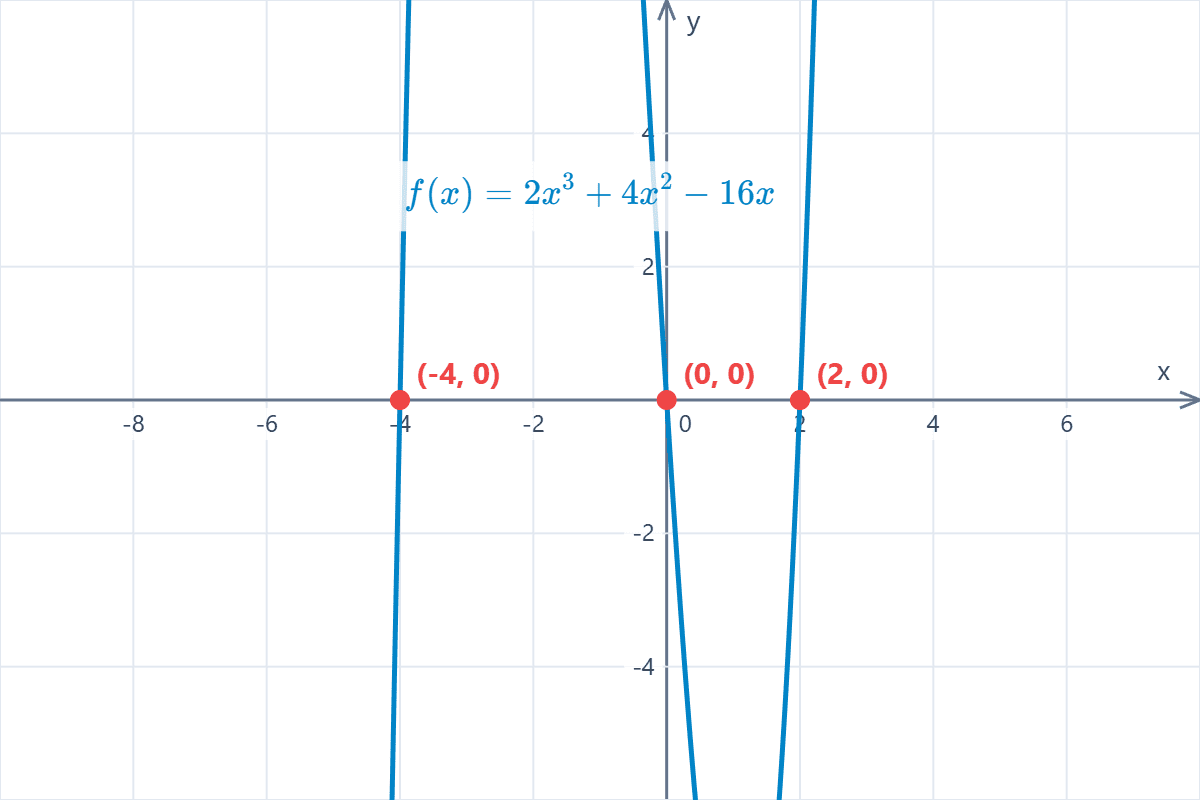
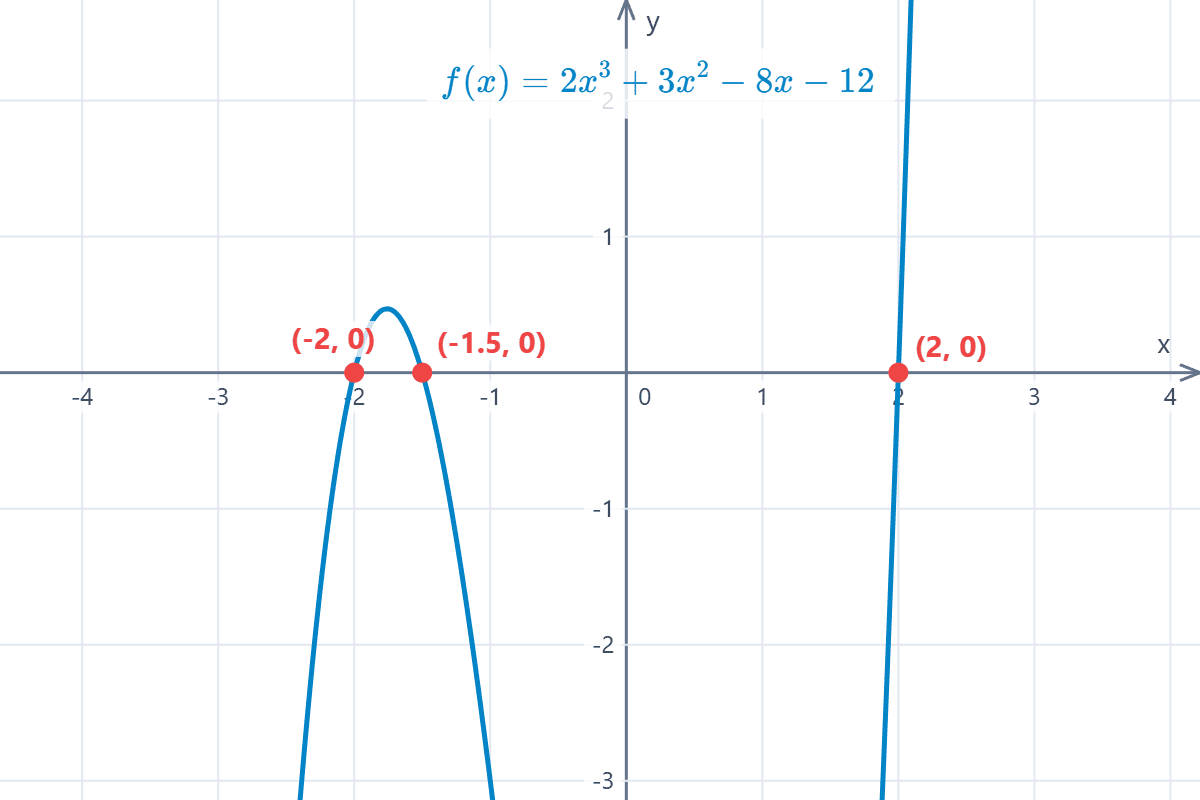
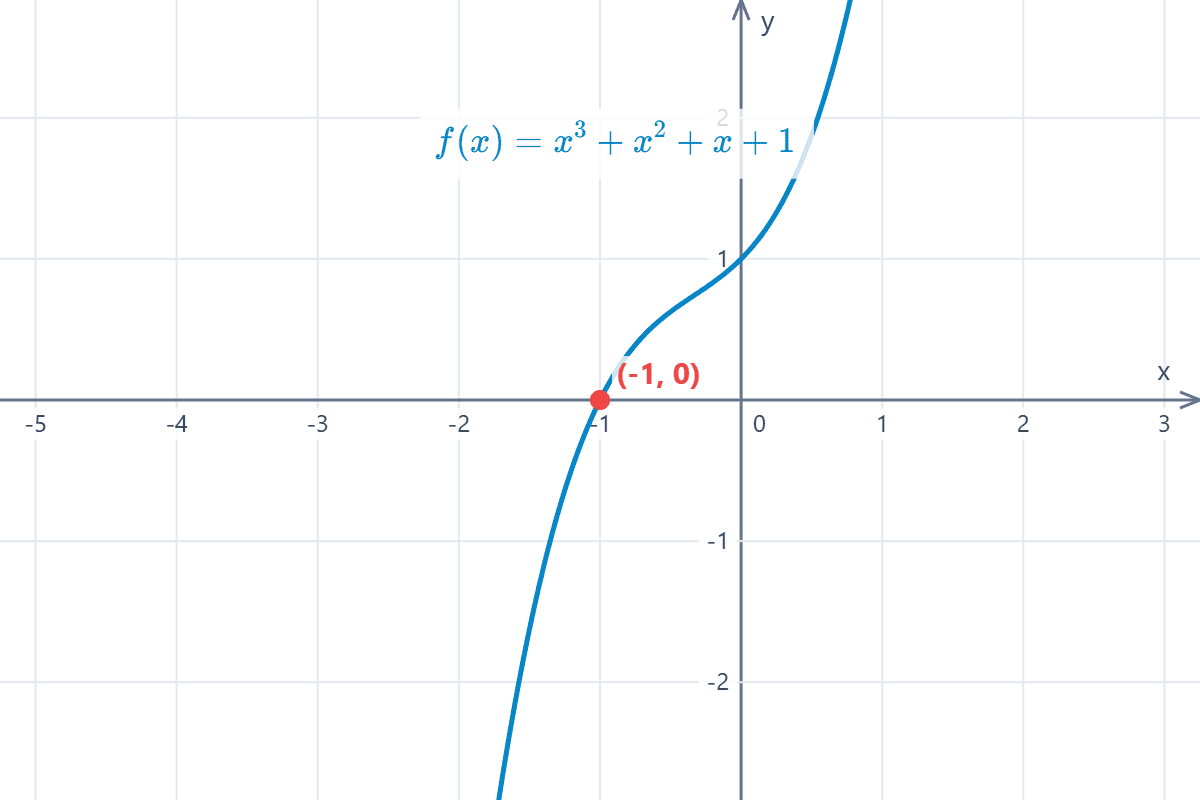
As a final step, the tool will generate the interactive graph of the polynomial on the Cartesian plane. The points where the curve intersects the horizontal axis will be highlighted, allowing you to verify the obtained results.
Step-by-Step Examples
The following are examples of third-degree equations solved by the calculator.
Calculate the solutions to the cubic equation \( x^3-5x^2+6x=0. \)
Result
The solutions to the cubic equation are:
Factored form of the equation:
Step-by-step resolution
1. Identify the equation.
The equation to solve is:
2. Factor out the common factor.
Since the equation does not have a constant term, we factor out the variable with the lowest degree to rewrite the expression:
3. Solve for the first root.
Having a product equal to zero, we set the first factor to zero to obtain a root:
4. Solve the resulting quadratic equation.
We set the remaining quadratic factor to zero:
By solving the quadratic equation (for example, using the quadratic formula), we can find the remaining roots:
Determine the roots of the third-degree polynomial \( 2x^3+4x^2-16x. \)
Result
The solutions to the cubic equation are:
Factored form of the equation:
Step-by-step resolution
1. Identify the equation.
The equation to solve is:
2. Factor out the common factor.
Since the equation does not have a constant term, we factor out the variable with the lowest degree to rewrite the expression:
3. Solve for the first root.
Having a product equal to zero, we set the first factor to zero to obtain a root:
4. Solve the resulting quadratic equation.
We set the remaining quadratic factor to zero:
By solving the quadratic equation (for example, using the quadratic formula), we can find the remaining roots:
Find all the values that satisfy the third-degree equation \( 2x^3+3x^2-8x-12=0. \)
Result
The solutions to the cubic equation are:
Factored form of the equation:
Step-by-step resolution
1. Identify the equation.
The equation to solve is:
2. Group the terms.
We conveniently group the terms of the equation into pairs to factor out a common factor from each group:
3. Factor out the common factor from each group.
We factor out the corresponding common factor within each of the parentheses:
4. Factor out the binomial.
Since a binomial is repeated in both terms, we factor it out as a new common factor to completely factor the expression:
5. Solve for the roots.
We set each factor to zero and solve to find all the roots of the equation:
Calculate the real and complex solutions to the cubic equation \( x^3+x^2+x+1=0. \)
Result
The solutions to the cubic equation are:
Factored form of the equation:
Step-by-step resolution
1. Identify the equation.
The equation to solve is:
2. Group the terms.
We conveniently group the terms of the equation into pairs to factor out a common factor from each group:
3. Factor out the common factor from each group.
We factor out the corresponding common factor within each of the parentheses:
4. Factor out the binomial.
Since a binomial is repeated in both terms, we factor it out as a new common factor to completely factor the expression:
5. Solve for the roots.
We set each factor to zero and solve to find all the roots of the equation:
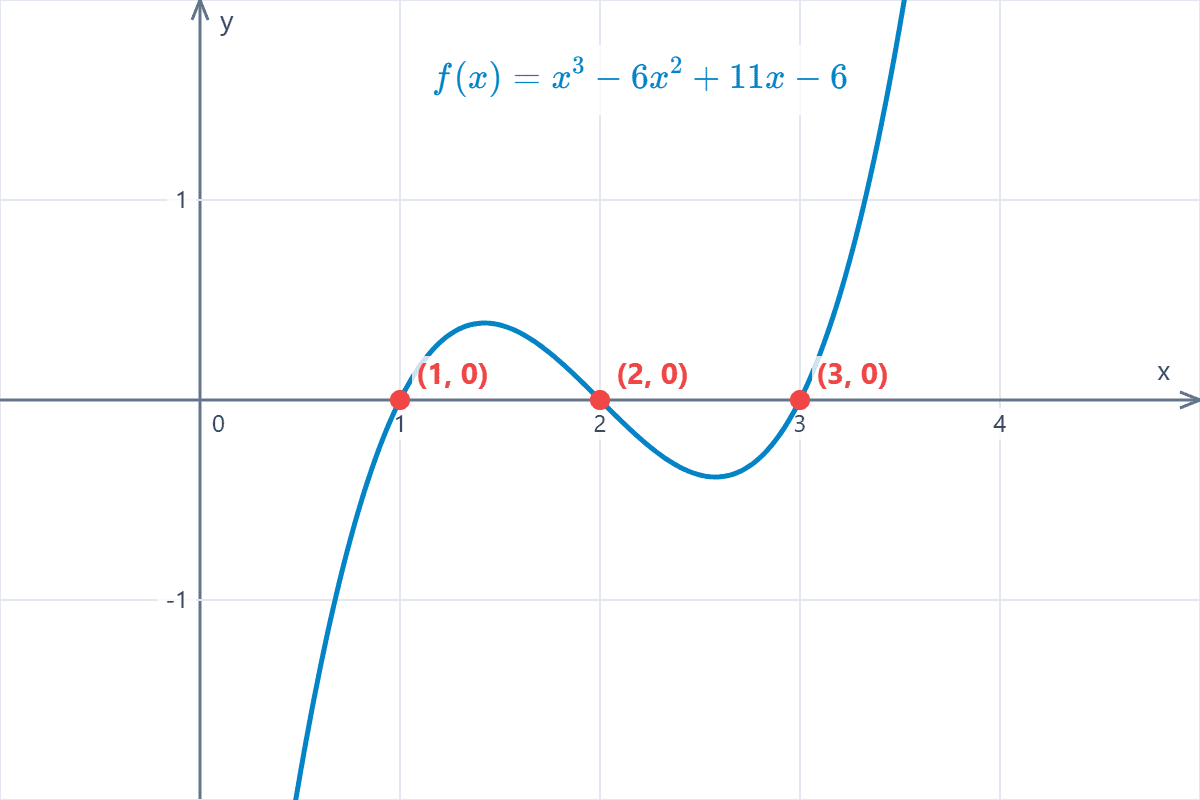
Calculate the solutions to the third-order equation \( x^3-6x^2+11x-6=0. \)
Result
The solutions to the cubic equation are:
Factored form of the equation:
Step-by-step resolution
1. Identify the equation.
The equation to solve is:
2. Find a rational root.
We apply the Rational Root Theorem by evaluating possible roots from the divisors of the constant term and the leading coefficient, until we find a value that makes the equation zero. This will be our first root:
3. Divide the polynomial.
We divide the original polynomial by the binomial formed by the variable and the found root, (x - r). We use this step to reduce the degree of the equation to a quadratic form:
The resulting quotient is:
That is, the cubic equation can be rewritten as:
4. Solve the resulting quadratic equation.
We set the remaining quadratic factor to zero:
By solving the quadratic equation (for example, using the quadratic formula), we can find the remaining roots:
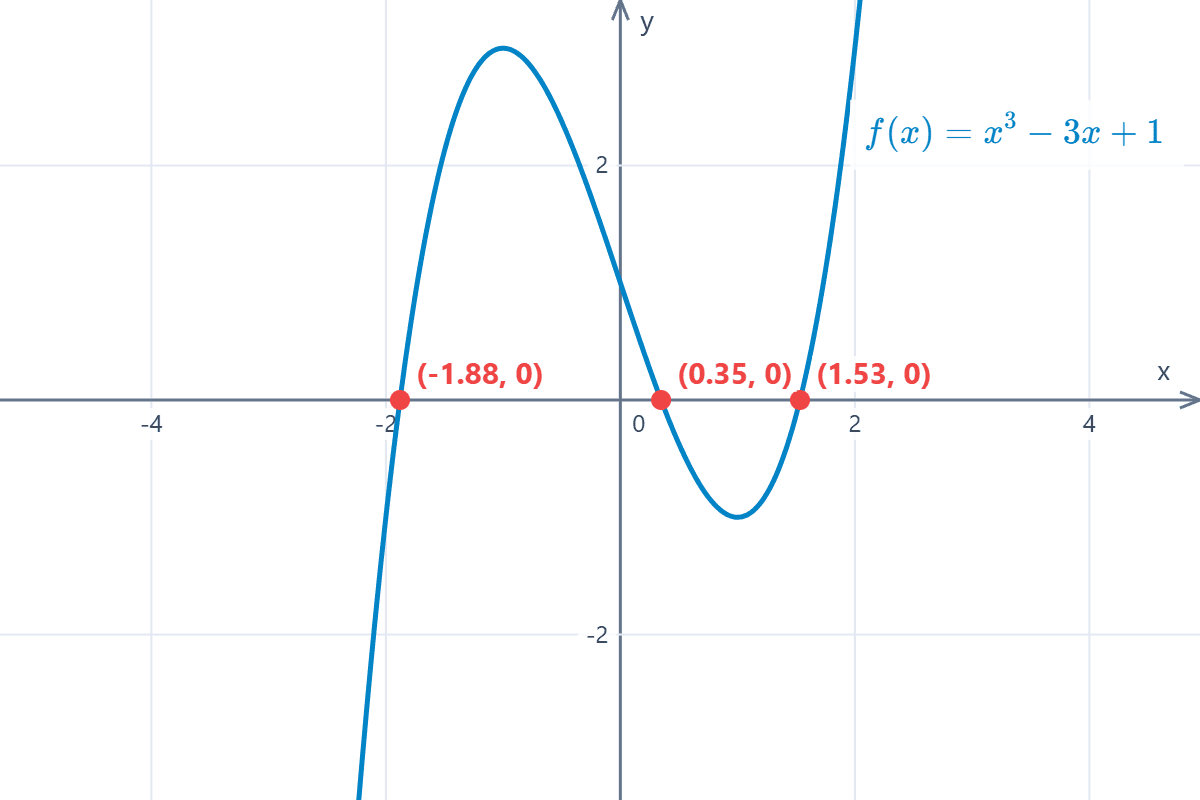
Determine the values of the unknown for the cubic equation \( x^3-3x+1=0. \)
Result
The solutions to the cubic equation are:
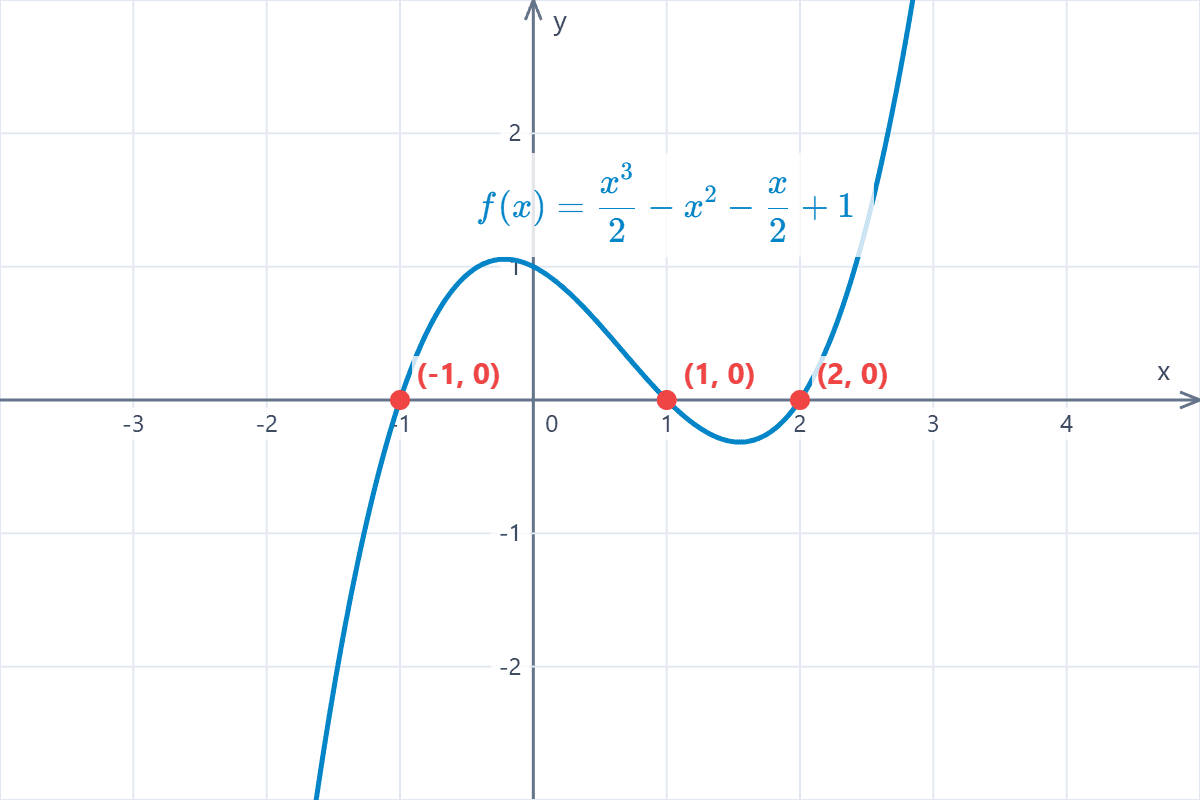
Find the algebraic solutions to the 3rd-degree equation with fractional coefficients \( \dfrac{1}{2}x^3-x^2-\dfrac{1}{2}x+1=0. \)
Result
The solutions to the cubic equation are:
Factored form of the equation:
Step-by-step resolution
1. Identify the equation.
The equation to solve is:
2. Group the terms.
We conveniently group the terms of the equation into pairs to factor out a common factor from each group:
3. Factor out the common factor from each group.
We factor out the corresponding common factor within each of the parentheses:
4. Factor out the binomial.
Since a binomial is repeated in both terms, we factor it out as a new common factor to completely factor the expression:
5. Solve for the roots.
We set each factor to zero and solve to find all the roots of the equation:
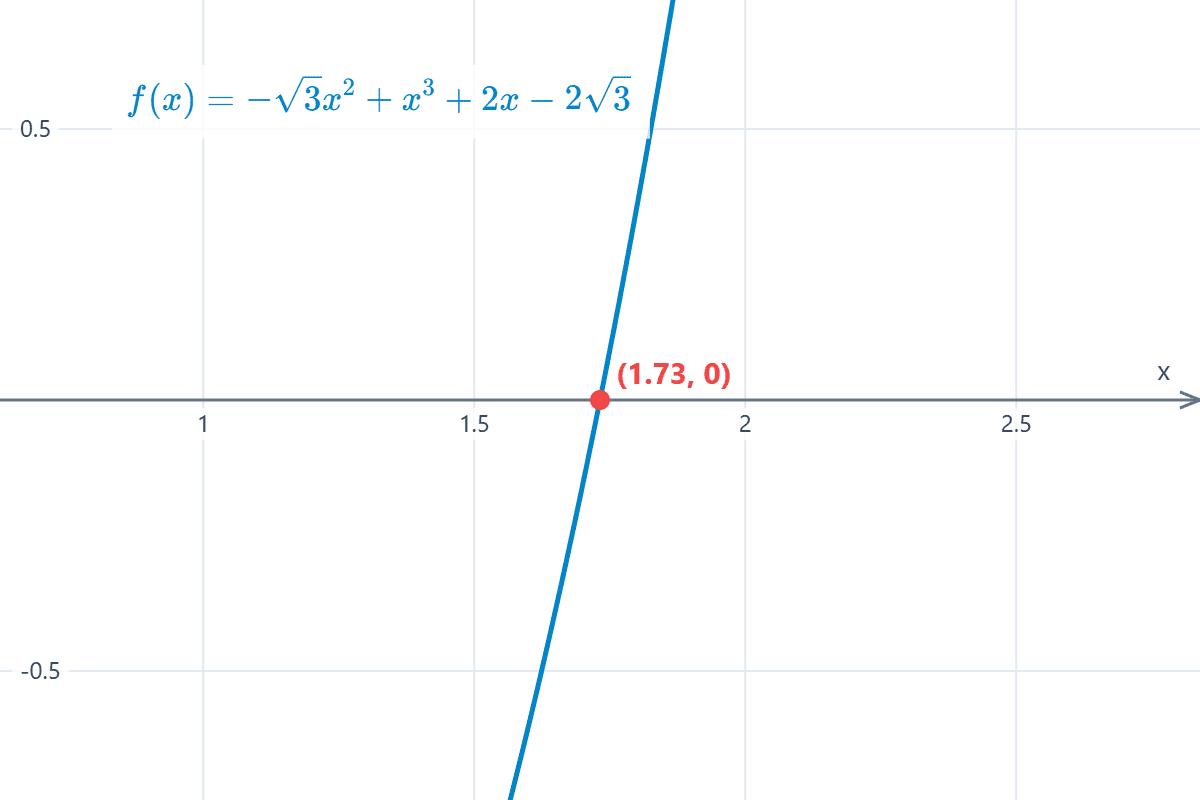
Calculate the real and imaginary solutions to the cubic equation \( x^3-\sqrt{3}x^2+2x-2\sqrt{3}=0. \)
Result
The solutions to the cubic equation are:
Step-by-step resolution
1. Identify the equation.
The equation to solve is:
2. Group the terms.
We conveniently group the terms of the equation into pairs to factor out a common factor from each group:
3. Factor out the common factor from each group.
We factor out the corresponding common factor within each of the parentheses:
4. Factor out the binomial.
Since a binomial is repeated in both terms, we factor it out as a new common factor to completely factor the expression:
5. Solve for the roots.
We set each factor to zero and solve to find all the roots of the equation:
Related Tools
