
Vector Direction Calculator
Calculate the direction angle(s) of a 2D or 3D vector from its components or endpoints, with step-by-step solutions and a graph.
Quick Examples
How to Use the Calculator
This online vector direction calculator is an analytical tool designed to determine the exact angular orientation of a vector in a plane or in space. The system processes your geometric data and generates a direct answer along with a step-by-step mathematical solution, supporting configurations for both the two-dimensional plane (2D) and three-dimensional space (3D).
How to enter your data:
Use the options menu to tell the system whether you will be working in 2D or 3D, and then select the input method that fits your problem:
- By its Cartesian components: enter the vector directly from the origin. For a 2D vector, use the (x, y) fields, and for a three-dimensional vector, fill in all three dimensions (x, y, z).
- By its endpoints: if your problem starts with two coordinates, select this mode and enter the initial point and the terminal point. The algebraic solver will subtract the coordinates to obtain the vector components before calculating its direction.
All fields accept integers, decimals, fractions, and roots. The step-by-step process works as follows:
- In 2D mode: the system will use the arctangent function via the formula θ = arctan(y/x). Additionally, the algorithm will evaluate the signs of each component to identify which quadrant the vector is in, adding or subtracting the necessary degrees to give you the actual angle measured from the positive x-axis.
- In 3D mode: the procedure is based on the direction cosines. First, the tool will calculate the vector magnitude; then, it will divide each component by this magnitude and apply the arccosine function to find the three direction angles: α (alpha) with respect to the x-axis, β (beta) with respect to the y-axis, and γ (gamma) with respect to the z-axis.
Solved Examples
The following are examples of problems solved by the calculator.
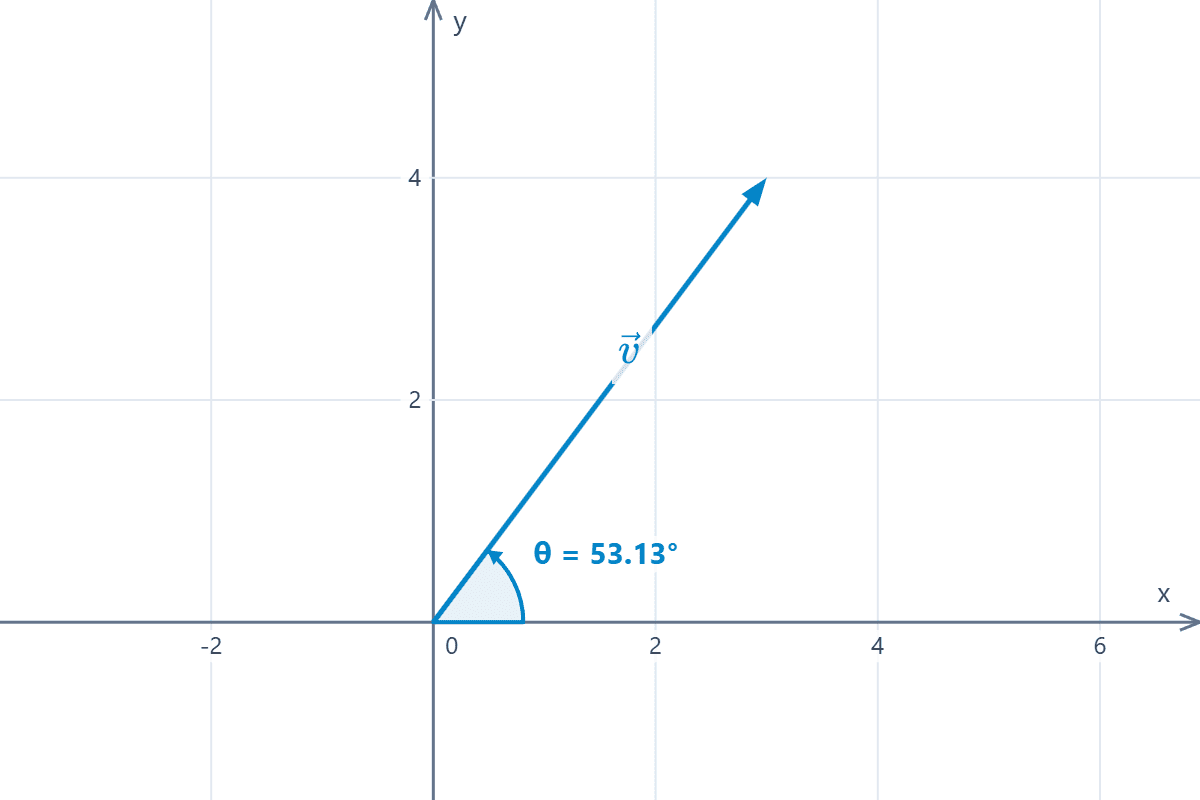
Calculate the direction of the vector \(\vec{v}=\langle3,4\rangle.\)
Result
The direction of the vector \( \vec{v} \) is:
Angle in radians: \( \theta \approx 0.9273 \text{ rad} \)
Location: First quadrant
Vector magnitude: \( |\vec{v}| = 5 \)
Polar form: \( \vec{v} = \langle 5, \; 53.13^\circ \rangle \)
Step-by-step solution
1. Identify the vector components.
The vector we are working with is:
We extract the values of its components:
2. Calculate the vector direction.
We use the arctangent function with the ratio between the vertical and horizontal components:
Since both components are positive, the vector lies in the first quadrant, so the obtained angle is the final direction with respect to the positive x-axis.
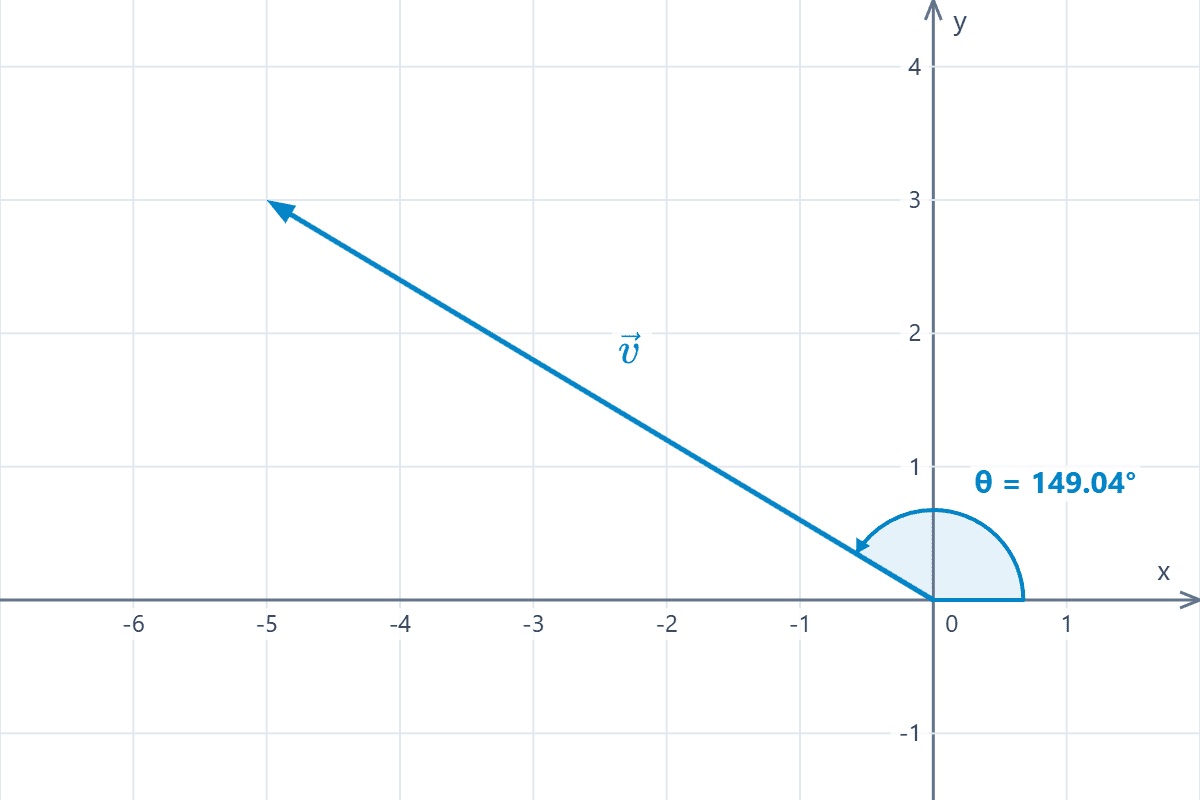
Find the direction angle of the vector \(\vec{v}=\langle-5,3\rangle.\)
Result
The direction of the vector \( \vec{v} \) is:
Angle in radians: \( \theta \approx 2.6012 \text{ rad} \)
Location: Second quadrant
Vector magnitude: \( |\vec{v}| = \sqrt{34} \approx 5.83 \)
Polar form: \( \vec{v} = \langle \sqrt{34}, \; 149.04^\circ \rangle \)
Step-by-step solution
1. Identify the vector components.
The vector we are working with is:
We extract the values of its components:
2. Calculate the vector direction.
We use the arctangent function with the ratio between the vertical and horizontal components:
The arctangent function yields a reference angle. However, by analyzing the signs of the components, we notice that the vector is located in the second quadrant. To find the actual direction with respect to the positive x-axis, we adjust the result by adding 180°:
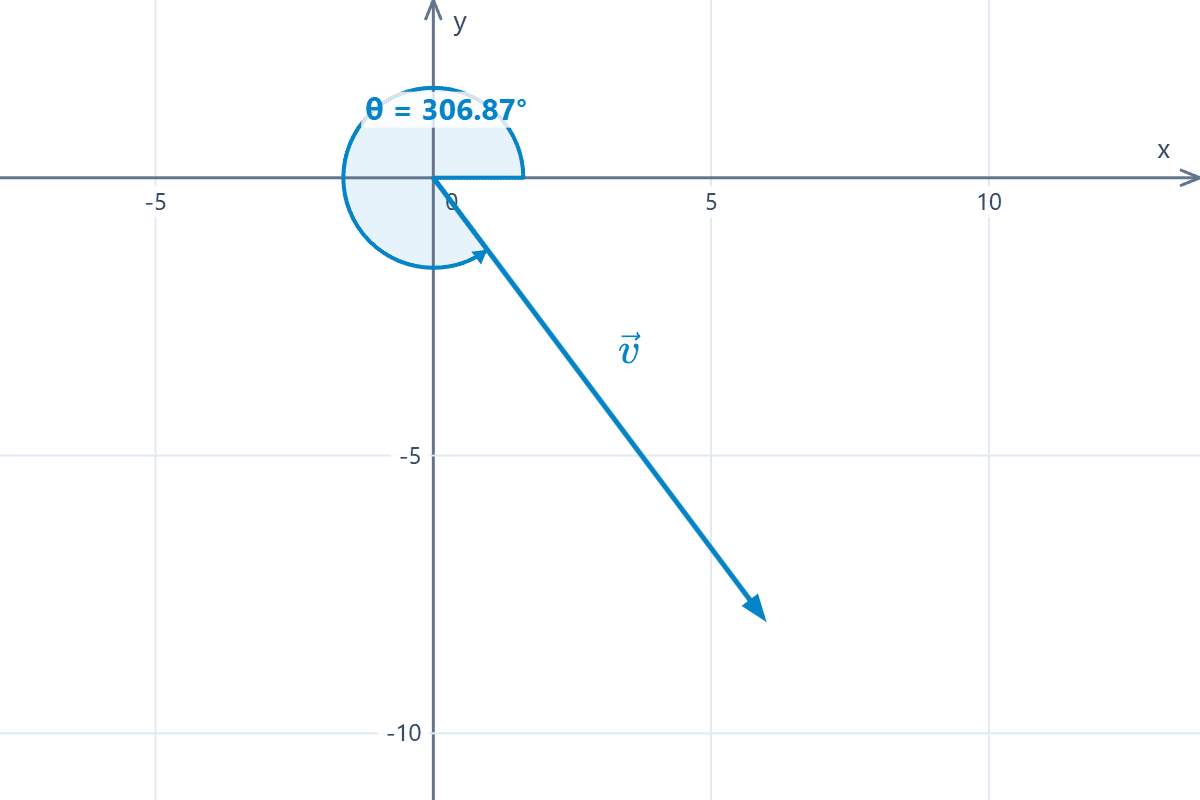
Find the direction angle of the vector defined by the points A(-2, 5) and B(4, -3).
Result
The direction of the vector \( \vec{v} \) is:
Angle in radians: \( \theta \approx 5.3559 \text{ rad} \)
Location: Fourth quadrant
Vector magnitude: \( |\vec{v}| = 10 \)
Polar form: \( \vec{v} = \langle 10, \; 306.87^\circ \rangle \)
Step-by-step solution
1. Calculate the vector components.
The input data corresponds to a vector defined by an initial point and a terminal point. We extract the coordinates of each point:
We obtain the vector components by subtracting the coordinates of the initial point from the corresponding coordinates of the terminal point:
Therefore, the resulting vector is:
2. Calculate the vector direction.
We use the arctangent function with the ratio between the vertical and horizontal components:
The arctangent function yields a reference angle. However, by analyzing the signs of the components, we notice that the vector is located in the fourth quadrant. To find the actual direction with respect to the positive x-axis, we adjust the result by adding 360°:
Calculate the direction of the three-dimensional vector \(\vec{v}=\langle2, -3, 6\rangle.\)
Result
The direction angles of the vector \( \vec{v} \) are:
The value α is the angle with respect to the x-axis, β with respect to the y-axis, and γ is the angle with respect to the z-axis.
Vector magnitude: \( |\vec{v}| = 7 \)
Step-by-step solution
1. Identify the vector components.
The vector we are working with is:
We extract the values of its components:
2. Calculate the vector magnitude.
We use the 3D Pythagorean theorem to find the vector's magnitude or length, which is required to find the direction cosines:
3. Calculate the direction angles.
To determine the direction in three-dimensional space, we calculate the angles the vector makes with each of the coordinate axes (x, y, z) by applying the inverse cosine function to its direction cosines:
Related Tools
