
Angle Between Two Vectors Calculator
Enter the vector components to calculate the angle between them (in degrees and radians) and see the step-by-step solution with a graph.
Quick Examples
How to Use the Calculator
This online angle between two vectors calculator is a geometric and algebraic tool that allows you to find the angle formed when positioning two vectors from the same origin. Designed to work in the Cartesian plane (R2) and in space (R3), the system will provide the direct value, the complete mathematical step-by-step solution, and a graphical representation of your problem.
How to enter your data:
- Select the dimension: Use the main menu to define whether your problem occurs in two dimensions (x, y axes) or three dimensions (x, y, z axes).
- Enter the components: Fill in the text fields with the rectangular components of each vector. The tool supports integers, decimals, and exact fractions.
Results:
When processing the values, the algorithm will structure the answer into three sections to make the analytical calculation easier to understand:
- Main answer: In a highlighted box, you will get the direct solution to your problem. The calculator will display the angle measure expressed simultaneously in degrees and radians, so you can use the format required by your assignment.
- Step-by-step solution: Below the answer, the entire procedure needed to find the angle will be displayed. First, the engine will calculate the dot product (or scalar product) between both vectors. Then, the individual magnitudes of each vector will be calculated. Finally, you will see how the classic trigonometric formula cos(θ) = (a · b) / (|a| · |b|) is used via the arccosine to solve for the angle.
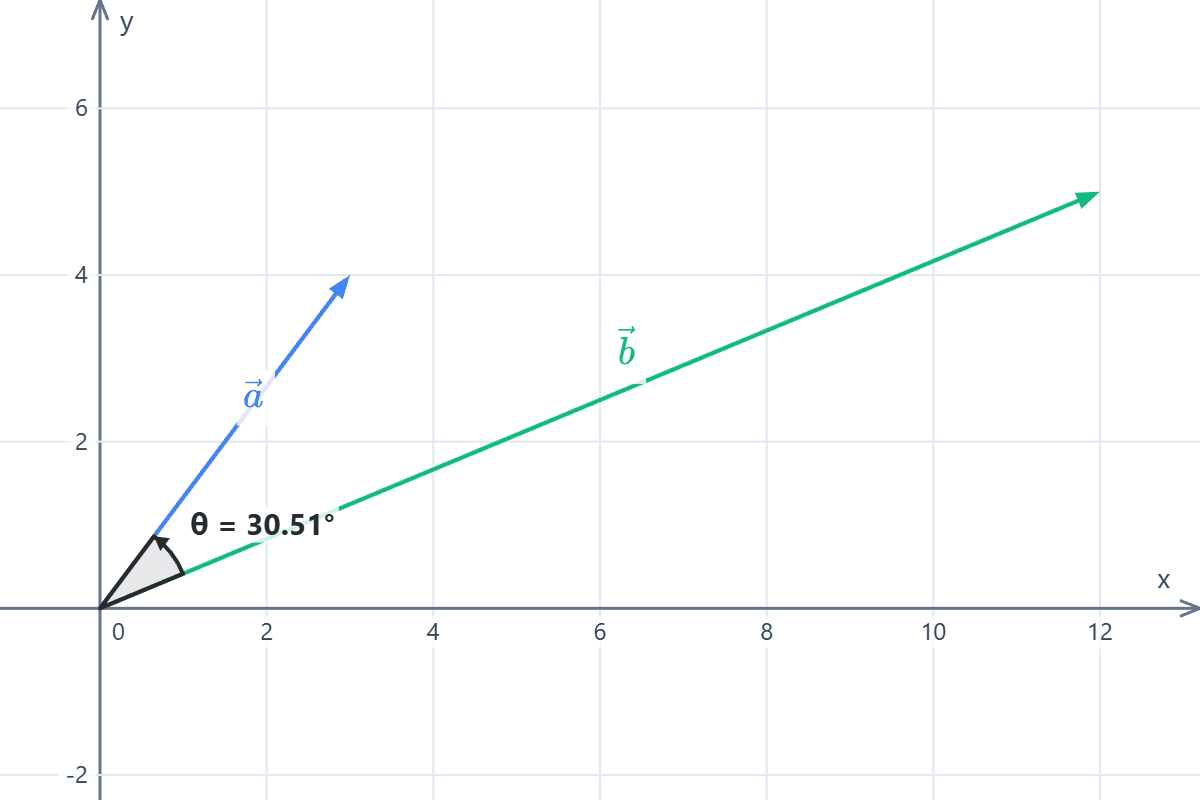
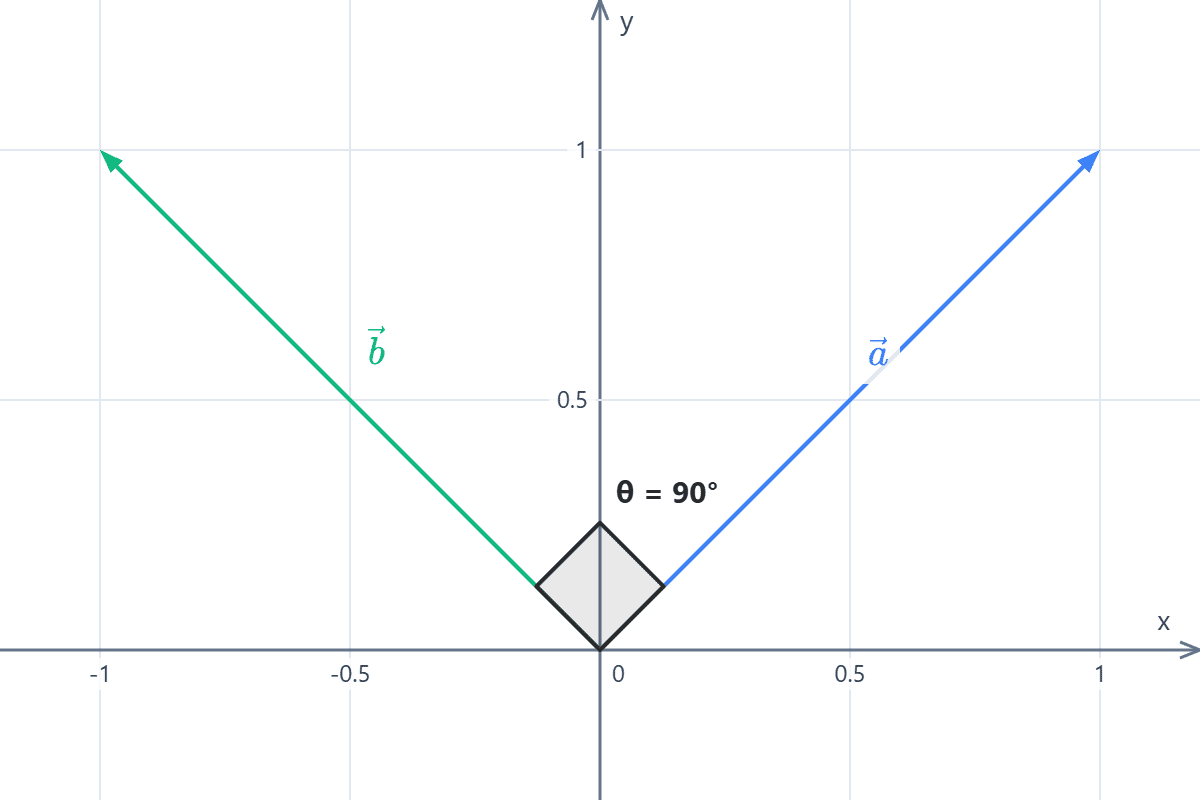
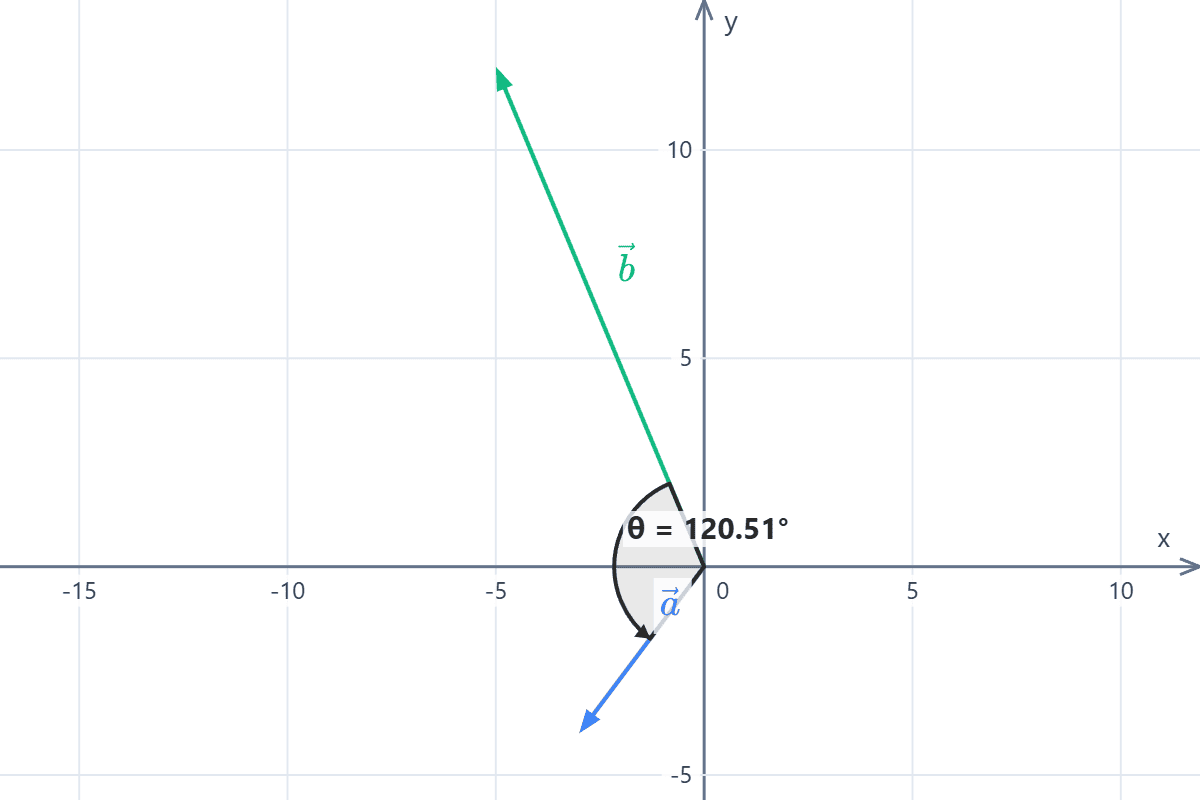
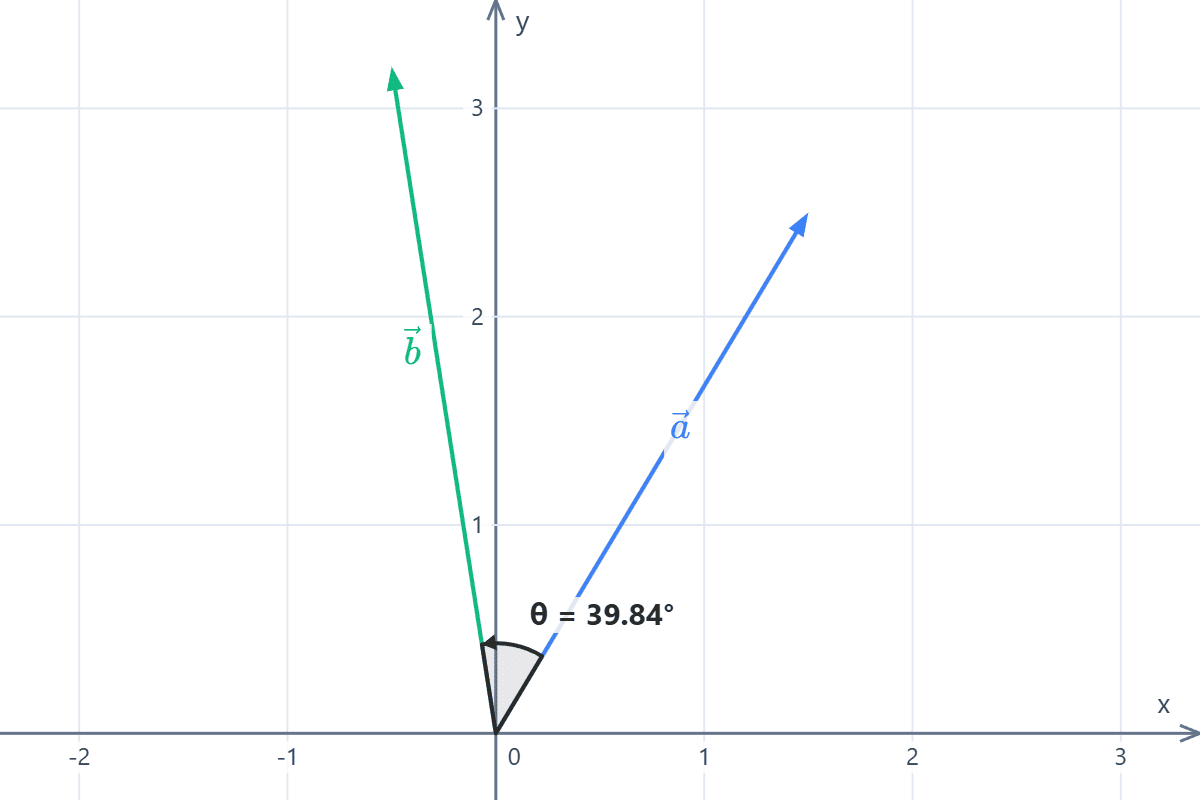
- Interactive graph: For problems set in R2, the bottom section will include an interactive Cartesian plane. In this representation, you can see both vectors plotted from the coordinate origin (0,0) and a visual arc highlighting the angle between them, allowing you to verify the geometric consistency of the results.
Solved Examples
The following are examples of problems solved by the calculator.
Find the angle between the vectors \(\vec{a}=\langle 3, 4\rangle\) and \(\vec{b}=\langle 12, 5\rangle.\)
Result
The angle between the given vectors is:
Step-by-step solution
1. Identify the vectors.
The vectors to work with are:
2. Calculate the dot product.
We determine the dot product between the vectors (to see the detailed step-by-step, check out the dot product calculator):
3. Calculate the magnitude of each vector.
We obtain the magnitude of both vectors (to see the step-by-step, check out the vector magnitude calculator):
4. Calculate the angle between the vectors.
We can obtain the angle between two vectors using the following formula:
We substitute the previously calculated values:
Get the angle between the two vectors \(\vec{a}=\langle 1, 1 \rangle\) and \(\vec{b}=\langle -1, 1\rangle.\)
Result
The angle between the given vectors is:
Step-by-step solution
1. Identify the vectors.
The vectors to work with are:
2. Calculate the dot product.
We determine the dot product between the vectors:
3. Calculate the magnitude of each vector.
We obtain the magnitude of both vectors:
4. Calculate the angle between the vectors.
We can obtain the angle between two vectors using the following formula:
We substitute the previously calculated values:
Find the angle formed between the vectors \(\langle -3, -4\rangle\) and \(\langle -5, 12\rangle.\)
Result
The angle between the given vectors is:
Step-by-step solution
1. Identify the vectors.
The vectors to work with are:
2. Calculate the dot product.
We determine the dot product between the vectors:
3. Calculate the magnitude of each vector.
We obtain the magnitude of both vectors:
4. Calculate the angle between the vectors.
We can obtain the angle between two vectors using the following formula:
We substitute the previously calculated values:
Determine the angle between the vectors with decimal components \(\vec{a}=\langle 1.5, 2.5\rangle\) and \(\vec{b}=\langle-0.5, 3.2\rangle.\)
Result
The angle between the given vectors is:
Step-by-step solution
1. Identify the vectors.
The vectors to work with are:
2. Calculate the dot product.
We determine the dot product between the vectors:
3. Calculate the magnitude of each vector.
We obtain the magnitude of both vectors:
4. Calculate the angle between the vectors.
We can obtain the angle between two vectors using the following formula:
We substitute the previously calculated values:
Calculate the angle between the vectors in three dimensions \(\langle 1, 2, 3\rangle\) and \(\langle 4, 5, 6\rangle.\)
Result
The angle between the given vectors is:
Step-by-step solution
1. Identify the vectors.
The vectors to work with are:
2. Calculate the dot product.
We determine the dot product between the vectors (to see the detailed step-by-step, check out the dot product calculator):
3. Calculate the magnitude of each vector.
We obtain the magnitude of both vectors (to see the step-by-step, check out the vector magnitude calculator):
4. Calculate the angle between the vectors.
We can obtain the angle between two vectors using the following formula:
We substitute the previously calculated values:
Related Tools
