
Ellipse Foci Calculator
Enter the ellipse equation (general or standard) to get the coordinates of its foci, the step-by-step procedure, and its graphical representation.
Quick Examples
How to Use the Calculator
This online ellipse foci calculator is an analytical tool designed to find exactly where the focal coordinates are located based on the equation of the curve. In addition to the result, the system generates the step-by-step analytical solution and graphs the figure on the Cartesian plane.
How to enter your equation:
- Format freedom: use the main math field to input your equation. The algebraic engine is flexible and does not require a specific order. You can enter the standard form, the general form equated to zero (e.g., 9x2 + 4y2 - 18x + 16y - 11 = 0), or completely unorganized and unsimplified expressions.
- Supported numerical formats: the calculator accepts integer coefficients, decimal numbers, exact fractions, and irrational roots. These values are preserved symbolically throughout the procedure to guarantee that there are no rounding errors.
Once the information is processed, the tool will generate a detailed report following this logical order:
- Parameter identification: if you provide a general equation, the algorithm will complete the square automatically, showing you the conversion to its standard form. From there, the finder will extract the coordinates of the center C(h, k), the values of a2 and b2, and deduce the orientation of the ellipse (horizontal or vertical).
- Calculation of the focal distance (c): using the fundamental geometric relationship c2 = a2 - b2, the calculator will solve for the exact distance from the center to the foci. If the root is irrational, both the exact value and its decimal approximation will be provided.
- Coordinates of the foci: depending on the orientation of the conic, the program will analytically add and subtract the distance c from the x-coordinate (if it is horizontal) or from the y-coordinate (if it is vertical) of the center, delivering the exact points F1 and F2.
Step-by-Step Examples
The following are examples of problems solved by the calculator.
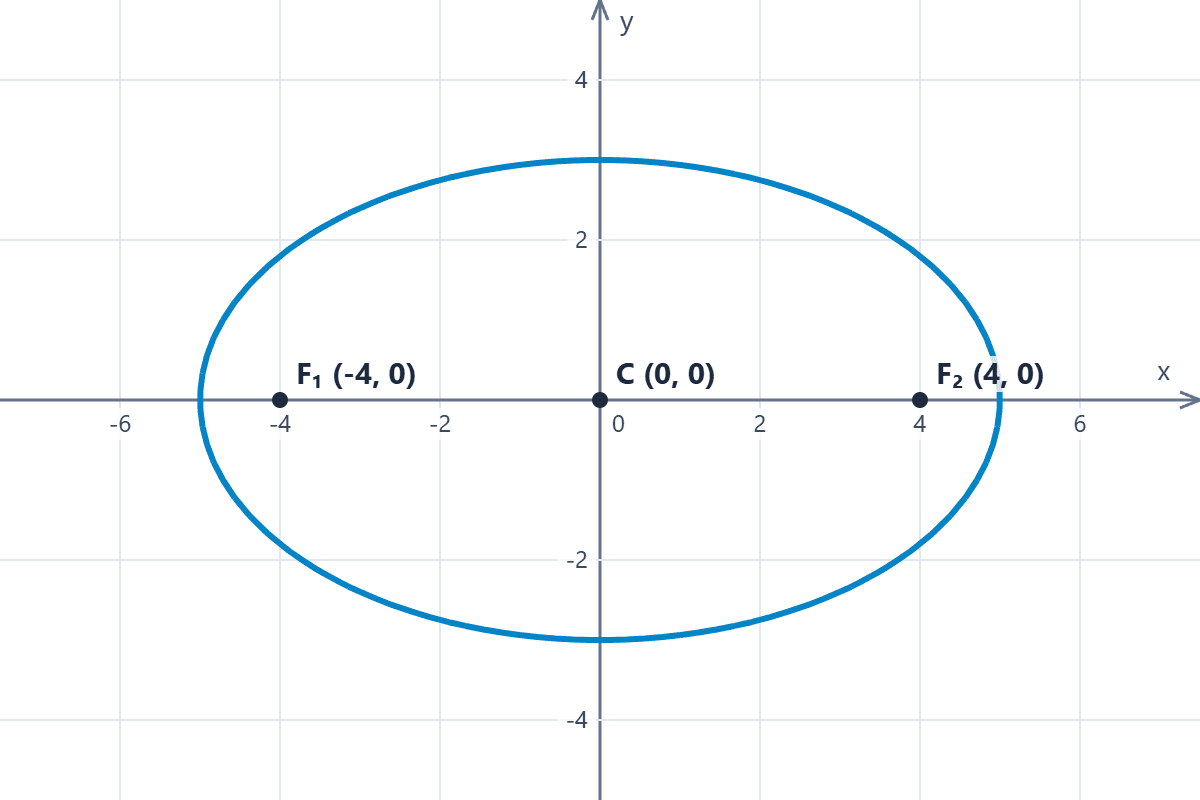
Find the foci of the ellipse in standard form \( \dfrac{x^2}{25}+\dfrac{y^2}{9}=1. \)
Result
The foci of the given ellipse are:
Step-by-step solution
1. Identify the equation and its parameters
The equation to work with is:
We extract the coordinates of the center C(h, k) and the denominators. The larger denominator corresponds to a2, and the variable of the term in which it appears indicates the geometric orientation of the ellipse. Therefore:
2. Calculate the focal distance (c)
We use the fundamental relationship of the ellipse to find the value of the focal distance:
3. Determine the coordinates of the foci
Since the ellipse is horizontal, its foci are obtained by adding and subtracting the value of c from the x-coordinate of the center (h).
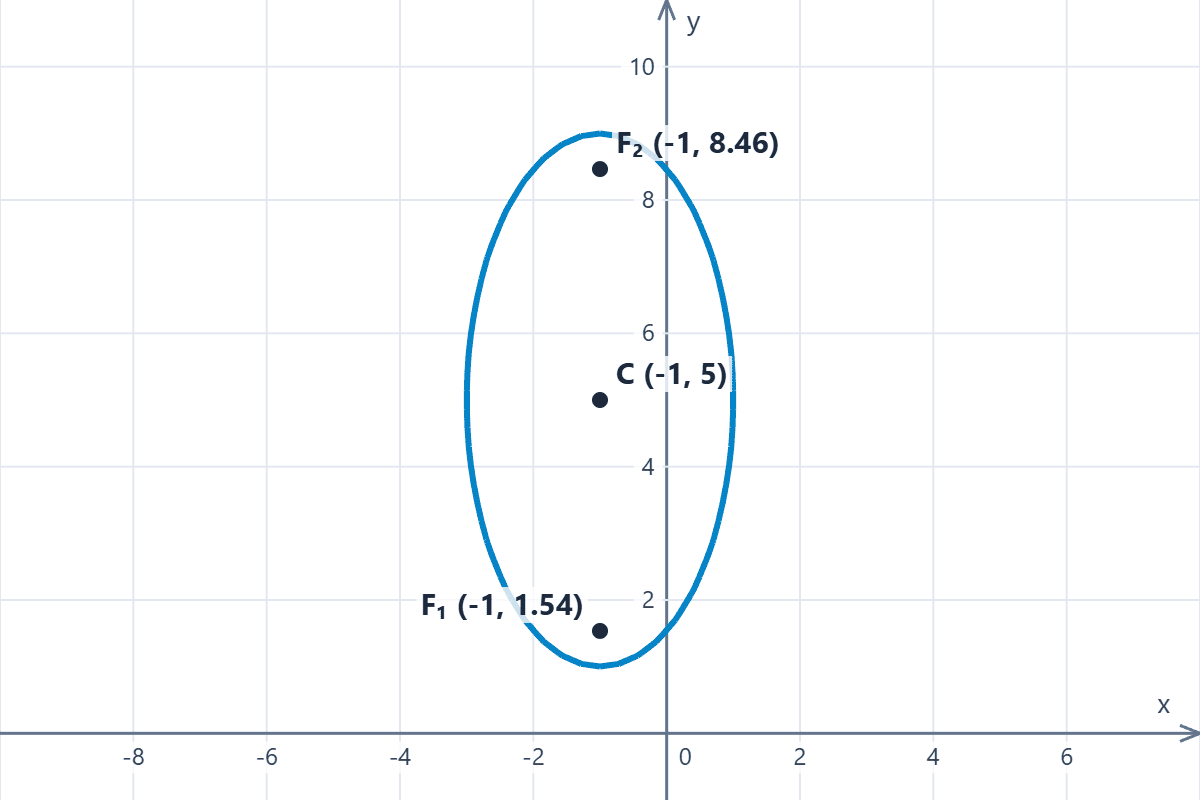
Find the coordinates of the foci of the ellipse \( \dfrac{(x+1)^2}{4}+\dfrac{(y-5)^2}{16}=1. \)
Result
The foci of the given ellipse are:
Step-by-step solution
1. Identify the equation and its parameters
The equation to work with is:
We extract the coordinates of the center C(h, k) and the denominators. The larger denominator corresponds to a2, and the variable of the term in which it appears indicates the geometric orientation of the ellipse. Therefore:
2. Calculate the focal distance (c)
We use the fundamental relationship of the ellipse to find the value of the focal distance:
3. Determine the coordinates of the foci
Since the ellipse is vertical, its foci are obtained by adding and subtracting the value of c from the y-coordinate of the center (k).
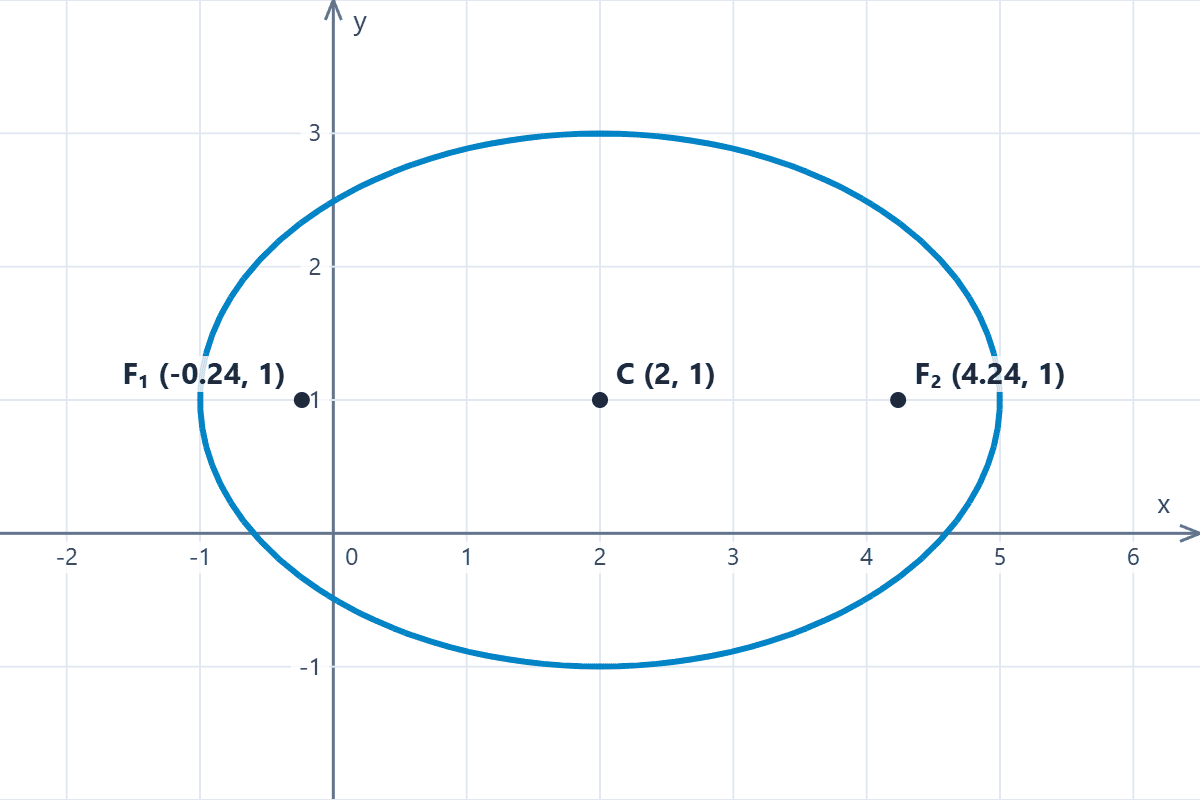
Find the location of the foci of the ellipse in general form \( 4x^2+9y^2-16x-18y-11=0. \)
Result
The foci of the given ellipse are:
Step-by-step solution
1. Identify the equation and its parameters
The equation to work with is:
To extract the parameters of the ellipse, we convert the equation to its standard form by completing the square if necessary:
We extract the coordinates of the center C(h, k) and the denominators. The larger denominator corresponds to a2, and the variable of the term in which it appears indicates the geometric orientation of the ellipse. Therefore:
2. Calculate the focal distance (c)
We use the fundamental relationship of the ellipse to find the value of the focal distance:
3. Determine the coordinates of the foci
Since the ellipse is horizontal, its foci are obtained by adding and subtracting the value of c from the x-coordinate of the center (h).
Related Tools
