
Vertex Form Calculator
Enter the equation of a parabola in any form to get its vertex form, the coordinates of its vertex, and see the step-by-step solution along with its graph.
Quick Examples
How to Use the Calculator
This online vertex form solver is a mathematical tool designed to process and transform any quadratic expression. The solver analyzes your input, returns the main geometric properties, and generates the step-by-step solution along with its graphical representation.
When we talk about vertex form (also known as standard form in some contexts, though typically vertex form) we refer to the structure y = a(x - h)2 + k for vertical parabolas (like quadratic functions), or x = a(y - k)2 + h for horizontal parabolas. In this format, the (h, k) values directly reveal the coordinates of the curve's vertex.
How to enter your equation:
- Format freedom: Type the equation into the available field. You can enter it in standard form (for example, y = 2x2 - 12x + 13), factored form, implicit form (set equal to zero), or completely unsimplified.
- Function and horizontal notation: The program automatically recognizes function notation (such as f(x), g(x)) and treats it the same way. If you are working with parabolas that open to the right or left, simply enter your equation in terms of x (for example, x = y2 + 6y - 7).
- Numeric support: The algorithm supports integer coefficients, decimals, exact fractions, and irrational roots. These values are kept symbolically throughout the calculation to prevent premature rounding errors.
Once the expression is processed, the solver will generate a detailed algebraic report with the vertex form, the standard form, and the vertex coordinates, in addition to the step-by-step procedure consisting of:
- Normalization and identification: If the equation is not in standard form (y = ax2 + bx + c), the system will perform the necessary operations to simplify it and extract the coefficients a, b, and c.
- Analytical calculation of the vertex: Using the extracted coefficients, the tool will apply the corresponding formulas to find the vertex coordinates step by step.
- Vertex form construction: Finally, the solver will assemble the equation by substituting the leading coefficient and the vertex coordinates into the final structure.
Solved Exercises
The following are examples of problems solved by the calculator.
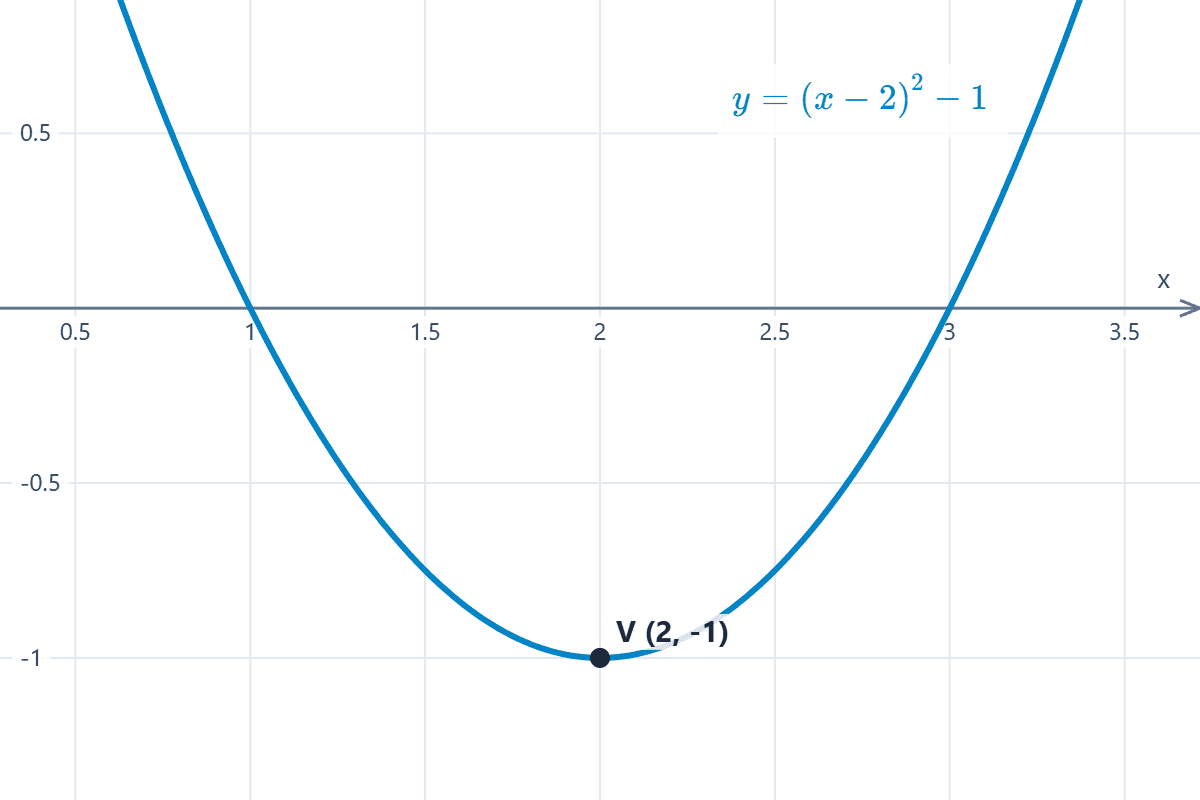
Calculate the vertex form of the parabola \(y = x^2 - 4x + 3.\)
Result
Vertex form
Standard form
Vertex coordinates
Step-by-step solution
1. Identify the equation and its coefficients.
The equation to work with is:
We extract its coefficients by comparing it with the form y = ax2 + bx + c:
2. Calculate the vertex coordinates.
We use the coefficients to find the vertex V(h, k). First, we calculate the h-coordinate:
Next, we evaluate the function at h to obtain the k-coordinate:
Therefore, the vertex is located at:
3. Construct the vertex form equation.
We substitute the obtained values for the vertex and the coefficient a into the vertex form structure:
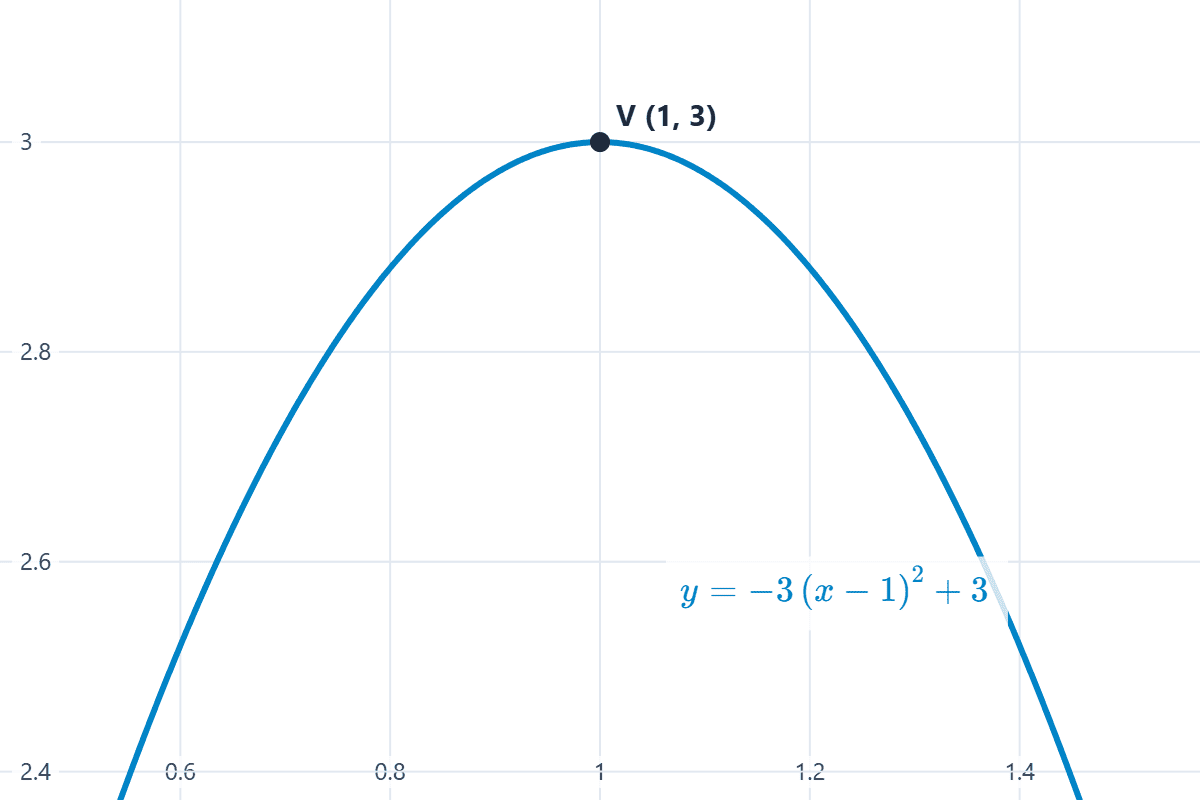
Find the vertex form equation of the parabola \(y = -3x^2 + 6x.\)
Result
Equation in vertex form
Equation in standard form
Vertex coordinates
Step-by-step solution
1. Identify the equation and its coefficients.
The equation to work with is:
We extract its coefficients by comparing it with the form y = ax2 + bx + c:
2. Calculate the vertex coordinates.
We use the coefficients to find the vertex V(h, k). First, we calculate the h-coordinate:
Next, we evaluate the function at h to obtain the k-coordinate:
Therefore, the vertex is located at:
3. Construct the vertex form equation.
We substitute the obtained values for the vertex and the coefficient a into the vertex form structure:
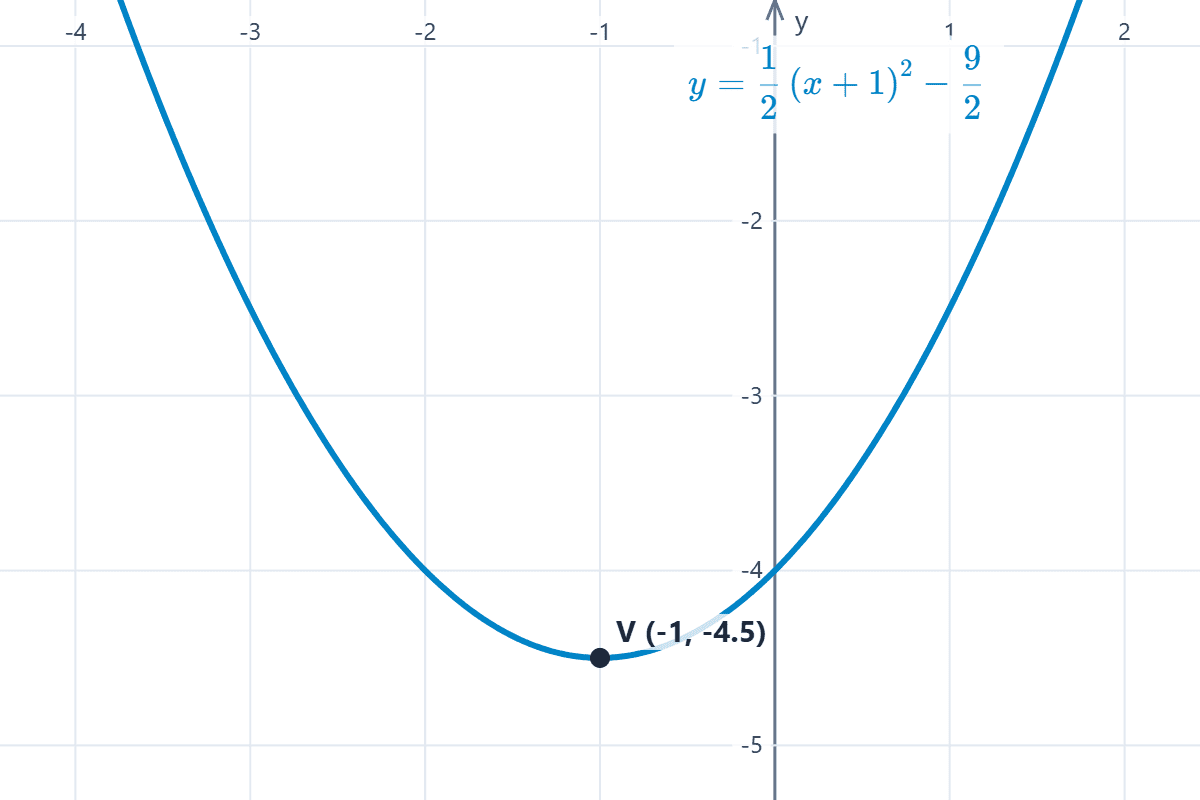
Determine the vertex form equation of the parabola \(y = \dfrac{1}{2}(x + 4)(x - 2).\)
Result
Equation in vertex form
Equation in standard form
Vertex coordinates
Step-by-step solution
1. Normalize the equation and extract its coefficients.
The equation to work with is:
We convert the equation to its standard form by expanding the corresponding algebraic operations:
We extract its coefficients by comparing it with the form y = ax2 + bx + c:
2. Calculate the vertex coordinates.
We use the coefficients to find the vertex V(h, k). First, we calculate the h-coordinate:
Next, we evaluate the function at h to obtain the k-coordinate:
Therefore, the vertex is located at:
3. Construct the vertex form equation.
We substitute the obtained values for the vertex and the coefficient a into the vertex form structure:
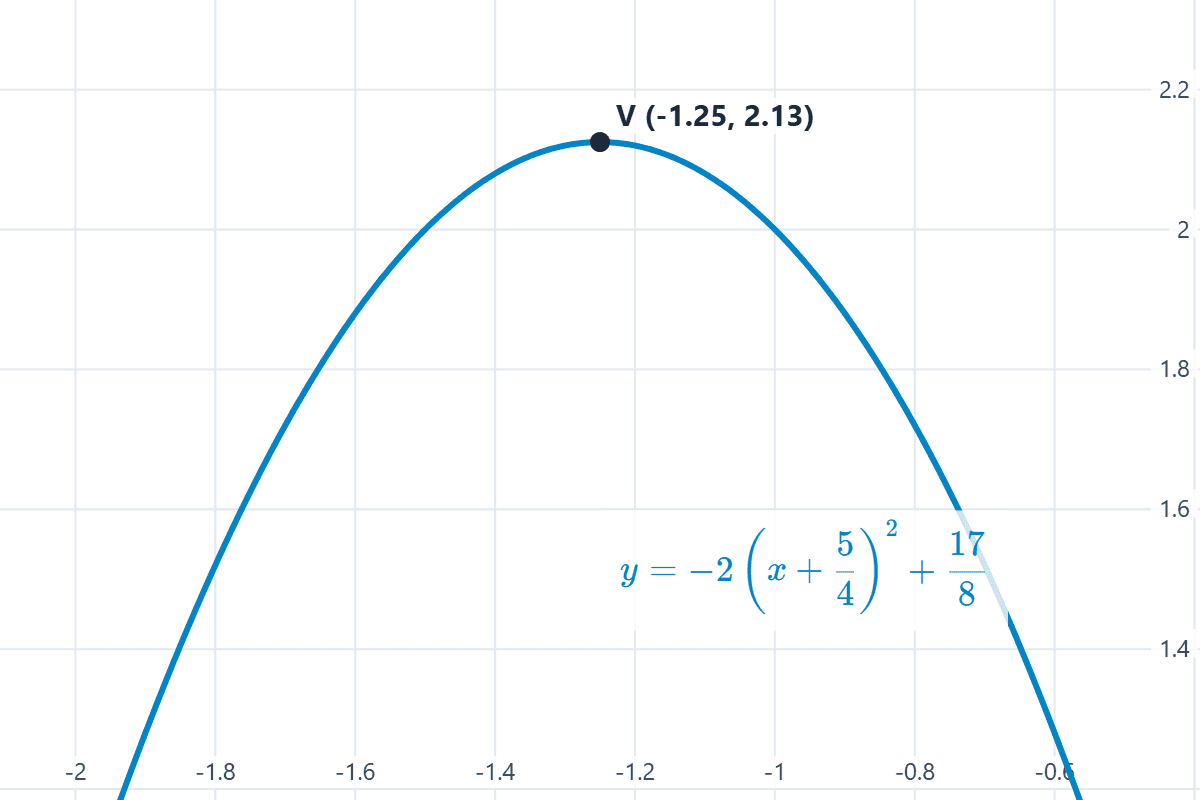
Find the vertex form of the quadratic function \(f(x) = -2x^2 -5x - 1\)
Result
Equation in vertex form
Equation in standard form
Vertex coordinates
Step-by-step solution
1. Identify the equation and its coefficients.
The equation to work with is:
We extract its coefficients by comparing it with the form y = ax2 + bx + c:
2. Calculate the vertex coordinates.
We use the coefficients to find the vertex V(h, k). First, we calculate the h-coordinate:
Next, we evaluate the function at h to obtain the k-coordinate:
Therefore, the vertex is located at:
3. Construct the vertex form equation.
We substitute the obtained values for the vertex and the coefficient a into the vertex form structure:
Related Tools
