
Orthogonal Vectors Calculator
Enter the vector components to determine if they are orthogonal (perpendicular) or not by calculating their dot product.
Quick Examples
Step-by-Step Examples
The following are examples of problems solved by the calculator.
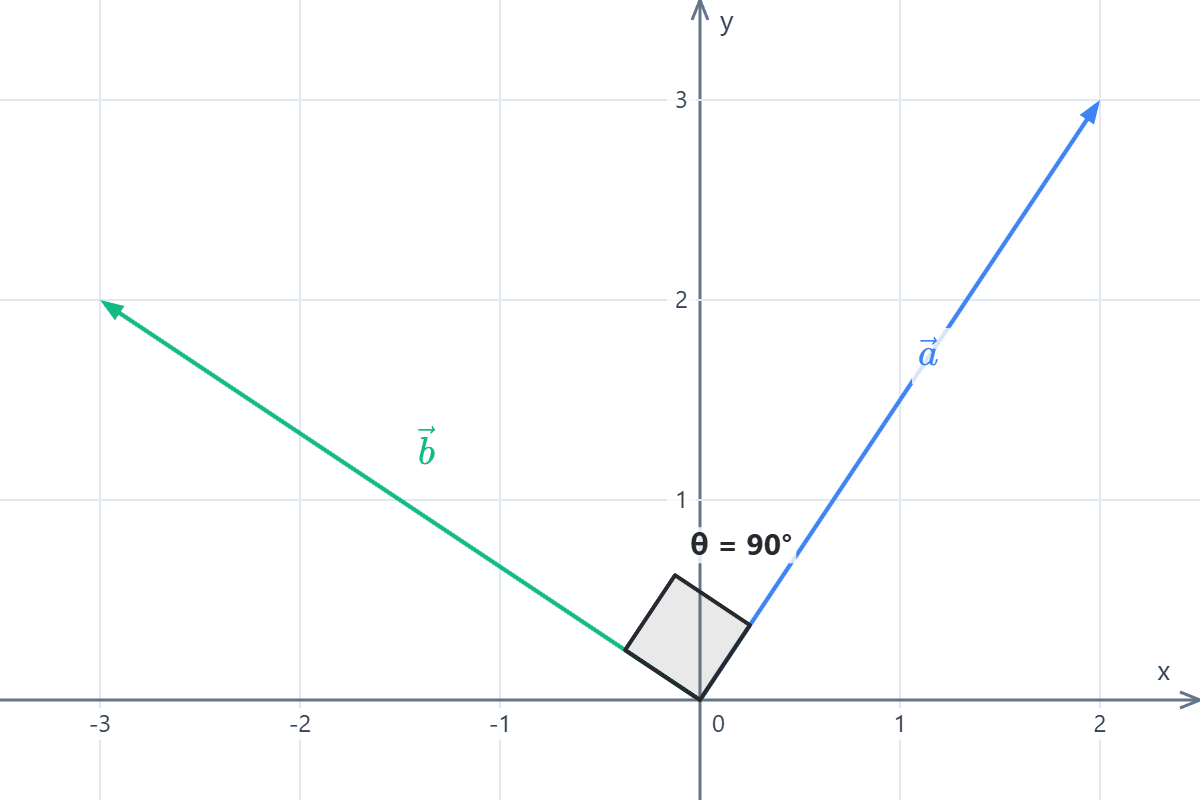
Determine whether the vectors ⟨2, 3⟩ and ⟨-3, 2⟩ are orthogonal or not.
Result
The given vectors ARE orthogonal.
To confirm this, we calculate their dot product:
Since the dot product is equal to zero, the vectors are perpendicular, meaning the angle between them is 90°.
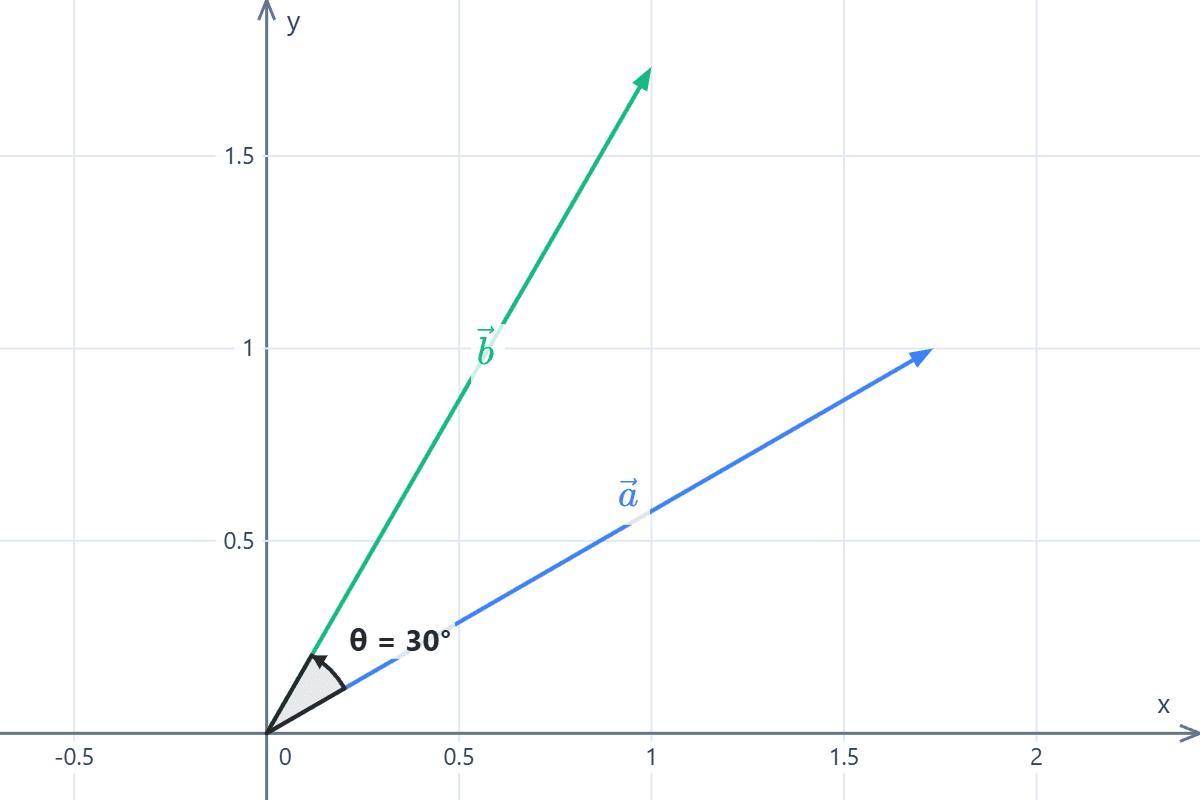
Find out if the vectors \(\langle \sqrt{3}, 1\rangle\) and \(\langle 1, \sqrt{3}\rangle\) are perpendicular to each other.
Result
The given vectors are NOT orthogonal.
To confirm this, we calculate their dot product:
Since the dot product is non-zero, the vectors are not perpendicular (the angle between them is not 90°).
In particular, the angle between them is:
Determine whether the three-dimensional vectors ⟨2, -1, 3⟩ and ⟨1, 5, 1⟩ are orthogonal or not.
Result
The given vectors ARE orthogonal.
To confirm this, we calculate their dot product:
Since the dot product is equal to zero, the vectors are perpendicular, meaning the angle between them is 90°.
Related Tools
