
Conic Section Calculator
Enter the general quadratic equation to identify the type of conic, get its graph, and see the step-by-step solution.
Quick Examples
How to Use the Calculator
This online conic section solver is a mathematical tool designed to process any general second-degree equation in two variables. The system not only classifies the geometric figure, but it also delivers the standard equation, details the complete analytical breakdown, and graphs the result. Furthermore, the algebraic engine is equipped to process equations with an xy cross-term, meaning it supports rotated conics where B ≠ 0.
Using this finder is very straightforward and is based on a single input mode:
- Entering the equation: Type the equation into the input box. You do not need to arrange it, simplify it, or set it equal to zero beforehand; you can enter the general expression Ax2 + Bxy + Cy2 + Dx + Ey + F = 0 or any unarranged implicit form.
- Main results box: Upon processing the information, the solver will display an initial panel with the direct analysis of the equation. Here, you will be shown the exact classification of the curve (circle, ellipse, parabola, hyperbola, or their degenerate equivalents) accompanied by its respective standard equation.
- Step-by-step resolution: The algorithm begins by extracting the coefficients to evaluate the discriminant (B2 - 4AC) and determine the main nature of the conic section. Next, it calculates the determinant of the 3x3 matrix associated with the equation to discover whether it is an ordinary curve or a degenerate case (a point, intersecting lines, or parallel lines). As a final step, if the discriminant indicates an ellipse type, the solver uses the trace invariant to mathematically verify whether the figure represents a real ellipse or if it corresponds to an empty set (imaginary ellipse).
- Interactive graph: At the bottom, you will find an interactive Cartesian plane. You will be able to visualize the plotting of the final conic and explore the graph by zooming in or out of the canvas.
Step-by-Step Examples
See some examples of problems solved directly with the tool.
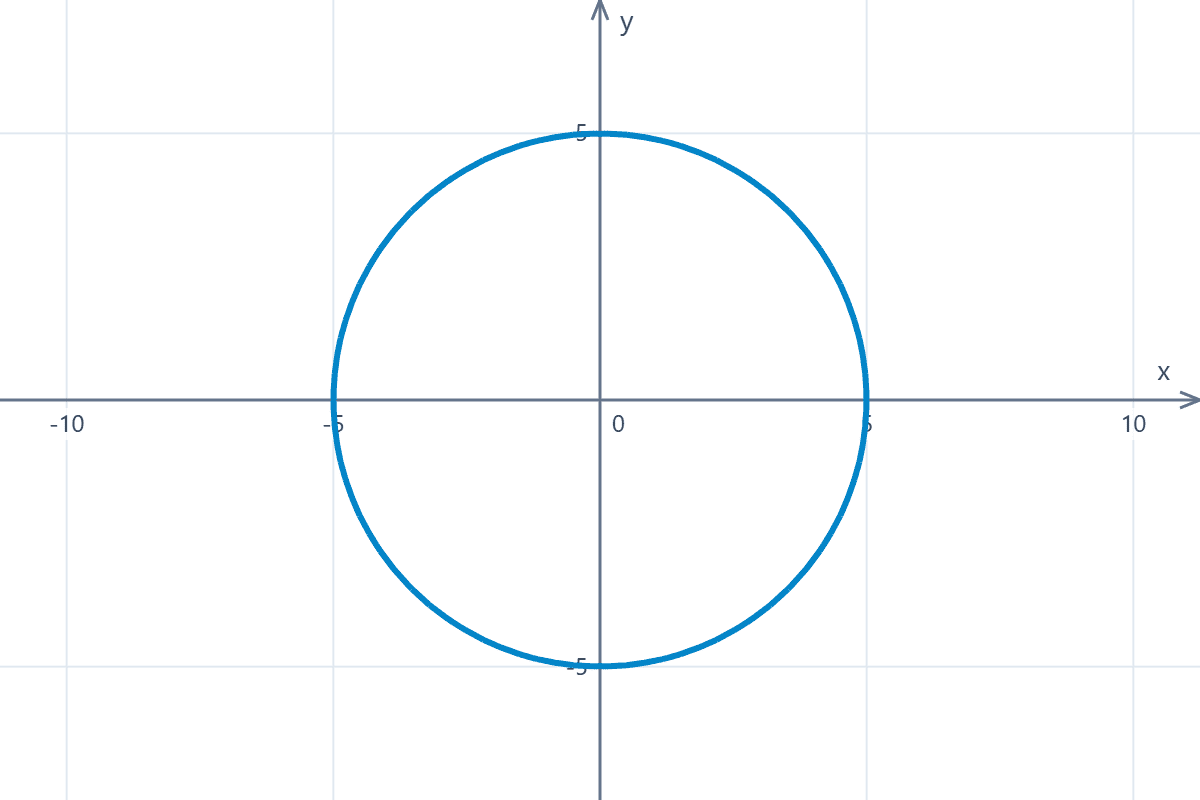
Analyze the equation \( x^2+y^2-25=0 \) and determine the type of conic it represents.
Equation analysis
Classification: Circle.
Standard form: \( x^2 + y^2 = 25 \)
Step-by-step solution
1. Analysis of the conic type.
The given equation is:
The general equation of a conic is:
By comparing, we extract the coefficients:
We use the discriminant to analyze the conic type:
Since Δ < 0, the equation corresponds to a general ellipse.
2. Determinant analysis.
To check if the equation corresponds to a degenerate case, we calculate the following determinant:
Since δ ≠ 0, the equation does not correspond to a degenerate case.
3. Existence analysis.
To check if the equation corresponds to a real or imaginary ellipse, we use the trace invariant:
Since the sign of A + C is different from the sign of δ, the equation corresponds to a real ellipse. Additionally, since A = C and B = 0, the conic is a circle.
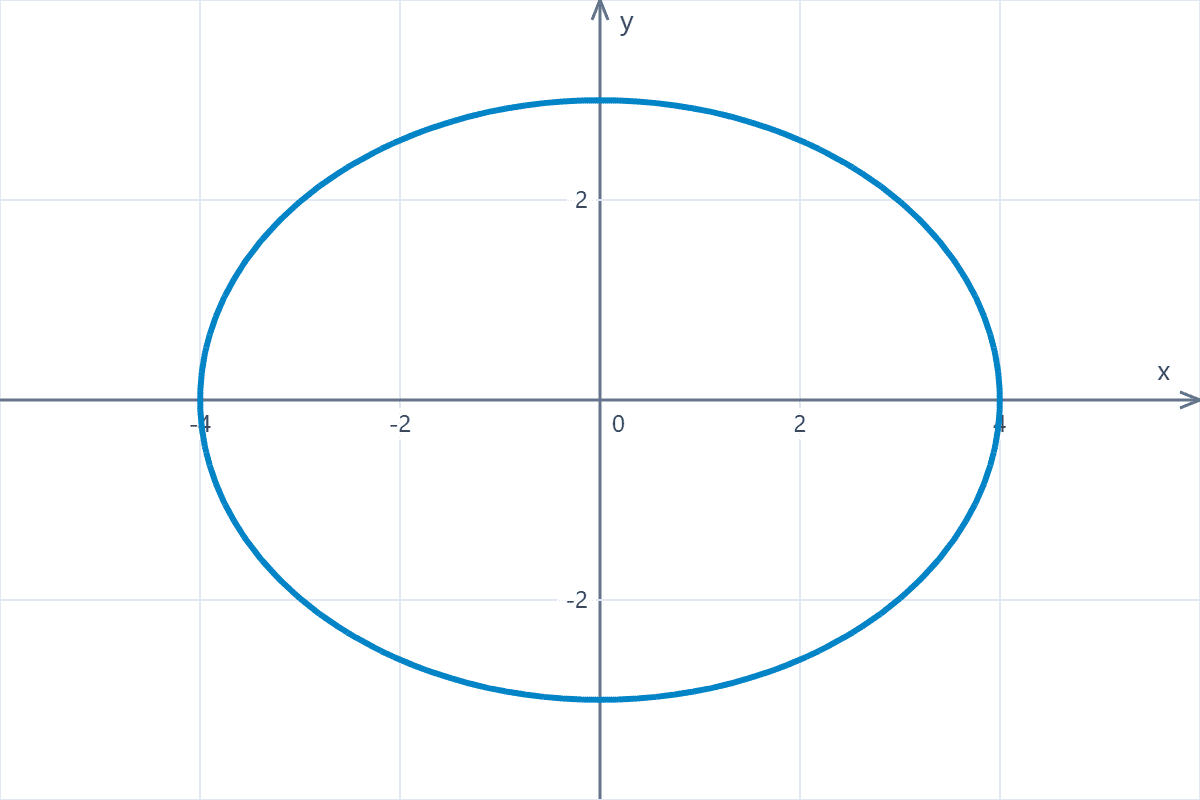
Determine the type of conic represented by the equation \( 9x^2+16y^2-144=0. \)
General equation analysis
Classification: Non-degenerate ellipse.
Orientation: Horizontal (principal axis parallel to the x-axis).
Standard form: \( \dfrac{x^2}{16} + \dfrac{y^2}{9} = 1 \)
For more information about the conic, check the ellipse calculator.
Step-by-step solution
1. Analysis of the conic type.
The given equation is:
The general equation of a conic is:
By comparing, we extract the coefficients:
We will perform an invariant analysis to determine the conic type.
We use the discriminant to analyze the conic type:
Since Δ < 0, the equation corresponds to a general ellipse.
2. Determinant analysis.
To check if the equation corresponds to a degenerate case, we calculate the following determinant:
Since δ ≠ 0, the equation does not correspond to a degenerate case.
3. Existence analysis.
To check if the equation corresponds to a real or imaginary ellipse, we use the trace invariant:
Since the sign of A + C is different from the sign of δ, the equation corresponds to a real ellipse.
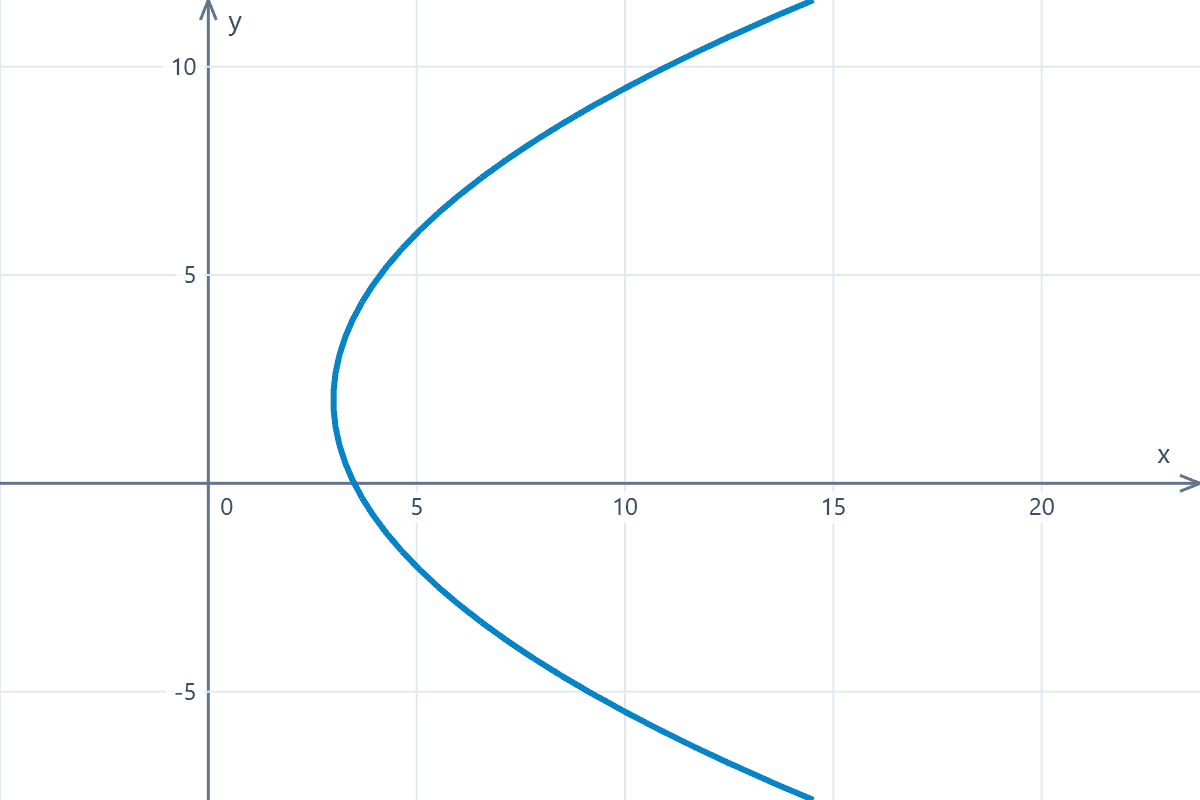
Find the conic associated with the following general quadratic equation: \( y^2-8x-4y+28=0 \)
Equation analysis
Type: Non-degenerate parabola.
Orientation: Horizontal (principal axis parallel to the x-axis).
Standard form: \( \left(y - 2\right)^2 = 8\left(x - 3\right) \)
For more information about the conic, check the parabola calculator.
Step-by-step solution
1. Analysis of the conic type.
The given equation is:
The general equation of a conic is:
By comparing, we extract the coefficients:
We use the discriminant to analyze the conic type:
Since Δ = 0, the equation corresponds to a general parabola.
2. Determinant analysis.
To check if the equation corresponds to a degenerate case, we calculate the following determinant:
Since δ ≠ 0, the equation does not correspond to a degenerate case.
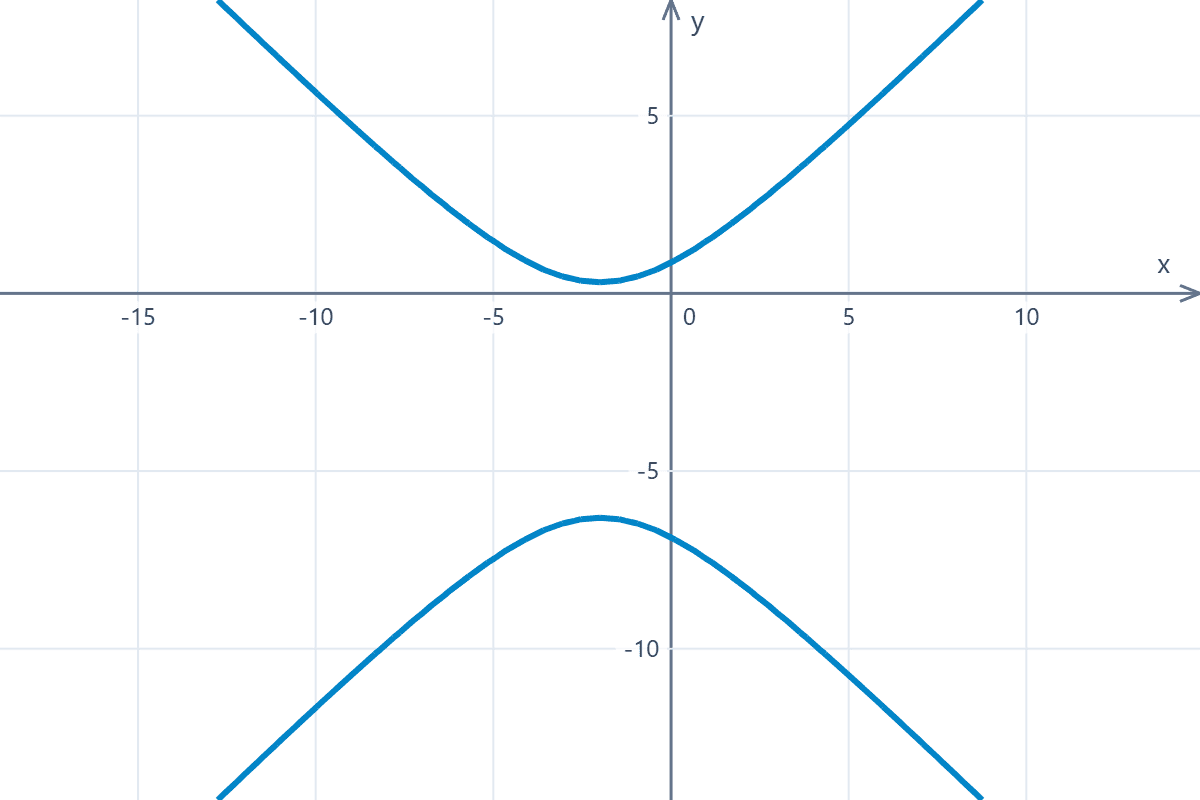
Identify which conic curve describes the expression \( y^2-x^2-4x+6y-6=0. \)
Equation analysis
Conic section: Non-degenerate hyperbola.
Orientation: Vertical (principal axis parallel to the y-axis).
Standard form: \( \dfrac{\left(y + 3\right)^2}{11} - \dfrac{\left(x + 2\right)^2}{11} = 1 \)
For more information about the conic, check the hyperbola calculator.
Step-by-step solution
1. Analysis of the conic type.
The given equation is:
The general equation of a conic is:
By comparing, we extract the coefficients:
We use the discriminant to analyze the conic type:
Since Δ > 0, the equation corresponds to a general hyperbola.
2. Determinant analysis.
To check if the equation corresponds to a degenerate case, we calculate the following determinant:
Since δ ≠ 0, the equation does not correspond to a degenerate case.
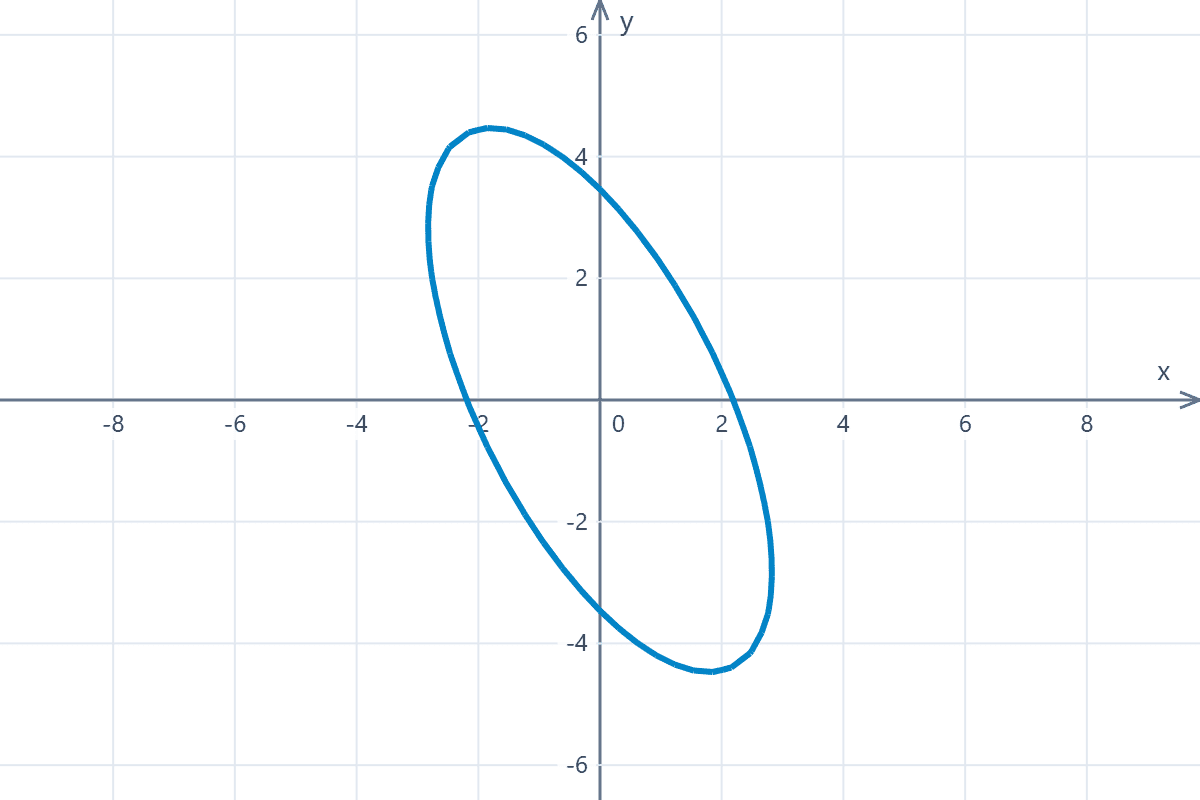
Classify the conic whose general equation is \( 5x^2+4xy+2y^2-24=0. \)
Equation analysis
Classification: Non-degenerate ellipse.
Orientation: Rotated with respect to the Cartesian axes.
Step-by-step solution
1. Analysis of the conic type.
The given equation is:
The general equation of a conic is:
By comparing, we extract the coefficients:
Since B ≠ 0, the principal axis of the conic has a rotation with respect to the Cartesian axes.
We use the discriminant to analyze the conic type:
Since Δ < 0, the equation corresponds to a general ellipse.
2. Determinant analysis.
To check if the equation corresponds to a degenerate case, we calculate the following determinant:
Since δ ≠ 0, the equation does not correspond to a degenerate case.
3. Existence analysis.
To check if the equation corresponds to a real or imaginary ellipse, we use the trace invariant:
Since the sign of A + C is different from the sign of δ, the equation corresponds to a real ellipse.
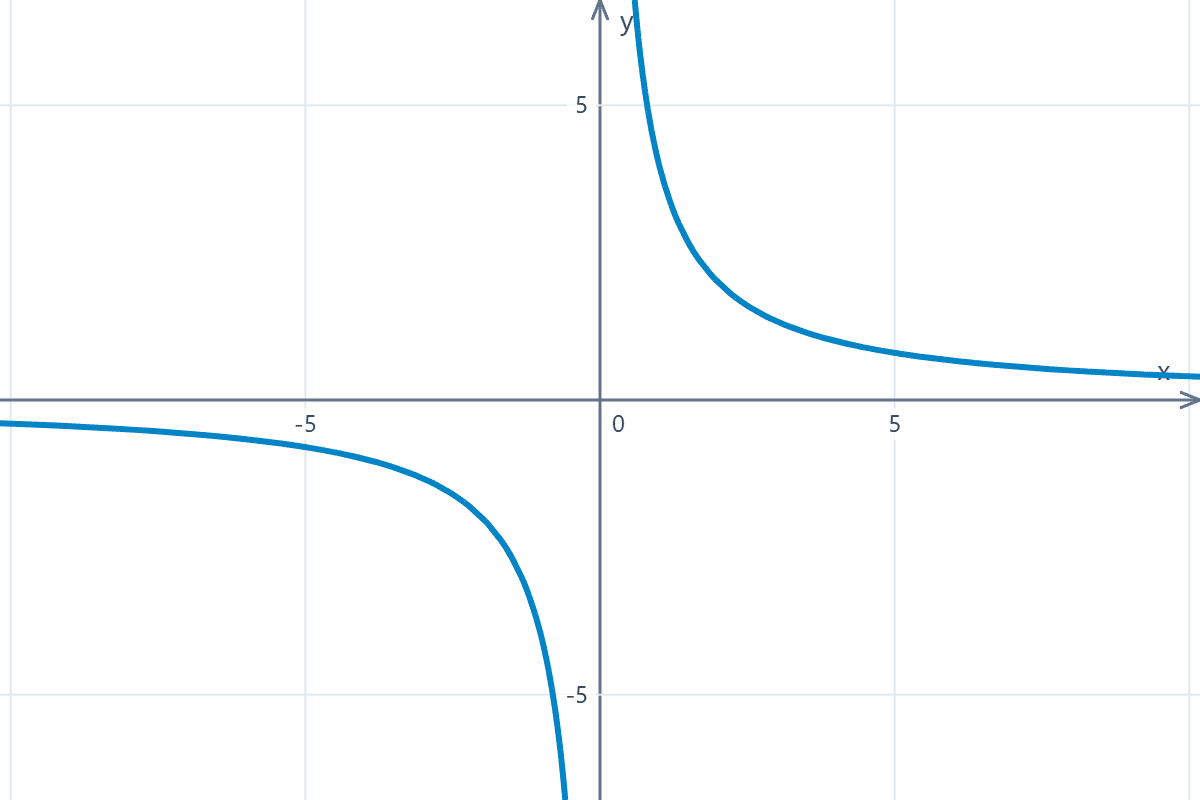
Given the quadratic equation \( xy=4 \), determine what type of conic it is.
Equation analysis
Classification: Non-degenerate hyperbola.
Orientation: Rotated with respect to the Cartesian axes.
Step-by-step solution
1. Analysis of the conic type.
The given equation is:
The general equation of a conic is:
By comparing, we extract the coefficients:
Since B ≠ 0, the principal axis of the hyperbola has a rotation with respect to the Cartesian axes.
We use the discriminant to analyze the conic type:
Since Δ > 0, the equation corresponds to a general hyperbola.
2. Determinant analysis.
To check if the equation corresponds to a degenerate case, we calculate the following determinant:
Since δ ≠ 0, the equation does not correspond to a degenerate case.
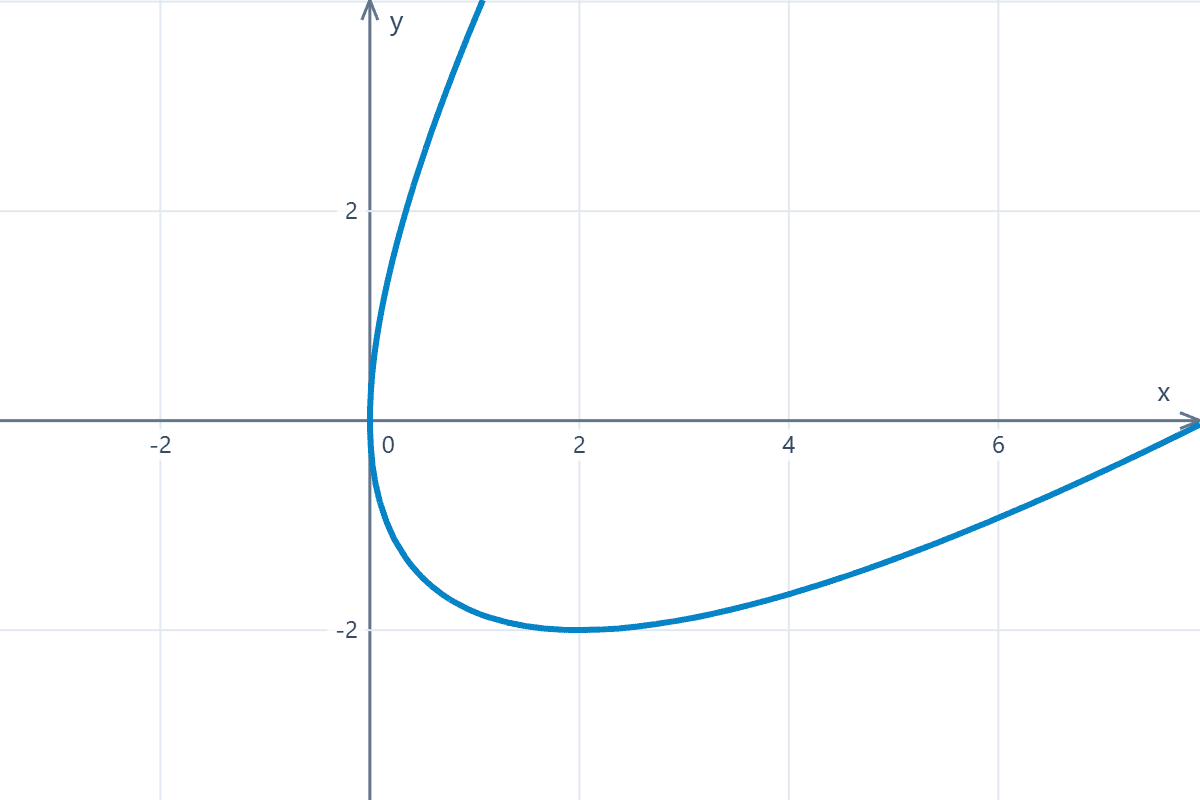
Analyze the equation \( x^2-2xy+y^2-8x=0 \) and find what type of conic it represents.
Equation analysis
Classification: Non-degenerate parabola.
Orientation: Rotated with respect to the Cartesian axes.
Step-by-step solution
1. Analysis of the conic type.
The given equation is:
The general equation of a conic is:
By comparing, we extract the coefficients:
Since B ≠ 0, the principal axis of the parabola has a rotation with respect to the Cartesian axes.
We use the discriminant to analyze the conic type:
Since Δ = 0, the equation corresponds to a general parabola.
2. Determinant analysis.
To check if the equation corresponds to a degenerate case, we calculate the following determinant:
Since δ ≠ 0, the equation does not correspond to a degenerate case.
Determine the conic corresponding to the general equation \( x^2+y^2=0 \) and whether it is a degenerate case or not.
Equation analysis
Classification: Degenerate ellipse (a real point).
Step-by-step solution
1. Analysis of the conic type.
The given equation is:
The general equation of a conic is:
By comparing, we extract the coefficients:
We use the discriminant to analyze the conic type:
Since Δ < 0, the equation corresponds to a general ellipse.
2. Determinant analysis.
To check if the equation corresponds to a degenerate case, we calculate the following determinant:
Since δ = 0, the equation corresponds to a degenerate case. In this case, the ellipse is just a point.
Related Tools
