
Circle Equation from 3 Points Calculator

Enter the coordinates of the three points to get the equation of the circle passing through them (standard and general form), center, radius, and the step-by-step resolution with a graph.

Point 1
( ,)
Point 2
( ,)
Point 3
( ,)

Quick Examples

Rate this tool

Solved Exercises

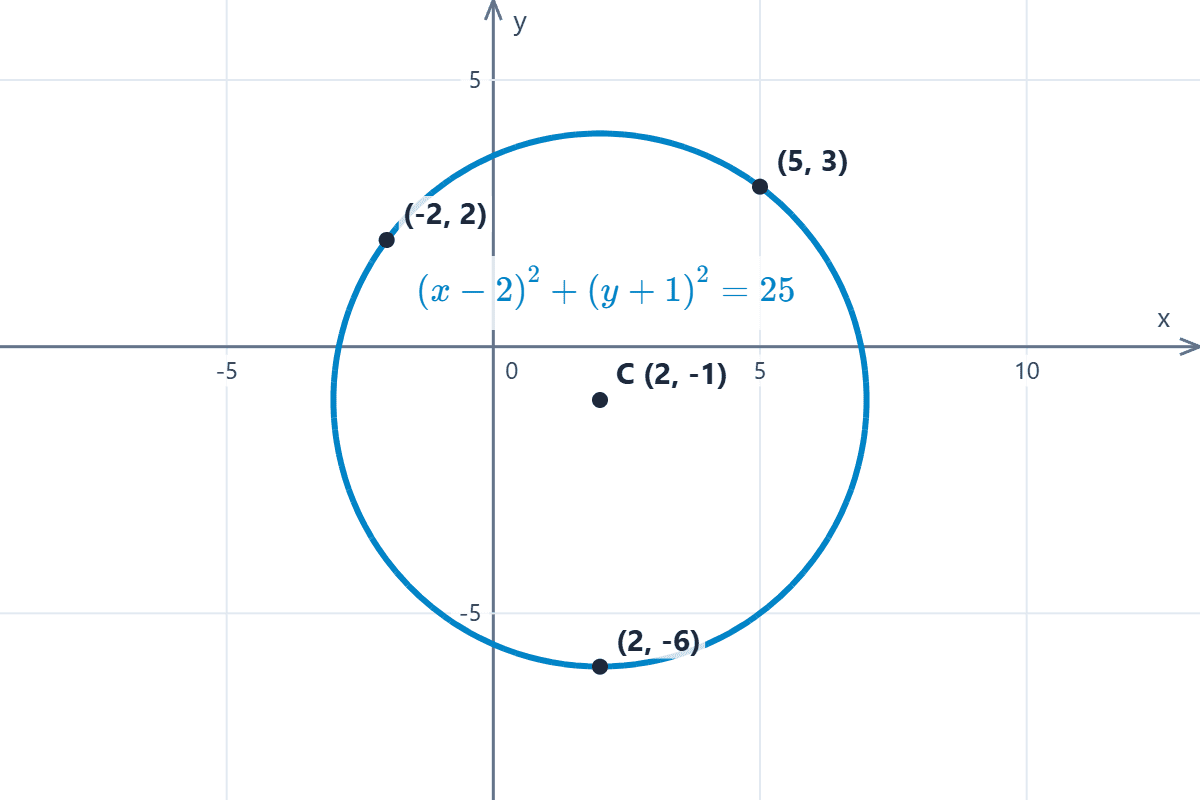
Find the equation, center, and radius of the circle given the 3 points (5, 3), (-2, 2) and (2, -6).

Answer


Standard form equation

$$ \left(x - 2\right)^2 + \left(y + 1\right)^2 = 25 $$

General form equation

$$ x^2 + y^2 - 4x + 2y - 20 = 0 $$

Center: \( C (2, -1) \)

Radius: \( r = 5 \)

Step-by-step resolution

1. Set up the system of equations.

The general form of the circle is:

$$ x^2 + y^2 + Dx + Ey + F = 0 $$

We evaluate each given point \( (x, y) \) in the equation:

\( P_{1}\left(5, 3\right): 5^2 + 3^2 + 5D + 3E + F = 0 \)
\( P_{2}\left(-2, 2\right): \left(-2\right)^2 + 2^2 - 2D + 2E + F = 0 \)
\( P_{3}\left(2, -6\right): 2^2 + \left(-6\right)^2 + 2D - 6E + F = 0 \)

By simplifying and rearranging, we get the following system of 3 equations:

$$ \begin{cases} 5D + 3E + F = -34 \\ - 2D + 2E + F = -8 \\ 2D - 6E + F = -40 \end{cases} $$

2. Solve the linear system (Cramer's rule).

We calculate the main determinant (\( \Delta \)) of the coefficients:

$$ \Delta = \begin{vmatrix} 5 & 3 & 1 \\ -2 & 2 & 1 \\ 2 & -6 & 1 \end{vmatrix} = 60 $$

We calculate the determinants for each variable by replacing the corresponding column with the constant terms (-34, -8, -40):

$$ \Delta D = \begin{vmatrix} -34 & 3 & 1 \\ -8 & 2 & 1 \\ -40 & -6 & 1 \end{vmatrix} = -240 \\[1em] \Delta E = \begin{vmatrix} 5 & -34 & 1 \\ -2 & -8 & 1 \\ 2 & -40 & 1 \end{vmatrix} = 120 \\[1em] \Delta F = \begin{vmatrix} 5 & 3 & -34 \\ -2 & 2 & -8 \\ 2 & -6 & -40 \end{vmatrix} = -1200 $$

We divide each determinant by \( \Delta \) to get the coefficients:

$$ D = \dfrac{\Delta D}{\Delta} = \dfrac{-240}{60} = -4 \\[1em] E = \dfrac{\Delta E}{\Delta} = \dfrac{120}{60} = 2 \\[1em] F = \dfrac{\Delta F}{\Delta} = \dfrac{-1200}{60} = -20 $$

3. Determine the general form, the center, and the radius.

We substitute the found coefficients into the general form:

$$ x^2 + y^2 - 4x + 2y - 20 = 0 $$

We calculate the center \( C(h, k) \) by dividing -D and -E by 2:

$$ h = \dfrac{-(-4)}{2} = 2 \\[0.5em] k = \dfrac{-2}{2} = -1 $$

The center is \( C (2, -1) \).

With the center and the value of F, we apply the formula \( r = \sqrt{h^2 + k^2 - F} \):

$$ r = \sqrt{4 + 1 - (-20)} = \sqrt{25} $$

Therefore, the radius is \( r = 5 \).

With these values, we can form the standard form of the circle:
$$ (x-h)^2+(y-k)^2=r^2 $$
$$ \left(x - 2\right)^2 + \left(y + 1\right)^2 = 25 $$
Graph on the Cartesian plane of a circle obtained from three points with its standard form equation. Example 2.
Graph of the circle
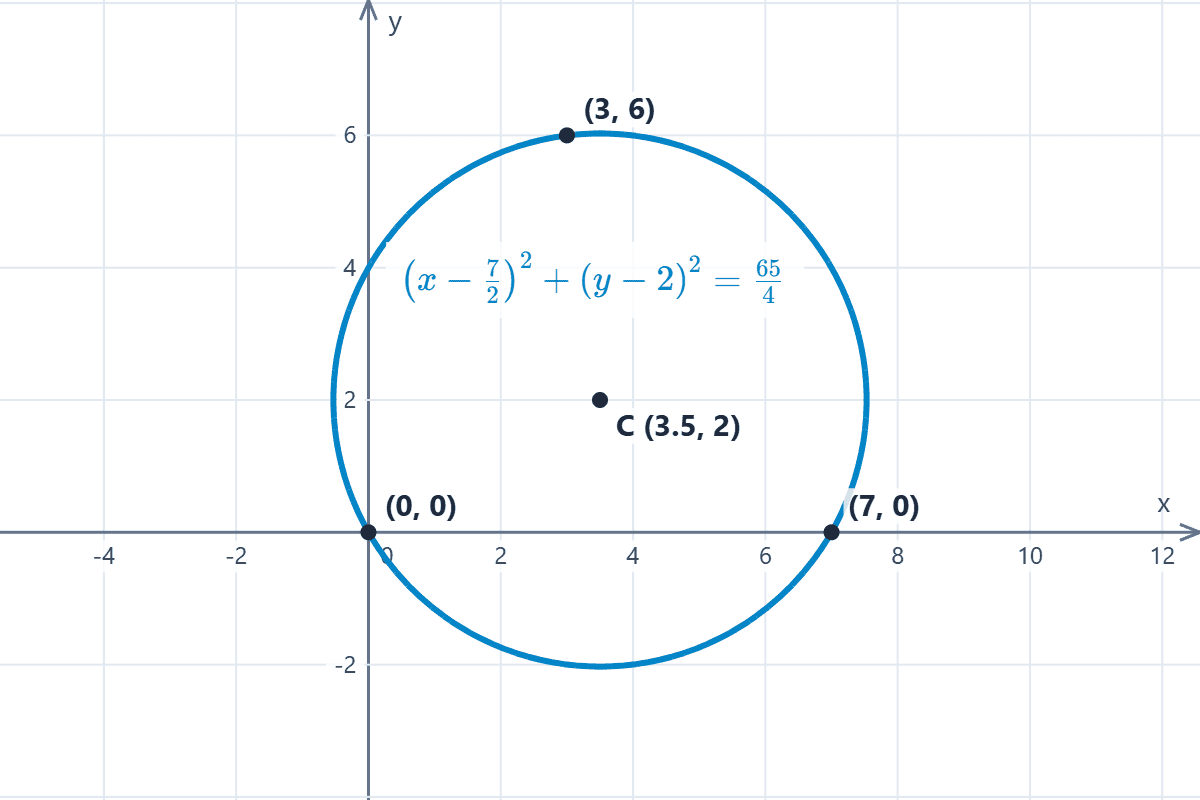
Determine the general and standard form equations of the circle given three of its points: (0, 0), (3, 6) and (7, 0).

Solution


Standard form equation

$$ \left(x - \dfrac{7}{2}\right)^2 + \left(y - 2\right)^2 = \dfrac{65}{4} $$

General form equation

$$ x^2 + y^2 - 7x - 4y = 0 $$

Center: \( C \left(\dfrac{7}{2}, 2\right) = (3.5, 2) \)

Radius: \( r = \dfrac{\sqrt{5} \sqrt{13}}{2} \approx 4.03 \)

Step-by-step resolution

1. Set up the system of equations.

The general form of the circle is:

$$ x^2 + y^2 + Dx + Ey + F = 0 $$

We evaluate each given point \( (x, y) \) in the equation:

\( P_{1}\left(0, 0\right): 0^2 + 0^2 + F = 0 \)
\( P_{2}\left(3, 6\right): 3^2 + 6^2 + 3D + 6E + F = 0 \)
\( P_{3}\left(7, 0\right): 7^2 + 0^2 + 7D + F = 0 \)

By simplifying and rearranging, we get the following system of 3 equations:

$$ \begin{cases} F = 0 \\ 3D + 6E + F = -45 \\ 7D + F = -49 \end{cases} $$

2. Solve the linear system (Cramer's rule).

We calculate the main determinant (\( \Delta \)) of the coefficients:

$$ \Delta = \begin{vmatrix} 0 & 0 & 1 \\ 3 & 6 & 1 \\ 7 & 0 & 1 \end{vmatrix} = -42 $$

We calculate the determinants for each variable by replacing the corresponding column with the constant terms (0, -45, -49):

$$ \Delta D = \begin{vmatrix} 0 & 0 & 1 \\ -45 & 6 & 1 \\ -49 & 0 & 1 \end{vmatrix} = 294 \\[1em] \Delta E = \begin{vmatrix} 0 & 0 & 1 \\ 3 & -45 & 1 \\ 7 & -49 & 1 \end{vmatrix} = 168 \\[1em] \Delta F = \begin{vmatrix} 0 & 0 & 0 \\ 3 & 6 & -45 \\ 7 & 0 & -49 \end{vmatrix} = 0 $$

We divide each determinant by \( \Delta \) to get the coefficients:

$$ D = \dfrac{\Delta D}{\Delta} = \dfrac{294}{-42} = -7 \\[1em] E = \dfrac{\Delta E}{\Delta} = \dfrac{168}{-42} = -4 \\[1em] F = \dfrac{\Delta F}{\Delta} = \dfrac{0}{-42} = 0 $$

3. Determine the general form, the center, and the radius.

We substitute the found coefficients into the general form:

$$ x^2 + y^2 - 7x - 4y = 0 $$

We calculate the center \( C(h, k) \) by dividing -D and -E by 2:

$$ h = \dfrac{-(-7)}{2} = \dfrac{7}{2} \\[0.5em] k = \dfrac{-(-4)}{2} = 2 $$

The center is \( C \left(\dfrac{7}{2}, 2\right) = (3.5, 2) \).

With the center and the value of F, we apply the formula \( r = \sqrt{h^2 + k^2 - F} \):

$$ r = \sqrt{\dfrac{49}{4} + 4 - 0} = \sqrt{\dfrac{65}{4}} $$

Therefore, the radius is \( r = \dfrac{\sqrt{5} \cdot \sqrt{13}}{2} \approx 4.03 \).

With these values, we can form the standard form of the circle:
$$ (x-h)^2+(y-k)^2=r^2 $$
$$ \left(x - \dfrac{7}{2}\right)^2 + \left(y - 2\right)^2 = \dfrac{65}{4} $$
Graph on the Cartesian plane of a circle obtained from three points with its standard form equation. Example 3.
Graph of the circle on the plane
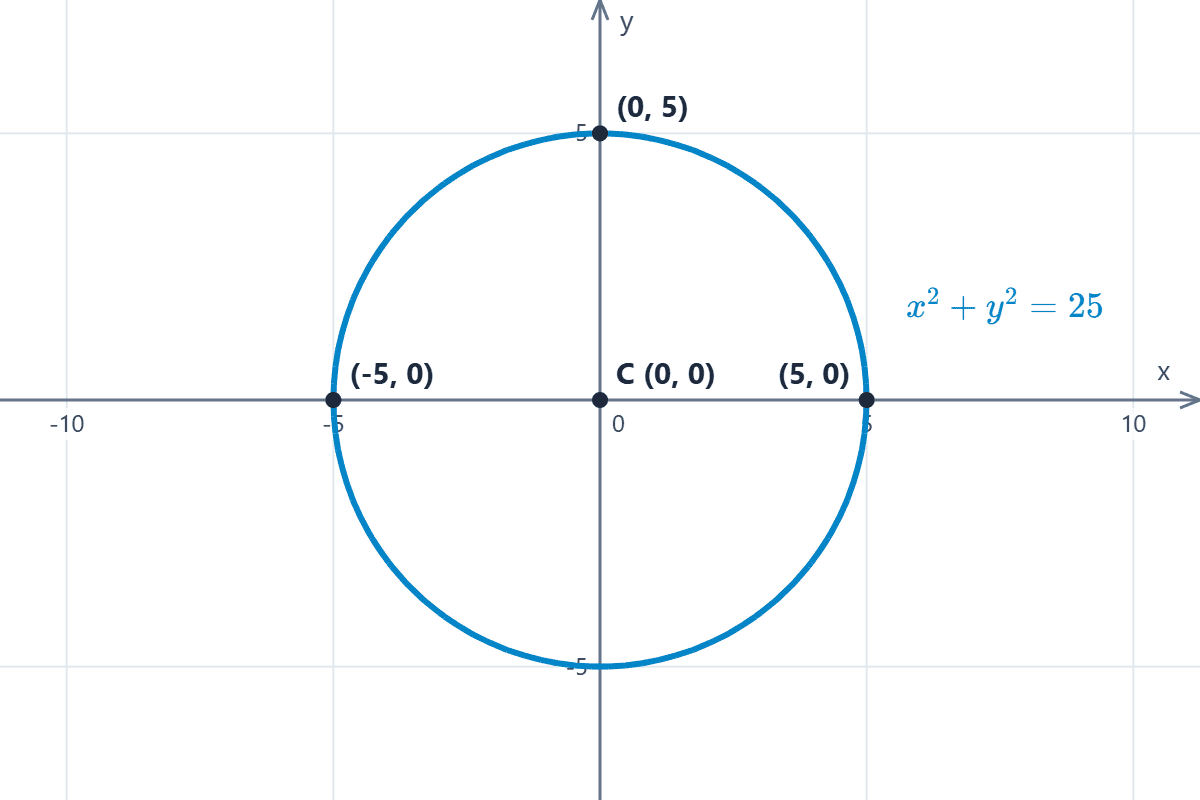
Calculate the equation of the circle passing through the three points (0, 5) (5, 0) and (-5, 0).

Results


Standard form

$$ x^2 + y^2 = 25 $$

General form

$$ x^2 + y^2 - 25 = 0 $$

Center: \( C (0, 0) \)

Radius: \( r = 5 \)

Step-by-step resolution

1. Set up the system of equations.

The general form of the circle is:

$$ x^2 + y^2 + Dx + Ey + F = 0 $$

We evaluate each given point \( (x, y) \) in the equation:

\( P_{1}\left(5, 0\right): 5^2 + 0^2 + 5D + F = 0 \)
\( P_{2}\left(0, 5\right): 0^2 + 5^2 + 5E + F = 0 \)
\( P_{3}\left(-5, 0\right): \left(-5\right)^2 + 0^2 - 5D + F = 0 \)

By simplifying and rearranging, we get the following system of 3 equations:

$$ \begin{cases} 5D + F = -25 \\ 5E + F = -25 \\ - 5D + F = -25 \end{cases} $$

2. Solve the linear system (Cramer's rule).

We calculate the main determinant (\( \Delta \)) of the coefficients:

$$ \Delta = \begin{vmatrix} 5 & 0 & 1 \\ 0 & 5 & 1 \\ -5 & 0 & 1 \end{vmatrix} = 50 $$

We calculate the determinants for each variable by replacing the corresponding column with the constant terms (-25, -25, -25):

$$ \Delta D = \begin{vmatrix} -25 & 0 & 1 \\ -25 & 5 & 1 \\ -25 & 0 & 1 \end{vmatrix} = 0 \\[1em] \Delta E = \begin{vmatrix} 5 & -25 & 1 \\ 0 & -25 & 1 \\ -5 & -25 & 1 \end{vmatrix} = 0 \\[1em] \Delta F = \begin{vmatrix} 5 & 0 & -25 \\ 0 & 5 & -25 \\ -5 & 0 & -25 \end{vmatrix} = -1250 $$

We divide each determinant by \( \Delta \) to get the coefficients:

$$ D = \dfrac{\Delta D}{\Delta} = \dfrac{0}{50} = 0 \\[1em] E = \dfrac{\Delta E}{\Delta} = \dfrac{0}{50} = 0 \\[1em] F = \dfrac{\Delta F}{\Delta} = \dfrac{-1250}{50} = -25 $$

3. Determine the general form, the center, and the radius.

We substitute the found coefficients into the general form:

$$ x^2 + y^2 - 25 = 0 $$

We calculate the center \( C(h, k) \) by dividing -D and -E by 2:

$$ h = \dfrac{-0}{2} = 0 \\[0.5em] k = \dfrac{-0}{2} = 0 $$

The center is \( C (0, 0) \).

With the center and the value of F, we apply the formula \( r = \sqrt{h^2 + k^2 - F} \):

$$ r = \sqrt{0 + 0 - (-25)} = \sqrt{25} $$

Therefore, the radius is \( r = 5 \).

With these values, we can form the standard form of the circle:
$$ (x-h)^2+(y-k)^2=r^2 $$
$$ x^2 + y^2 = 25 $$
Graph on the Cartesian plane of a circle obtained from three points with its standard form equation. Example 1.
Graph of the circle

Related Tools

Daniel Machado

Professor of Mathematics, graduated from the Faculty of Exact, Chemical and Natural Sciences of the National University of Misiones (UNAM). Developer and creator of RigelUp, dedicated to building tools for mathematical learning.

Leave a Reply

Your email address will not be published. Required fields are marked *