
Distance Between Two Lines Calculator
Enter the equations of both lines to get the distance between them, see the step-by-step solution, and their graph.
Result
The distance between line and line is:
Quick Examples
What Is the Distance Between Two Lines?
The distance between two lines in the plane is the measure of their minimum separation. When the lines are intersecting (they cross at a single point) or coincident (they are the same line), the distance between them is zero.
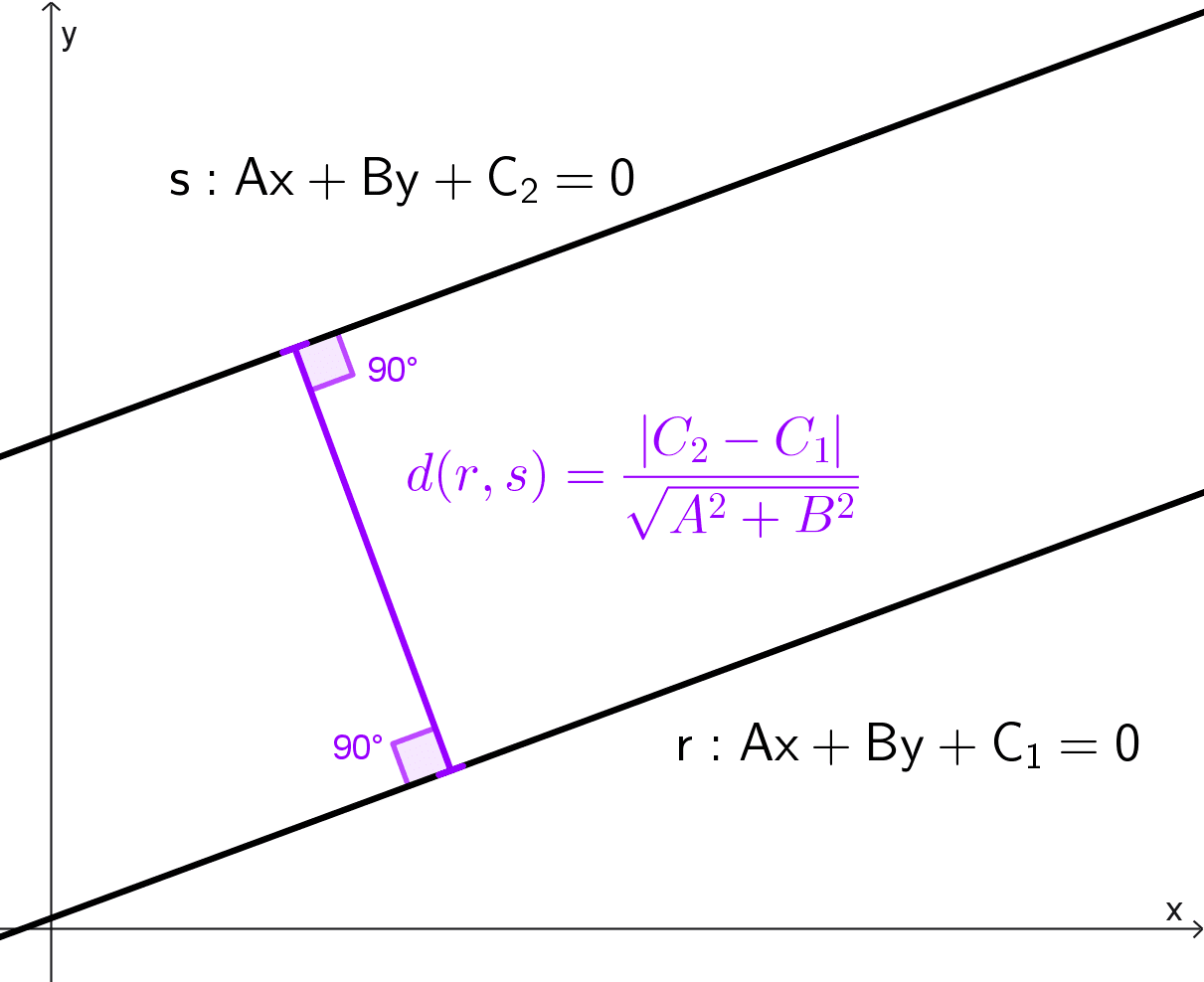
On the other hand, if the lines are parallel and non-coincident, the distance between them is the length of the perpendicular segment drawn from any point on one line to the other line, and it is a constant positive value.
Given two parallel lines in their general form: L1: Ax + By + C1 = 0 and L2: Ax + By + C2 = 0 where the coefficients A and B are identical, the distance between them is given by the following formula:
\(d(L_1, L_2)=\dfrac{|C_2-C_1|}{\sqrt{A^2+B^2}}\)
Solved Exercises
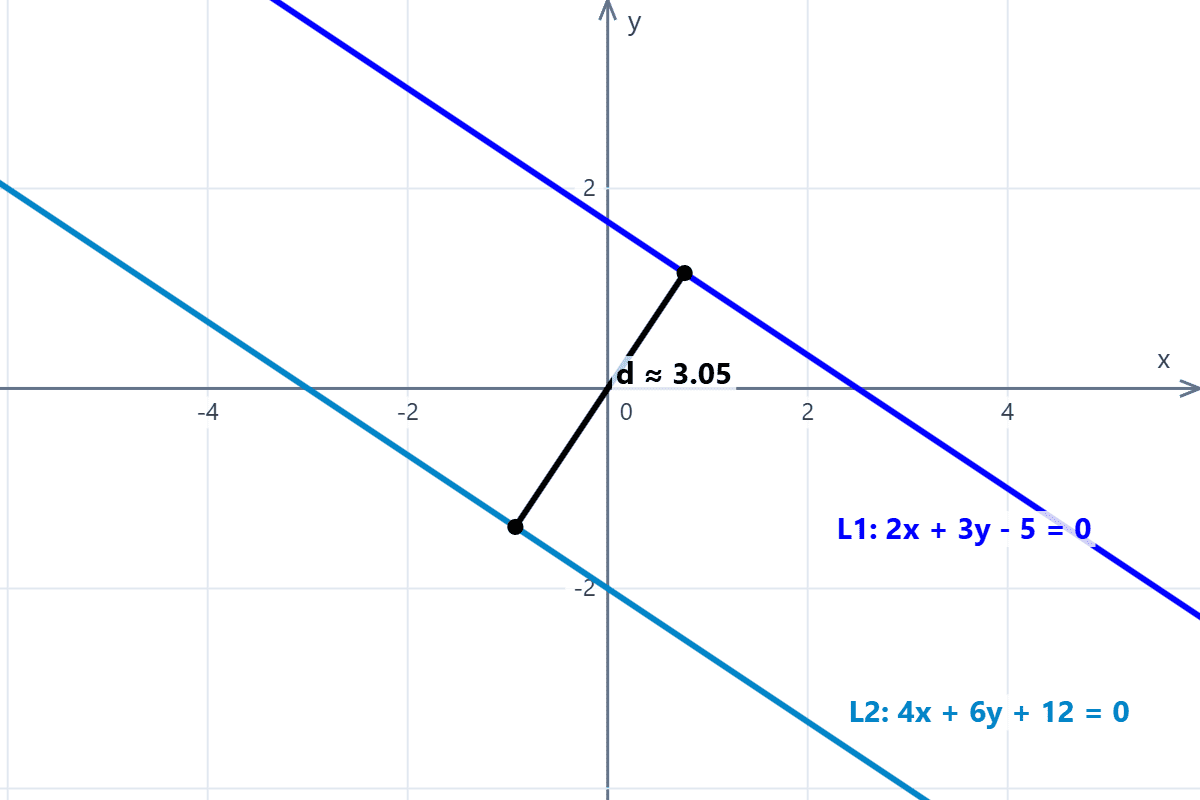
Calculate the distance between the parallel lines 2x + 3y - 5 = 0 and 4x + 6y + 12 = 0.
Result
The distance between the line \( 2x+ 3y- 5 = 0 \) and the line \( 4x+ 6y+ 12 = 0 \) is:
Step-by-step solution
1. Analyze if the lines are parallel.
We calculate the ratio of the corresponding linear terms and determine if they are equal:
The ratios are equal; therefore, the lines are parallel.
2. Standardize the linear coefficients.
We express both equations in general form; in this case, they are already in that form:
We multiply L2 by a suitable constant k so that the linear coefficients are equal to L1.
3. Apply the formula.
The formula to use is:
We identify the coefficients and the constant terms:
We substitute into the formula and calculate:
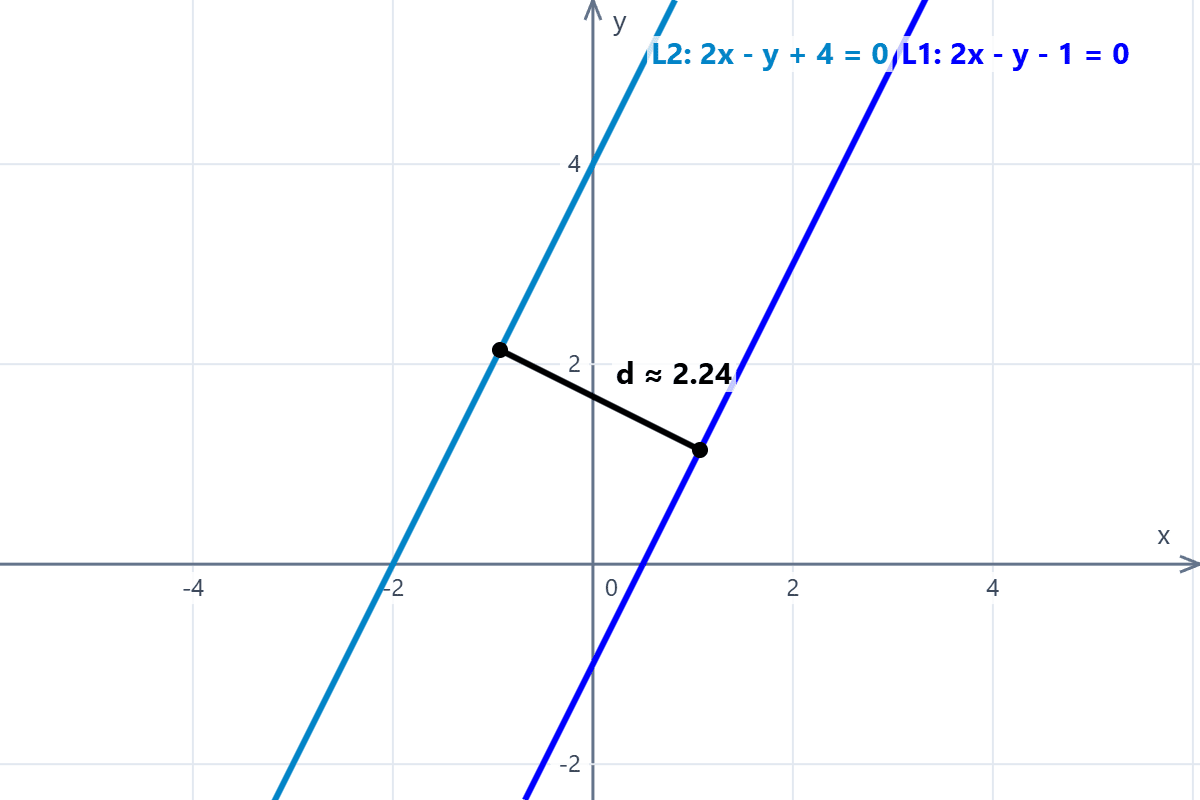
Find the distance separating the straight lines y = 2x - 1 and y = 2x + 4.
Solution
The distance between the line \( y = 2x - 1 \) and the line \( y = 2x + 4 \) is:
Step-by-step solution
1. Analyze if the lines are parallel.
We verify if the slopes of both lines are equal:
The slopes are equal; therefore, the lines are parallel.
2. Standardize the linear coefficients.
We express both equations in general form:
The linear coefficients are already standardized. We continue.
3. Apply the formula.
The formula to use is:
We identify the coefficients and the constant terms:
We substitute into the formula and calculate:
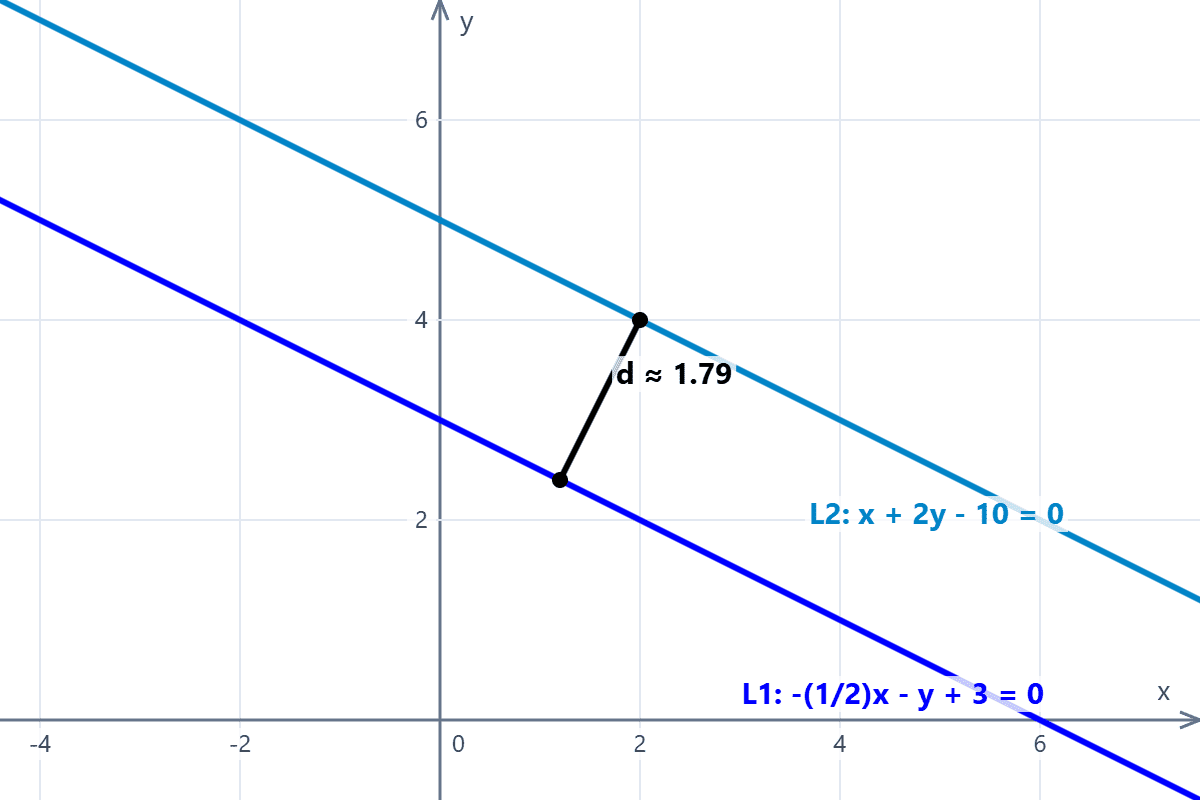
Determine the distance between the parallel lines y = (1/2)x + 3 and x + 2y - 10 = 0.
Answer
The distance between the line \( y = \dfrac{1}{2}x + 3\) and the line \( x+ 2y- 10 = 0 \) is:
Step-by-step solution
1. Analyze if the lines are parallel.
We convert the equation in slope-intercept form to its general form:
We calculate the ratio of the corresponding linear terms and determine if they are equal:
The ratios are equal; therefore, the lines are parallel.
2. Standardize the linear coefficients.
We express both equations in general form:
We multiply L2 by a suitable constant k so that the linear coefficients are equal to L1.
3. Apply the formula.
The formula to use is:
We identify the coefficients and the constant terms:
We substitute into the formula and calculate:
Related Tools
