
Line Equation from Two Points Calculator
Enter the coordinates of two points to get the equation of the line passing through them (slope-intercept, general, and point-slope forms), the step-by-step solution, and the graph.
Quick Examples
How to Use This Calculator
This online calculator finds the equation of a line given two points. Designed for algebra and analytic geometry students, this solver not only provides the final line formula, but it also explains the procedure step by step.
Using this line equation finder is very simple:
- Enter the data: Type the (x, y) coordinates of the two points you know. Double-check the signs before clicking calculate. The input fields accept integers, fractions, and decimals.
- Main results: You will instantly see a box with the line expressed in several forms: the slope-intercept form (y = mx + b), the point-slope form (y - y₁ = m(x - x₁)), and the general form (Ax + By + C = 0). It also shows you the slope (m) and the y-intercept (b).
- Step-by-step: Further down, you will find the complete breakdown of the problem. You will see how the slope is calculated using m = (y₂ - y₁) / (x₂ - x₁), how the point-slope equation is set up with two points (by picking one of them), and then how it is rearranged to reach the slope-intercept and general forms.
- Interactive graph: At the very bottom, there is a graph on the Cartesian plane. You can move it around to see the slope of the line, verify that it passes through the points you entered, and read the equation directly on the image.
Solved Exercises
The following are examples of problems solved by the calculator.
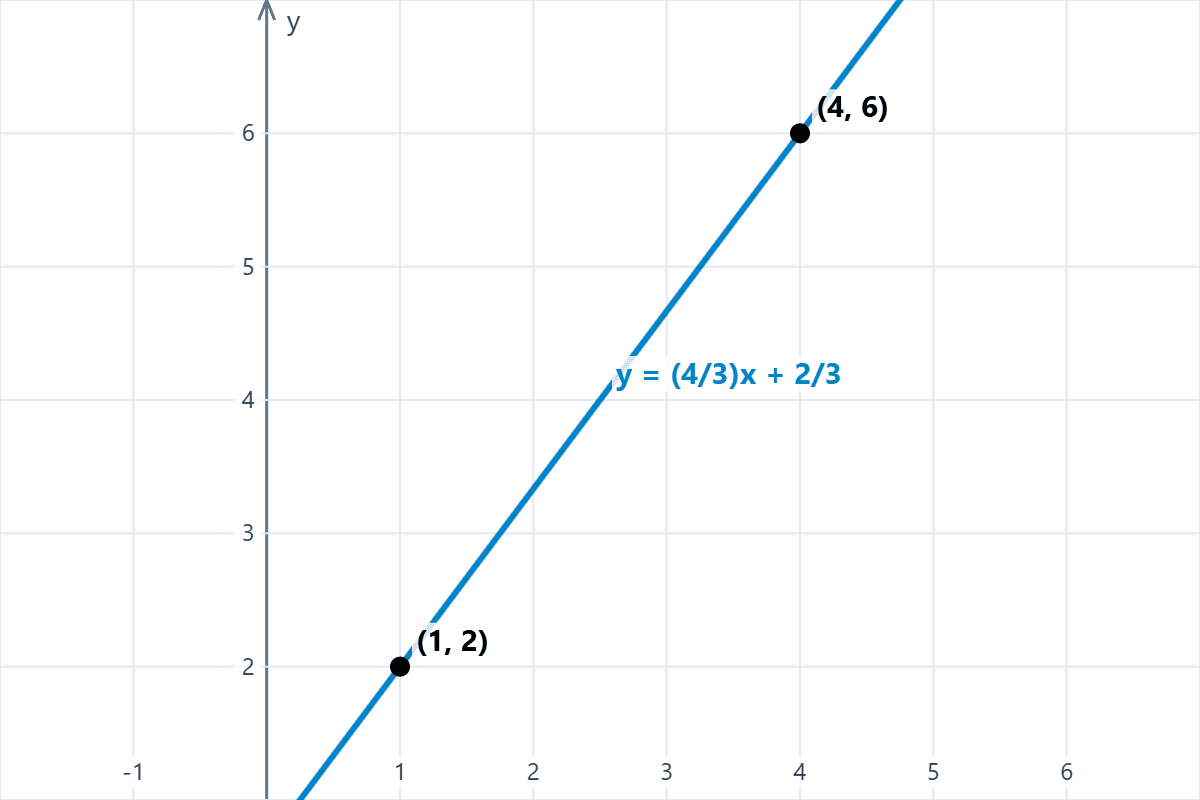
Calculate the equation of the straight line from the points (1, 2) and (4, 6).
Slope: \( m = \dfrac{4}{3} \approx 1.33 \)
y-intercept: \( b = \dfrac{2}{3} \approx 0.67 \)
Step-by-step solution
1. Identify the coordinates of the points.
The given points are:
We extract the coordinates:
2. Calculate the slope (m) of the line.
The slope formula given two points is:
Substituting the values:
3. Set up the point-slope equation.
We take the calculated slope m and the coordinates of the first point and substitute them into the formula:
4. Solve for 'y' to obtain the slope-intercept form.
Moving everything to the left side, we get the general equation:
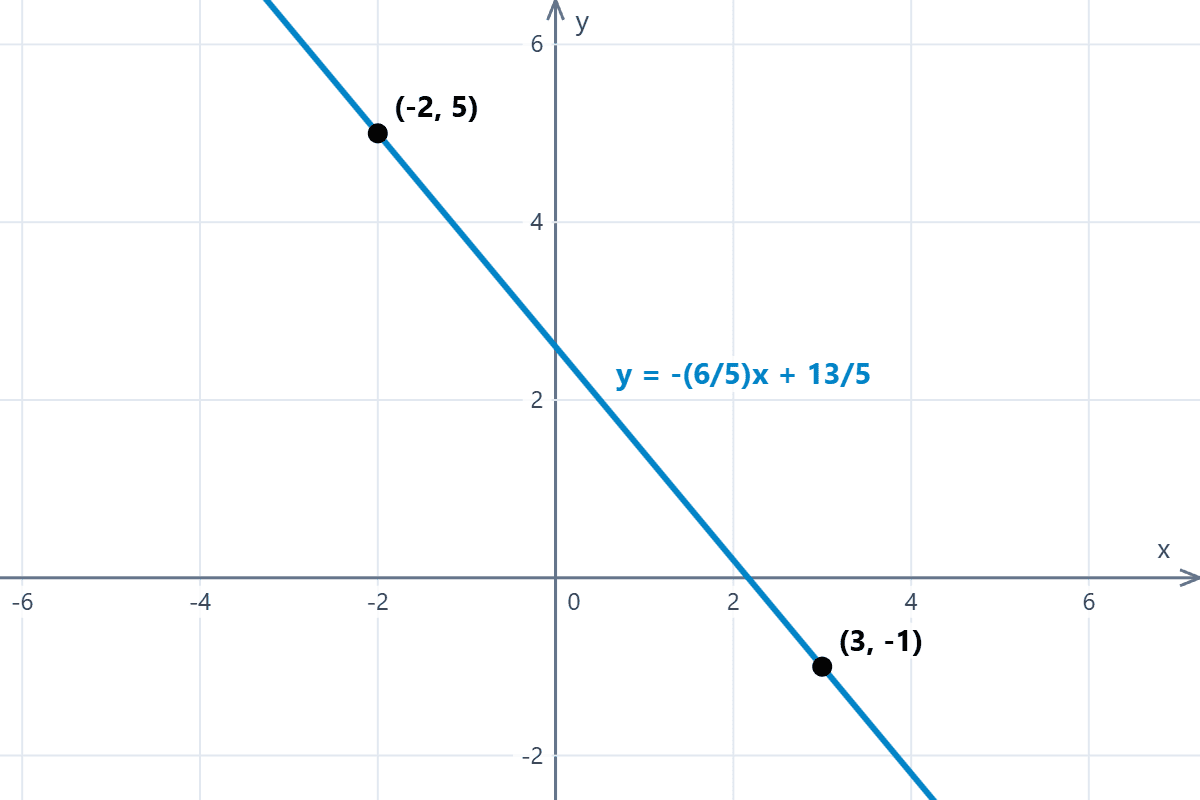
Determine the equations of the line given the points (-2, 5) and (3, -1).
Slope: \( m = -\dfrac{6}{5} = -1.2 \)
y-intercept: \( b = \dfrac{13}{5} = 2.6 \)
Step-by-step solution
1. Identify the coordinates of the points.
The given points are:
We extract the coordinates:
2. Calculate the slope (m) of the line.
The slope formula given two points is:
Substituting the values:
3. Set up the point-slope equation.
We take the calculated slope m and the coordinates of the first point and substitute them into the formula:
4. Solve for 'y' to obtain the slope-intercept form.
Moving everything to the left side, we get the general equation:
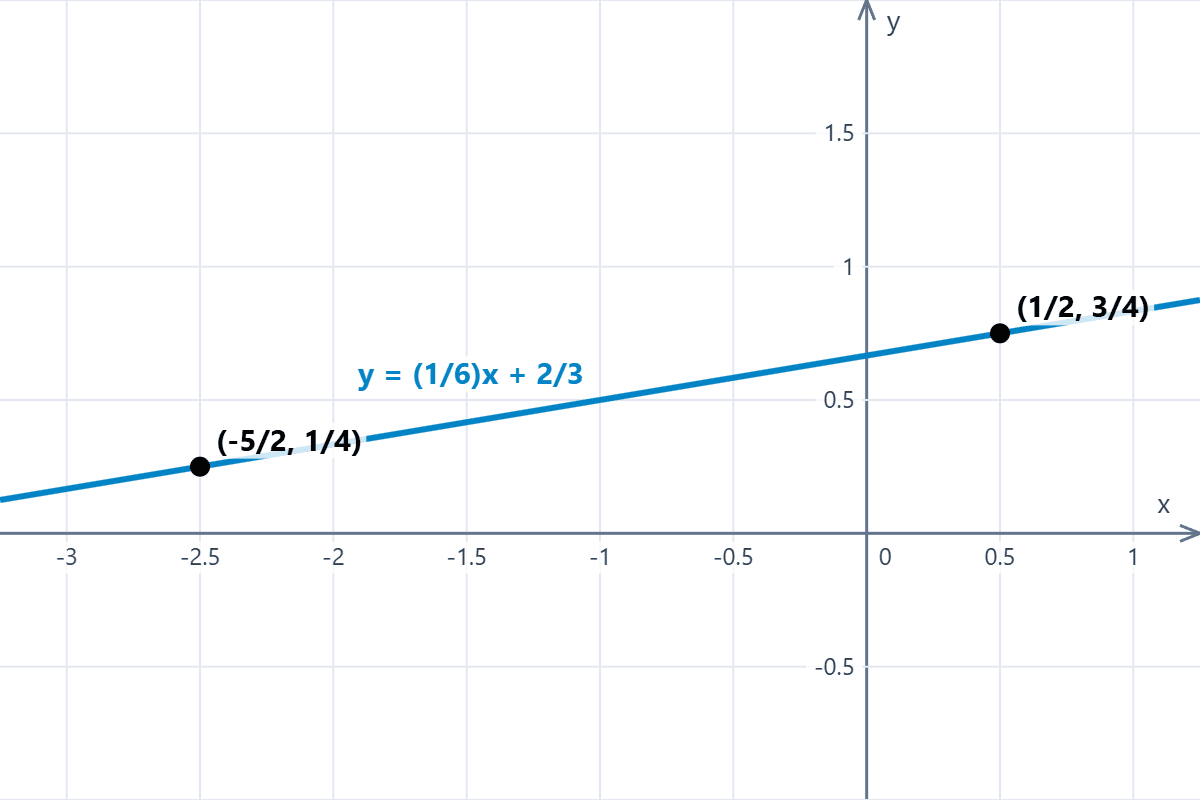
Find the equation of the line passing through points (1/2, 3/4) and (-5/2, 1/4).
Slope: \( m = \dfrac{1}{6} \approx 0.17 \)
y-intercept: \( b = \dfrac{2}{3} \approx 0.67 \)
Step-by-step solution
1. Identify the coordinates of the points.
The given points are:
We extract the coordinates:
2. Calculate the slope (m) of the line.
The slope formula given two points is:
Substituting the values:
3. Set up the point-slope equation.
We take the calculated slope m and the coordinates of the first point and substitute them into the formula:
4. Solve for 'y' to obtain the slope-intercept form.
Moving everything to the left side, we get the general equation:
Related Tools
