
Orthogonal Vectors Calculator
Enter the vector components to determine if they are orthogonal (perpendicular) or not by calculating their dot product.
Quick Examples
Solved Problems
The following are examples of problems solved by the calculator.
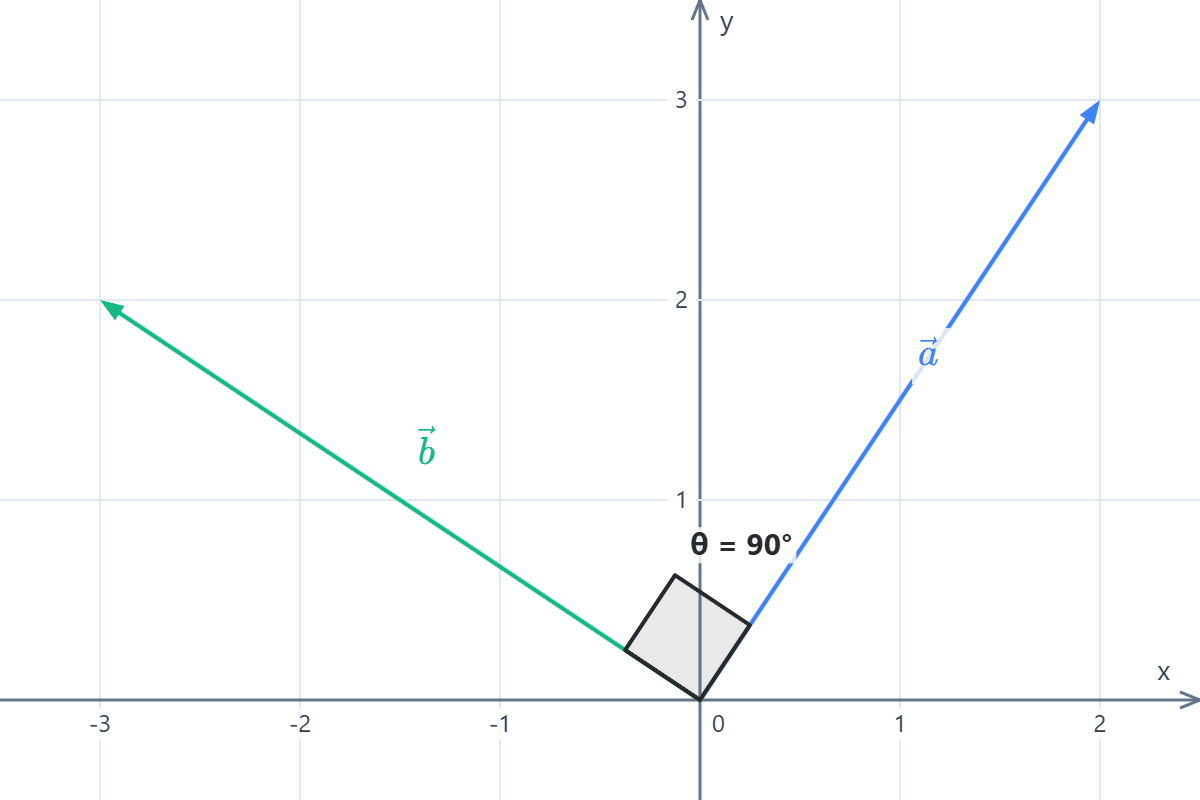
Determine whether the vectors ⟨2, 3⟩ and ⟨-3, 2⟩ are orthogonal or not.
Result
The given vectors ARE orthogonal.
To confirm this, we calculate their dot product:
Since the dot product is equal to zero, the vectors are perpendicular, meaning the angle between them is 90°.
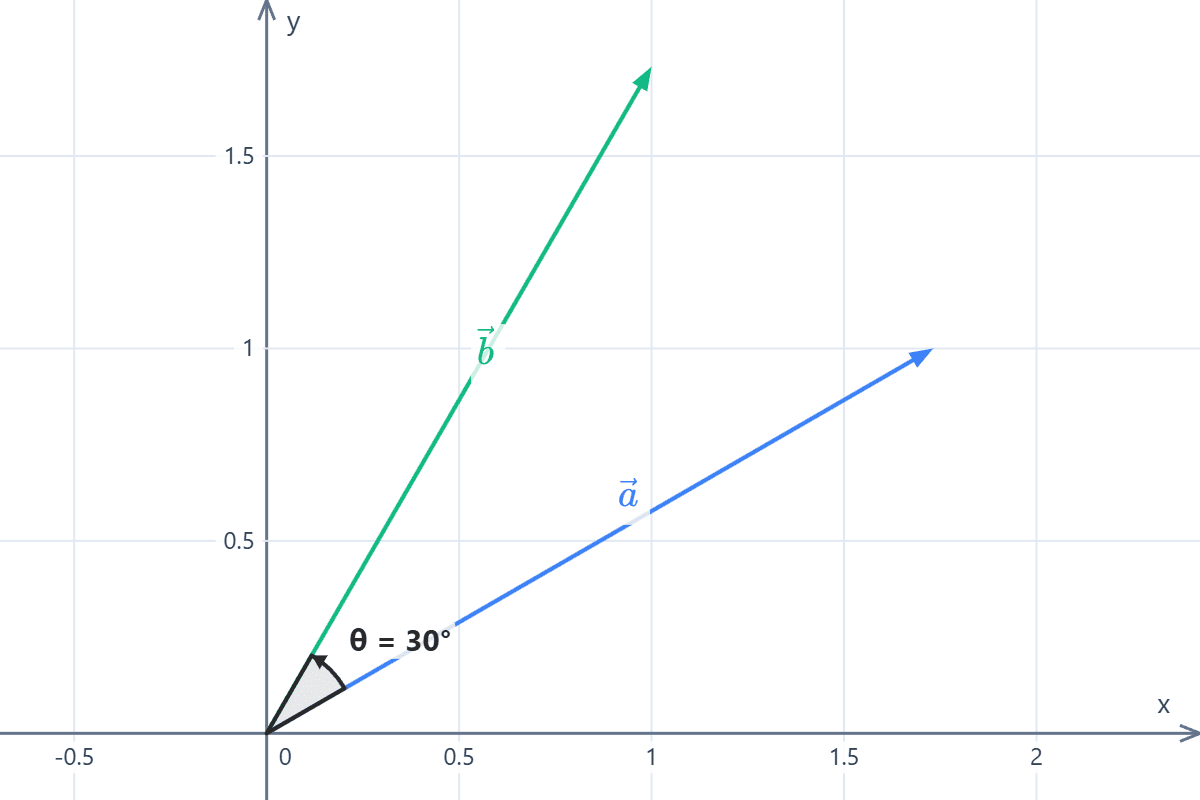
Find out if the vectors \(\langle \sqrt{3}, 1\rangle\) and \(\langle 1, \sqrt{3}\rangle\) are perpendicular to each other.
Result
The given vectors are NOT orthogonal.
To confirm this, we calculate their dot product:
Since the dot product is non-zero, the vectors are not perpendicular (the angle between them is not 90°).
In particular, the angle between them is:
Determine whether the three-dimensional vectors ⟨2, -1, 3⟩ and ⟨1, 5, 1⟩ are orthogonal or not.
Result
The given vectors ARE orthogonal.
To confirm this, we calculate their dot product:
Since the dot product is equal to zero, the vectors are perpendicular, meaning the angle between them is 90°.
Related Tools
