
Parabola Equation and Graph Calculator
Enter the parabola equation or the known data to get all its equations (standard, general, and vertex form), its elements (focus, vertex, directrix, axis of symmetry, latus rectum, intercepts), and an interactive graph of the curve.
Quick Examples
How to Use the Calculator
This online parabola solver is an analytical tool that processes various input data to provide a comprehensive report of all the curve's elements. The mathematical engine interprets the information and returns the different forms of the equation, important elements, and geometric properties, working with exact fractions and roots to avoid rounding errors.
To get started, use the main dropdown to tell the system what data you know about your problem. The available calculation modes are as follows:
- Parabola equation: Enter the equation in any recognizable format. The system automatically interprets the dependent variable; if you type x^2+2x+3, it assumes it is y = x^2+2x+3. It also accepts functional notation like f(x), g(x), or implicit equations. The solver processes unsimplified, unordered expressions or those with terms on both sides of the equal sign, completing the square and grouping terms internally.
- Vertex and focus: Provide the coordinates of the vertex (h, k) and the focus. From these two references, the algorithm determines the orientation of the parabola (opens upwards, downwards, right, or left) and builds the vertex form and general form.
- Vertex and directrix: enter the vertex data and the equation of the directrix line (for example, y = -3 or x = 5).
- Vertex and a point: Input the coordinates of the vertex and any point (x, y) the curve passes through. Since a single point does not define the orientation, you must select the direction the parabola opens (horizontal or vertical, in a positive or negative direction) from the dropdown menu.
- Focus and directrix: Based on the geometric definition of the locus, enter the focus coordinates and the equation of the directrix. The calculator works as a vertex finder by locating the midpoint of the shortest distance between both elements, deduces the orientation, and generates the corresponding equation.
- Three points: Provide the coordinates of three non-collinear points the parabola passes through. In this mode, it is mandatory to indicate the orientation of the curve (vertical or horizontal focal axis) using the corresponding selector.
Once the data is processed, the solver will generate a detailed report with the important components of the figure:
- Standard form: expressed in the polynomial form y = ax² + bx + c (or its equivalent for x).
- Vertex form: the form y = a(x - h)² + k (or its equivalent for x) that allows for quick identification of the vertex.
- Standard form (analytic geometry): the form (x - h)² = 4p(y - k), which makes it easy to visually identify the vertex and focal length, used when working with the parabola as a conic section.
- General form: the expression set equal to zero (Ax² + Dx + Ey + F = 0 or Cy² + Dx + Ey + F = 0).
- Geometric elements: a list that includes the coordinates of the vertex, focus, equation of the directrix, axis of symmetry, latus rectum length, value of parameter p, and intersection points with the Cartesian axes.
Note: all numerical and equation fields accept integers, decimals, and exact fractions. Irrational roots are kept in symbolic form in the results to ensure analytical accuracy; decimal approximations are also provided.
Step-by-Step Examples
The following are examples of problems solved by the parabola calculator in its different modes.
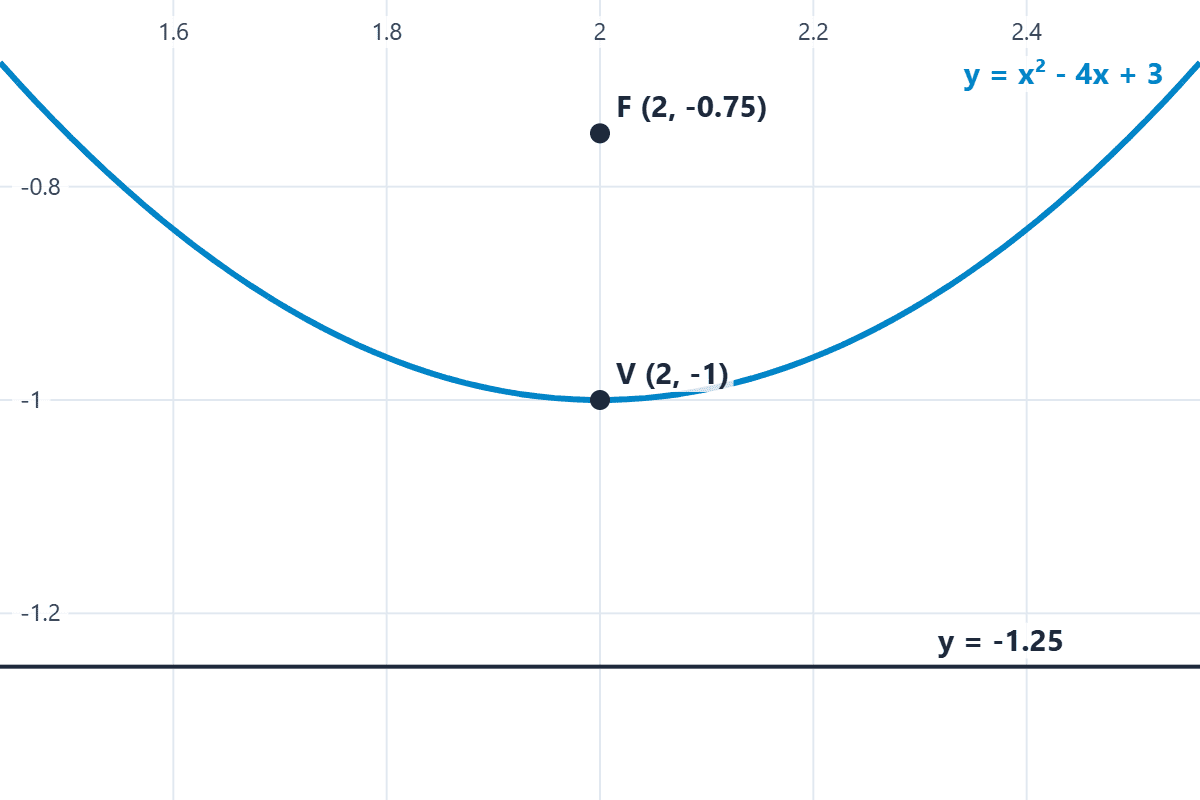
Find all the equations and elements of the parabola given its equation \( y=x^2-4x+3. \)
Parabola equations
Standard form
Vertex form
Conic standard form
General form
Parabola elements
Orientation: Vertical opening up.
Vertex: \( V \left(2, -1\right) \)
Focus: \( F \left(2, -\dfrac{3}{4}\right) \approx \left(2, -0.75\right) \)
Directrix equation: \( y = -\dfrac{5}{4} = -1.25 \)
Axis of symmetry equation: \( x = 2 \)
Latus rectum length: \( L_R = 1 \)
Parameter: \( p = \dfrac{1}{4} = 0.25 \)
Focal length: \( |p| = \dfrac{1}{4} = 0.25 \)
Eccentricity: \( e = 1 \)
x-intercepts (roots)
y-intercepts
Domain: \( D = \mathbb{R} \)
Range: \( R = \left[-1, +\infty\right) \)
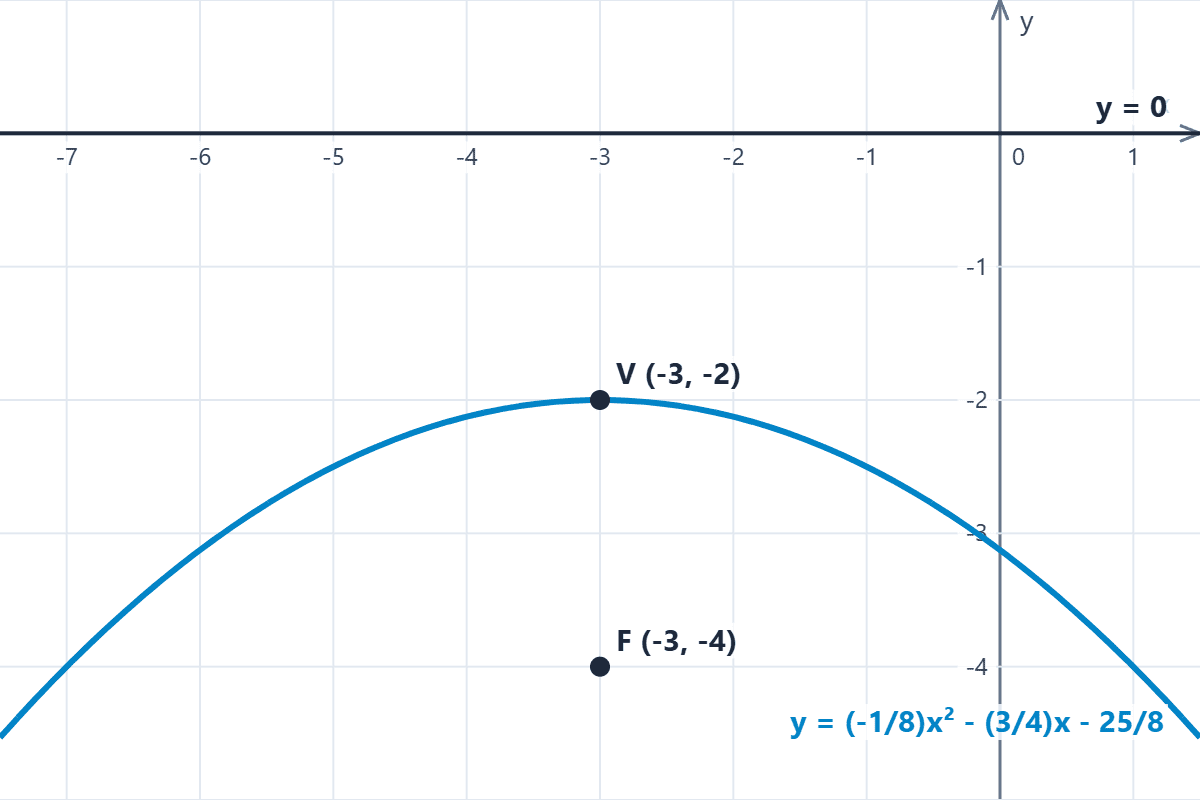
Given the parabola with equation \( x^{2}+6 x+8 y+25 = 0 \), determine its elements.
Equations
Standard form equation
Vertex form
General form equation
Conic Standard form equation
Elements
Orientation: Vertical opening down.
Vertex: \( V \left(-3, -2\right) \)
Focus: \( F \left(-3, -4\right) \)
Directrix equation: \( y = 0 \)
Axis of symmetry: \( x = -3 \)
Latus rectum length: \( L_R = 8 \)
Parameter: \( p = -2 \)
Focal length: \( |p| = 2 \)
Eccentricity: \( e = 1 \)
x-axis intercepts
Do not exist in real numbers.
y-axis intercepts
Domain: \( D = \mathbb{R} \)
Range: \( R = \left(-\infty, -2\right] \)
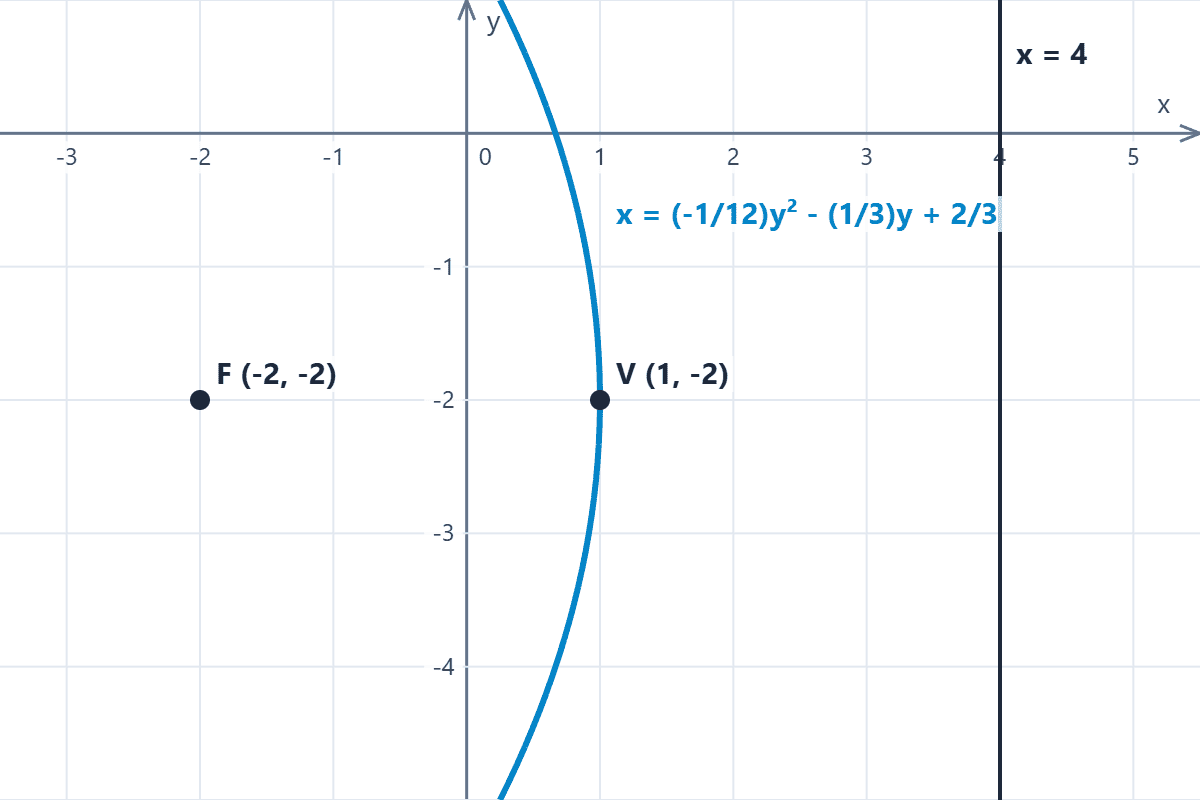
Perform a complete analysis of the horizontal parabola with equation \( (y+2)^2 = -12(x-1) \).
Parabola formulas
Standard form
Vertex Form
General form
Conic standard form
Parabola elements
Orientation: Horizontal opening left.
Vertex: \( V \left(1, -2\right) \)
Focus: \( F \left(-2, -2\right) \)
Directrix: \( x = 4 \)
Axis of symmetry: \( y = -2 \)
Latus rectum: \( L_R = 12 \)
Parameter: \( p = -3 \)
Focal length: \( |p| = 3 \)
Eccentricity: \( e = 1 \)
x intercepts
y intercepts
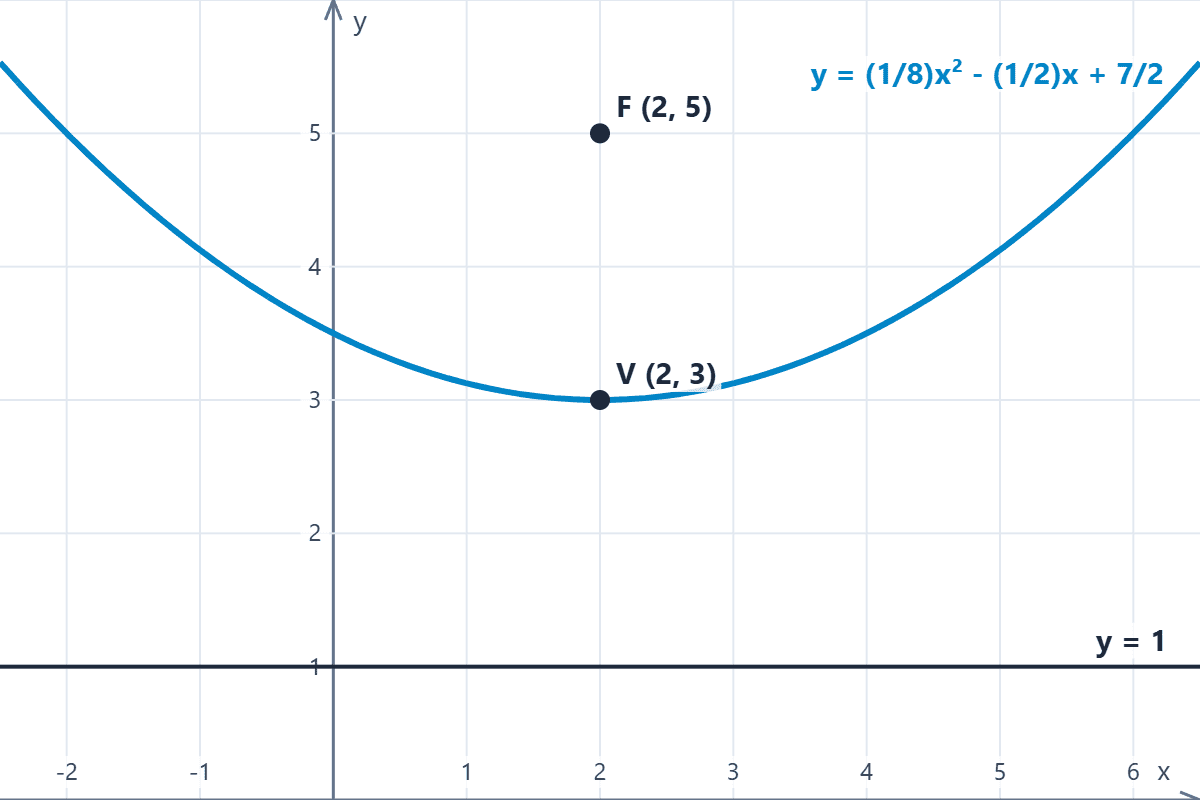
Find the equation of the parabola given the vertex (2, 3) and the focus (2, 5).
Parabola equations
Standard form equation
General form equation
Conic standard form
Elements
Orientation: Vertical opening up.
Vertex: \( V \left(2, 3\right) \)
Focus: \( F \left(2, 5\right) \)
Directrix: \( y = 1 \)
Axis of symmetry: \( x = 2 \)
Latus rectum: \( L_R = 8 \)
Parameter: \( p = 2 \)
Focal length: \( |p| = 2 \)
Eccentricity: \( e = 1 \)
x-axis intercepts
Do not exist in real numbers.
y-axis intercepts
Domain: \( D = \mathbb{R} \)
Range: \( R = \left[3, +\infty\right) \)
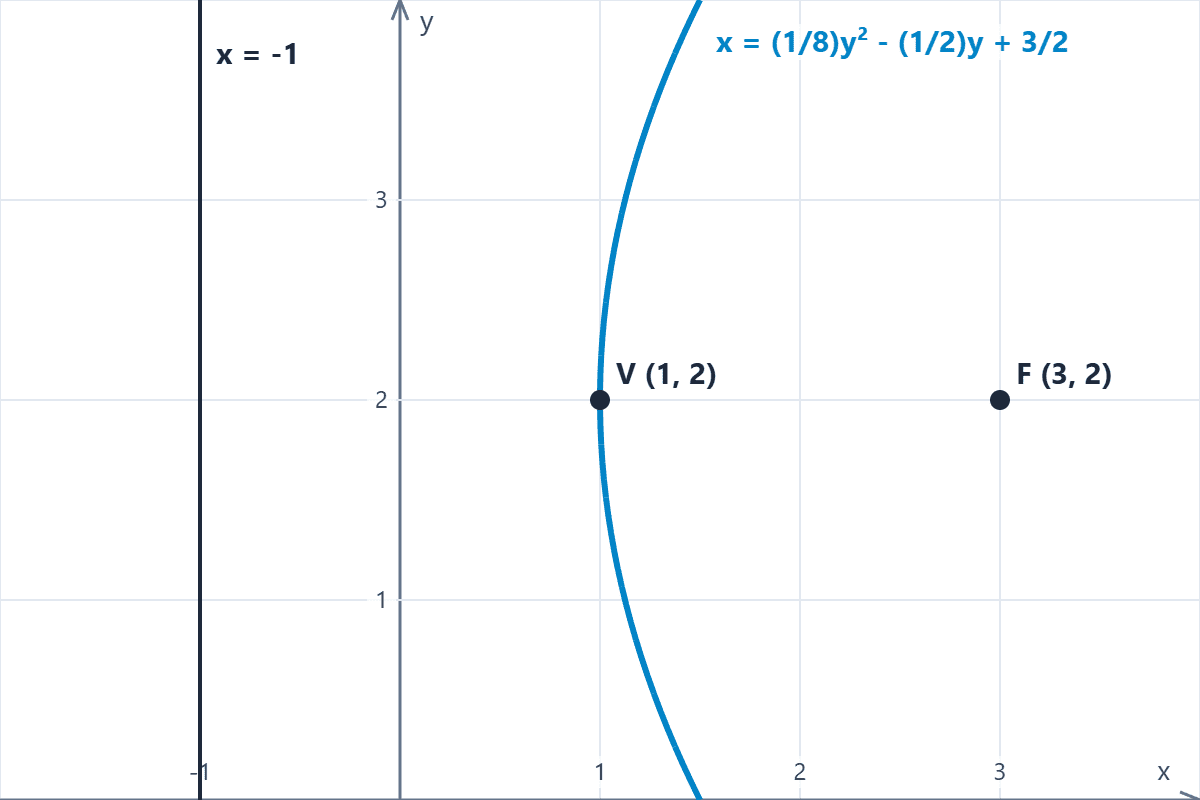
Write the equation of the parabola given the focus (3, 2) and directrix x = -1.
Equations
Standard form
General form
Conic standard form
Parabola elements
Orientation and opening: Horizontal opening right.
Vertex: \( V \left(1, 2\right) \)
Focus: \( F \left(3, 2\right) \)
Directrix equation: \( x = -1 \)
Equation of the axis of symmetry: \( y = 2 \)
Latus rectum: \( L_R = 8 \)
Parameter: \( p = 2 \)
Focal length: \( |p| = 2 \)
Eccentricity: \( e = 1 \)
x-intercepts
y-intercepts
Do not exist in real numbers.
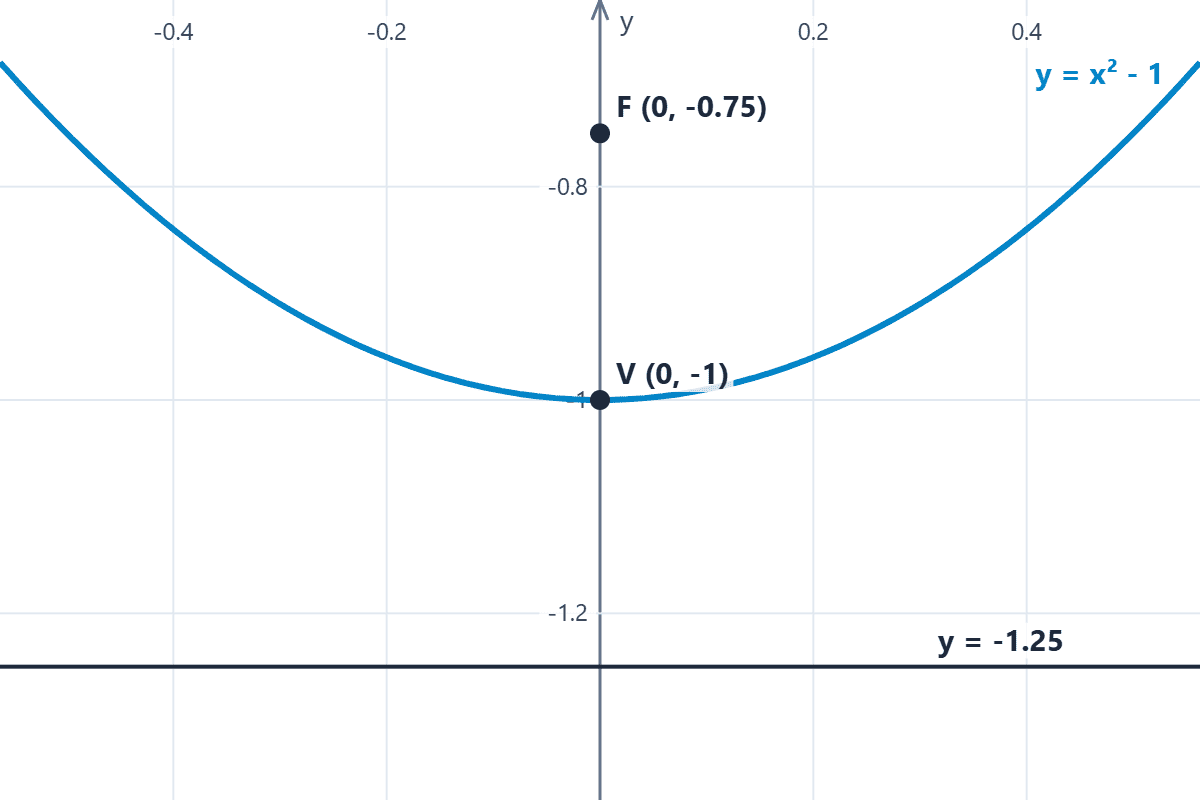
Find the equation of the vertical parabola given 3 points: (1, 0), (2, 3) and (3, 8).
Equations
Standard equation
General equation
Conic standard form
Elements
Orientation: Vertical opening up.
Vertex: \( V \left(0, -1\right) \)
Focus: \( F \left(0, -\dfrac{3}{4}\right) \approx \left(0, -0.75\right) \)
Directrix: \( y = -\dfrac{5}{4} = -1.25 \)
Axis of symmetry: \( x = 0 \)
Latus rectum: \( L_R = 1 \)
Parameter: \( p = \dfrac{1}{4} = 0.25 \)
Focal length: \( |p| = \dfrac{1}{4} = 0.25 \)
Eccentricity: \( e = 1 \)
x-axis intercepts
y-axis intercepts
Domain: \( D = \mathbb{R} \)
Range: \( R = \left[-1, +\infty\right) \)
Related Tools
