
Elimination Method Calculator
Enter the coefficients of the 2x2 system of linear equations to solve it step by step using the elimination method with an interactive graph.
Quick Examples
How to Use the Calculator
This online elimination method calculator (also known as the addition method) is an algebraic and graphing tool designed to solve 2x2 systems of linear equations. In addition to giving you the direct solution and classifying the system analytically, the math engine walks through the complete step-by-step procedure and generates an interactive graph on the Cartesian coordinate plane.
How to enter coefficients into the grid:
- Unit coefficients (1 and -1): If a variable appears without a visible number in your problem (for example, x + 2y = 8 or -y = 4), you must explicitly enter 1 or -1 in the corresponding box so the calculator can process the term.
- Missing terms or blank cells: If one of the equations does not contain one of the variables (for example, 2x = 6), you can enter 0 in the missing variable's box or leave it blank; the system automatically treats empty fields as zero.
- Supported number formats: You can enter integers (positive or negative), decimal values (with a period or comma, such as 1.5 or -0.25), and exact fractions (such as 1/2, -3/4, or 7/3). The engine preserves fractions symbolically throughout the entire calculation to avoid rounding errors.
Once you enter the values and click the calculate button, the output is organized into three main sections:
1. Quick Answer and System Classification
In the first highlighted block, you will get an immediate diagnosis of the system based on the nature of its solutions:
- Consistent and independent system: Has a unique solution. Both exact and decimal values for x and y are displayed, along with the coordinates of the intersection point P(x, y) where the two lines cross.
- Inconsistent system: Has no solution. This occurs when the equations represent two parallel lines that never intersect on the plane.
- Consistent and dependent system: Has infinitely many solutions. This occurs when both equations represent the exact same geometric line (coincident lines).
2. Step-by-Step Mathematical Solution
To provide a clean, easy-to-follow breakdown, the algorithm analyzes the coefficients of both equations and automatically selects the most convenient variable to eliminate (prioritizing terms that are already opposites, equal, or integer multiples of each other). The procedure is structured into five stages:
- Identify the system: The system is presented in standard notation, labeling equation (1) and equation (2).
- Match the coefficients: One or both equations are multiplied by the appropriate factors so that the coefficients of the chosen variable have the same absolute value and opposite signs, producing an equivalent system.
- Add the equations vertically: Both equations are added term by term to cancel out the selected variable and reduce the problem to a single-variable linear equation.
- Solve the resulting equation: The remaining variable is solved for, with its value highlighted in a box. If the system has no solution or infinitely many solutions, this step demonstrates the contradiction (for example, 0 = 5) or the identity (for example, 0 = 0).
- Back-substitution: The value found is substituted into the simpler original equation to solve for the second variable and complete the solution set.
3. Interactive Graph on the Cartesian Plane
In the bottom section, the geometric representation of the system is plotted in two dimensions. Each linear equation is drawn in a distinct color, highlighting the intersection point whenever a unique solution exists.
Worked Examples
Below are examples of problems solved using the calculator.
Example 1
Solve the following system of linear equations using the elimination method:
Result
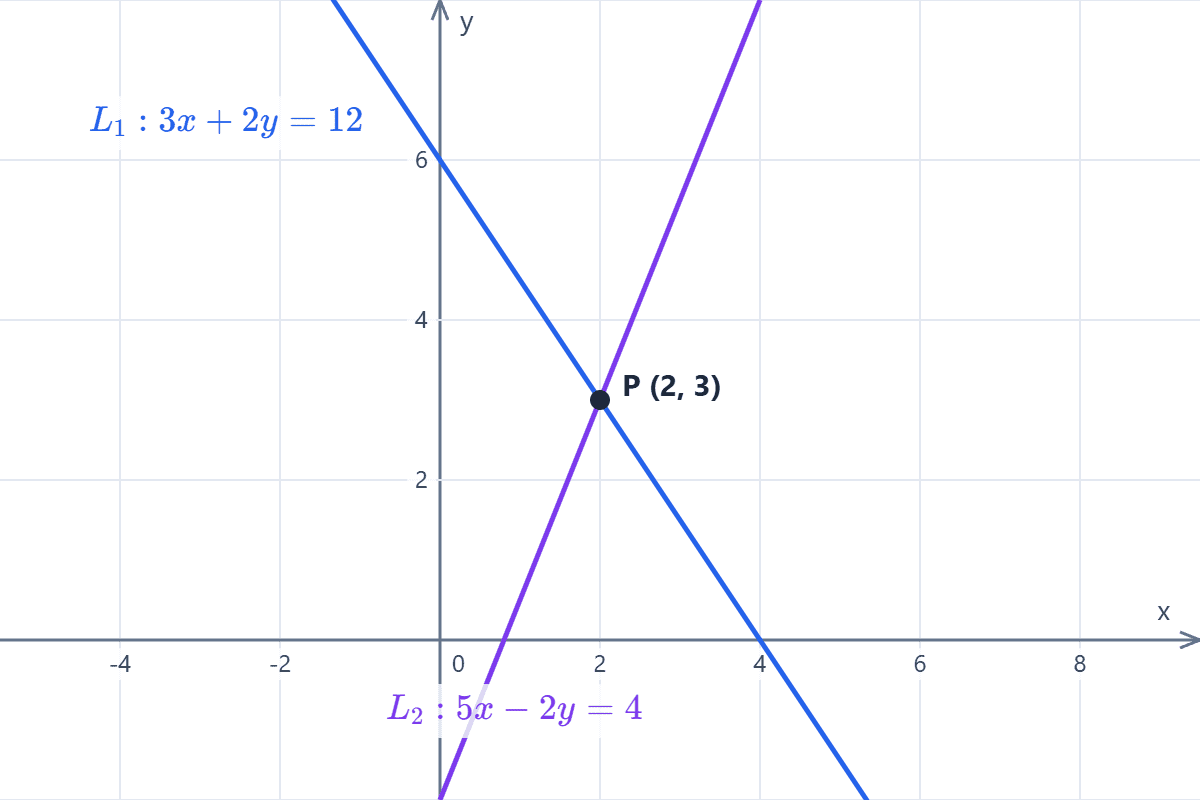
The system has a unique solution (consistent and independent system):
The lines intersect at a single point:
Step-by-Step Solution
1. Identify the system of equations.
The system of linear equations to solve is:
2. Make the coefficients of the variable to eliminate opposites.
The coefficients of the variable y are already opposites, so there is no need to multiply the equations.
3. Add the equations to eliminate the variable.
Add both equations term by term to eliminate the variable y:
4. Solve the resulting single-variable linear equation.
Solve for x:
5. Substitute the known value to find the other variable.
Substitute the value of x into equation (1) and solve for y:
Therefore, the solution to the system is:
Example 2
Find the solution to the 2x2 system of equations using elimination:
Result
The system has a unique solution (consistent and independent system):
Both lines intersect at the point:
Step-by-Step Solution
1. Identify the system of equations.
The system of equations to solve is as follows:
2. Make the coefficients of the variable to eliminate opposites.
Multiply equation (1) by 3 and equation (2) by -2 so that the coefficients of x become opposites:
This gives us the following equivalent system:
3. Add the equations to eliminate the variable.
Add both equations term by term to cancel out the variable x:
4. Solve the resulting single-variable linear equation.
Solve for y:
5. Substitute the known value to find the other variable.
Substitute the value obtained for y into equation (1) to solve for x:
Therefore, the solution to the system is:

Example 3
Determine the values of the variables in the following system with fractional coefficients:
Result
The system has a unique solution (consistent and independent system):
The point of intersection of the lines is:
Step-by-Step Solution
1. Identify the system of equations.
We start with the following system of equations with fractions:
2. Make the coefficients of the variable to eliminate opposites.
Multiply equation (1) by 3 so that the coefficients of y become opposites:
This yields the following equivalent system:
3. Add the equations to eliminate the variable.
Add both equations term by term to eliminate the variable y:
4. Solve the resulting single-variable linear equation.
Solve for the variable x:
5. Substitute the known value to find the other variable.
Substitute x into equation (1) and solve for y:
Thus, the solution to the system is:

Example 4
Analyze and solve the following system of linear equations using the addition method:
Result
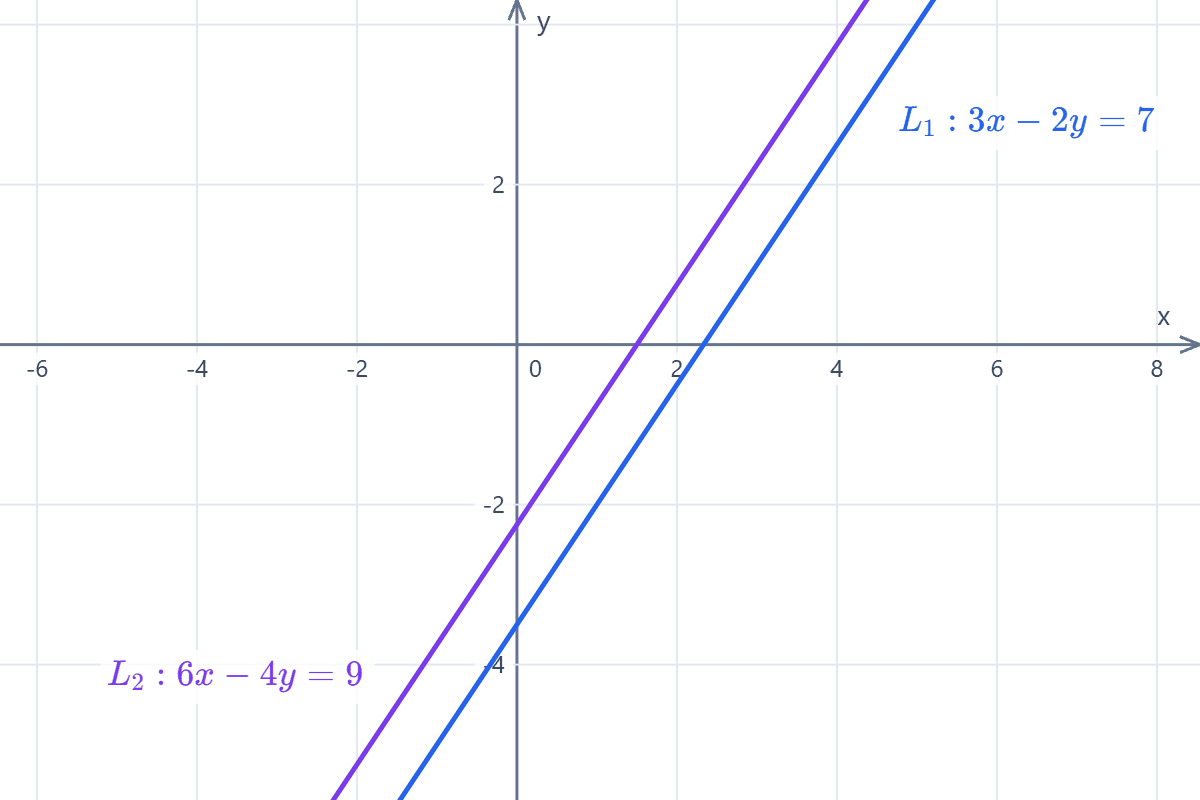
The system has no solution (inconsistent system). The lines are parallel and do not intersect at any point.
Step-by-Step Solution
1. Identify the system of equations.
Consider the following system of linear equations:
2. Make the coefficients of the variable to eliminate opposites.
Multiply equation (1) by -2 to give the variable x opposite coefficients:
This gives us the following equivalent system:
3. Add the equations to eliminate the variable.
Add the two equations term by term to eliminate x:
4. Analyze the resulting statement.
Examine the statement obtained after adding the equations:
This statement is a mathematical contradiction; therefore, the system has no solution (the lines are parallel).
Example 5
Find the solution set of the following system of equations using elimination:
Result
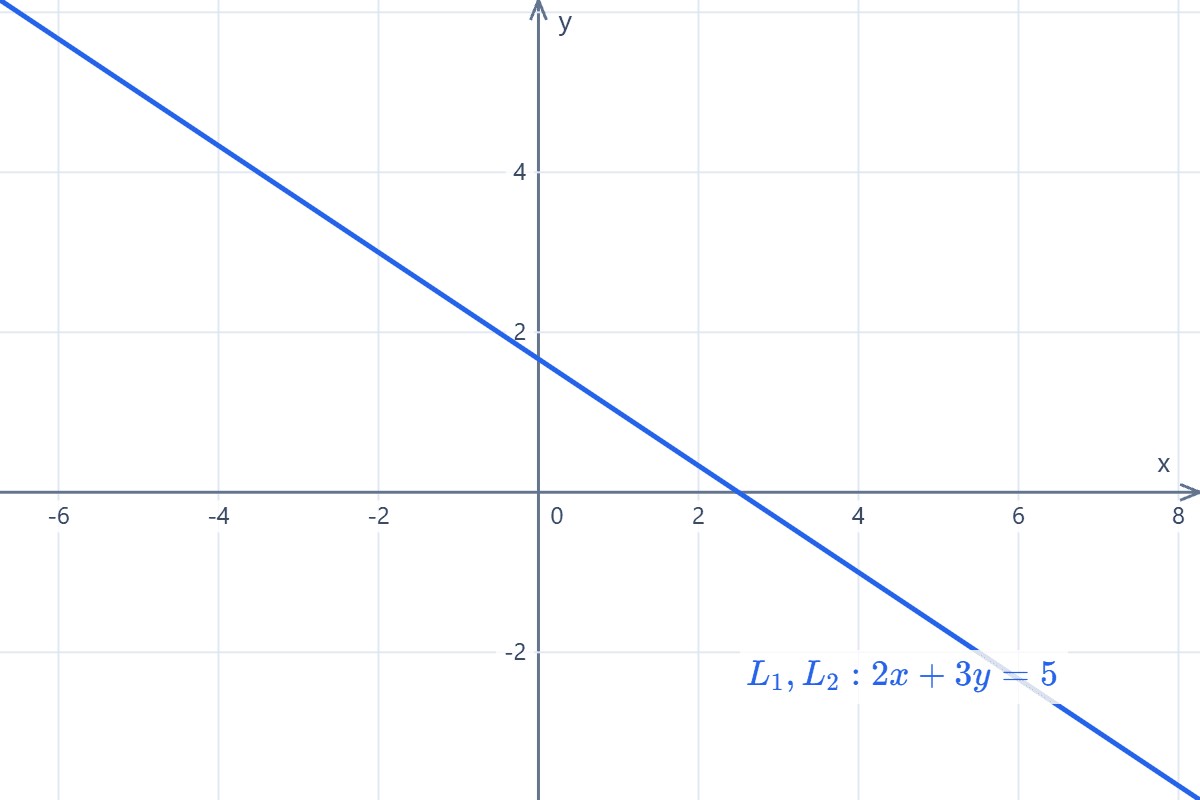
The system has infinitely many solutions (consistent and dependent system). Both equations describe the exact same line (coincident lines).
Step-by-Step Solution
1. Identify the system of equations.
The given system of equations is:
2. Make the coefficients of the variable to eliminate opposites.
Multiply equation (1) by -2 so that the variable x has opposite coefficients:
This leads to the following equivalent system:
3. Add the equations to eliminate the variable.
Add both equations term by term to eliminate x:
4. Analyze the resulting statement.
Review the statement obtained after adding the equations:
Since this statement is an identity that holds true for any values satisfying the equation, the system has infinitely many solutions (the lines are coincident).
Related Tools
