
Latus Rectum Calculator
Enter the equation of a conic section (in any form) to calculate the length of the latus rectum and its endpoints, as well as to get the step-by-step procedure and the Cartesian graph.
Quick Examples
How to Use the Calculator
This online latus rectum solver is an analytical tool designed to find the exact length and endpoint coordinates of this segment. In addition to providing the final answer, the system generates the step-by-step procedure and plots the figure on an interactive Cartesian plane.
How to enter the equation:
- Type the equation freely: enter the expression in the available field. The engine is designed to interpret the equation in any of its forms. You do not need to order it; you can enter the standard form as (x-2)2 = 8(y-1), the general form as 9x2 + 4y2 - 18x + 16y - 11 = 0, or even unsimplified expressions.
- Supported formats: the calculator accepts integers, decimals, fractions, and irrationals (such as square roots). Enter the data exactly as it appears in your problem.
Once the equation is entered, the algorithm will analyze it and provide you with a complete report that includes:
- Identification and conversion: the solver will automatically detect if it is a parabola, an ellipse, or a hyperbola.
- Length of the latus rectum (LR): the system will apply the corresponding formula to the identified conic section. For parabolas, it will evaluate the absolute value of the focal parameter |4p|. For ellipses and hyperbolas, it will apply the relationship 2b2/a.
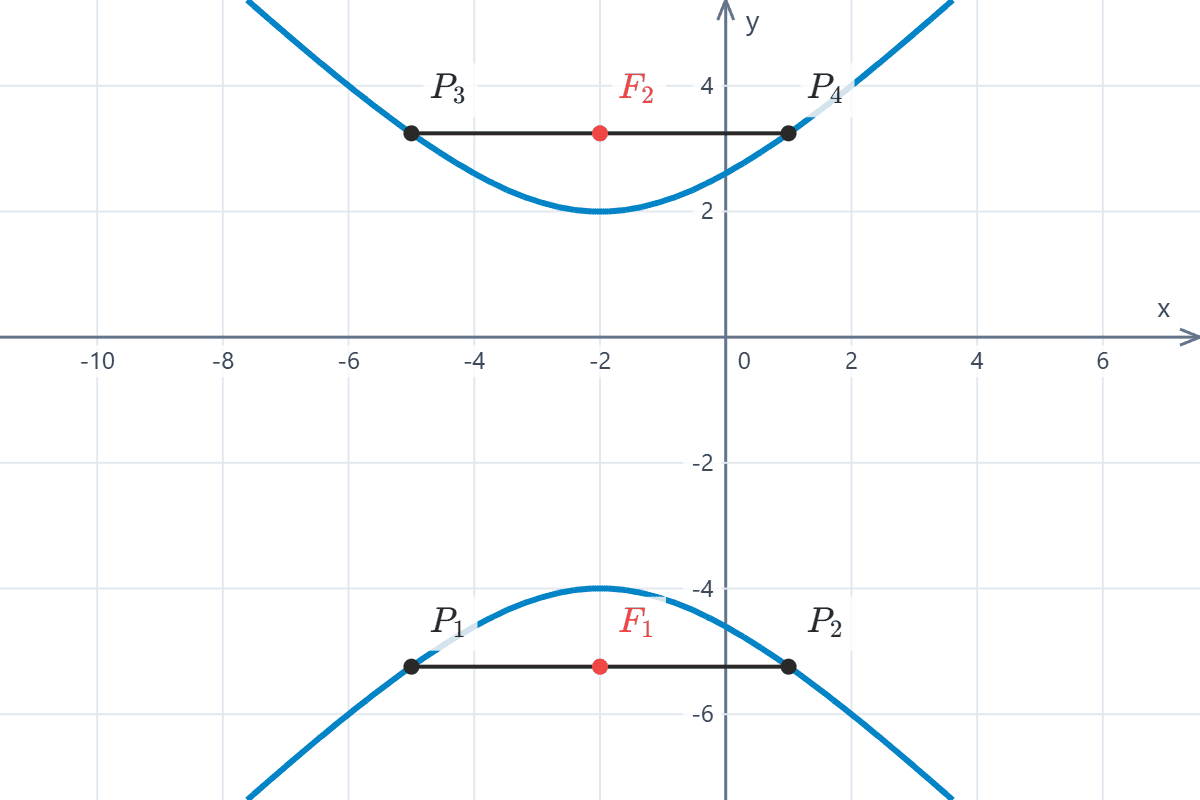
- Coordinates of the endpoints: the step-by-step procedure will show you how, starting from the focus (or foci), half the length of the latus rectum is added and subtracted in a perpendicular direction to the focal axis to find the points P1, P2 (and P3, P4 if there are two foci).
To ensure maximum algebraic rigor, the internal engine works with exact fractions and preserves roots symbolically, thus avoiding premature rounding errors. If the result is irrational, you will be provided with the exact notation along with its decimal approximation. Finally, at the bottom of the results, you will find an interactive graph generated for the problem.
Step-by-Step Examples
Check out some examples of problems solved directly with the tool.
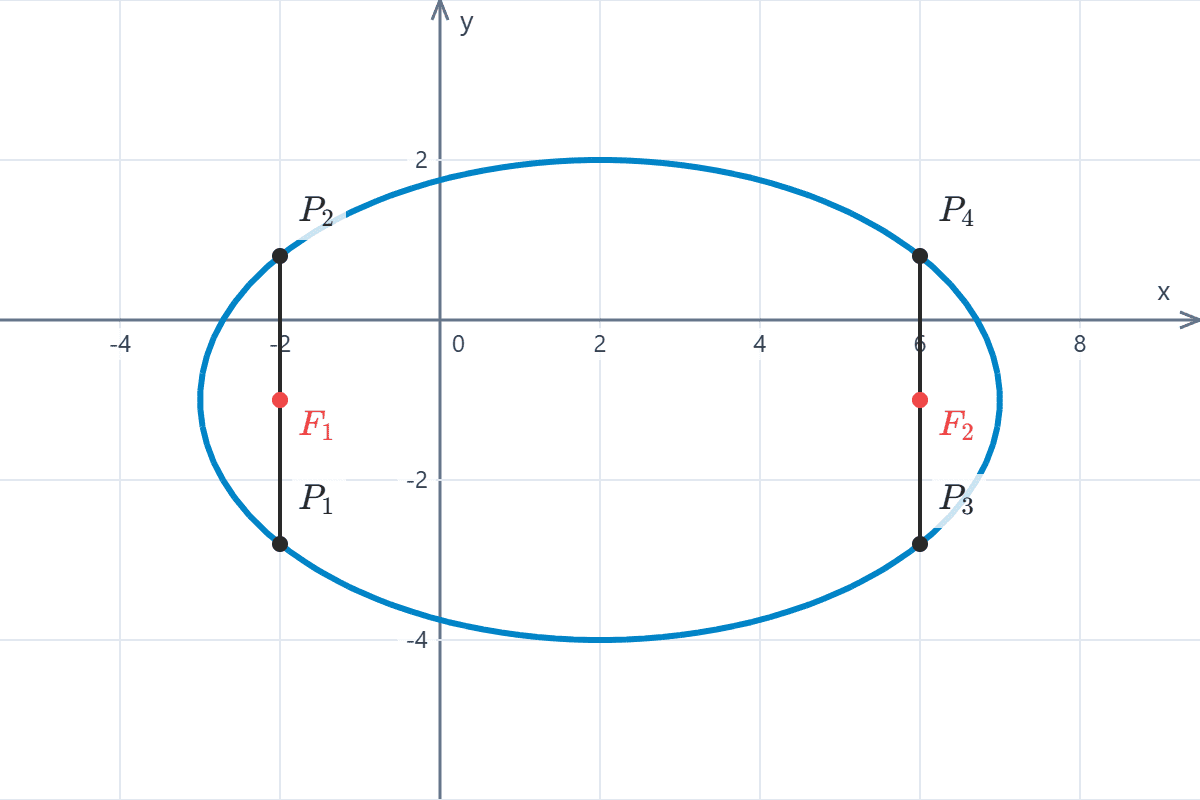
Calculate the latus rectums of the ellipse \( \dfrac{(x-2)^2}{25}+\dfrac{(y+1)^2}{9}=1. \)
Result
The length of the latus rectum is:
The endpoints are:
Step-by-step solution
1. Identify the equation and its parameters.
The entered equation corresponds to an ellipse:
We extract the center, semi-axes, and orientation, and we calculate the coordinates of the foci, as they will be needed for further calculations:
2. Calculate the length of the latus rectum.
We use the latus rectum length formula, substituting the semi-axis values from the equation:
3. Determine the endpoints of the latus rectum.
To find the endpoints, we take the coordinates of each focus and move perpendicularly to the focal axis by a distance equal to half the latus rectum.
For the first focus:
For the second focus:
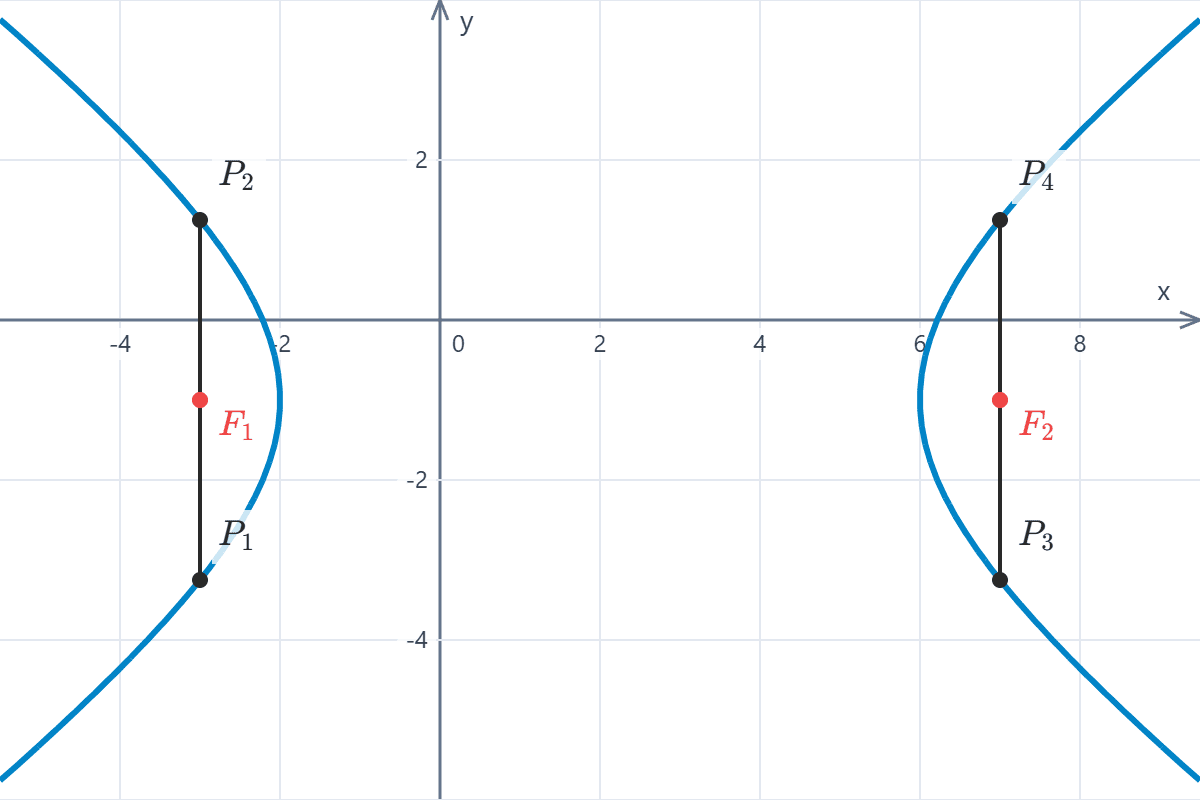
Find the length and endpoints of the latus rectums of the hyperbola \( \dfrac{(x-2)^2}{16}-\dfrac{(y+1)^2}{9}=1. \)
Result
The length of the latus rectum is:
The endpoints are:
Step-by-step solution
1. Identify the equation and its parameters.
The entered equation corresponds to a hyperbola:
We extract the center, semi-axes, and orientation, and we calculate the coordinates of the foci, as they will be needed for further calculations:
2. Calculate the length of the latus rectum.
We use the latus rectum length formula, substituting the semi-axis values from the equation:
3. Determine the endpoints of the latus rectum.
To find the endpoints, we take the coordinates of each focus and move perpendicularly to the focal axis by a distance equal to half the latus rectum.
For the first focus:
For the second focus:
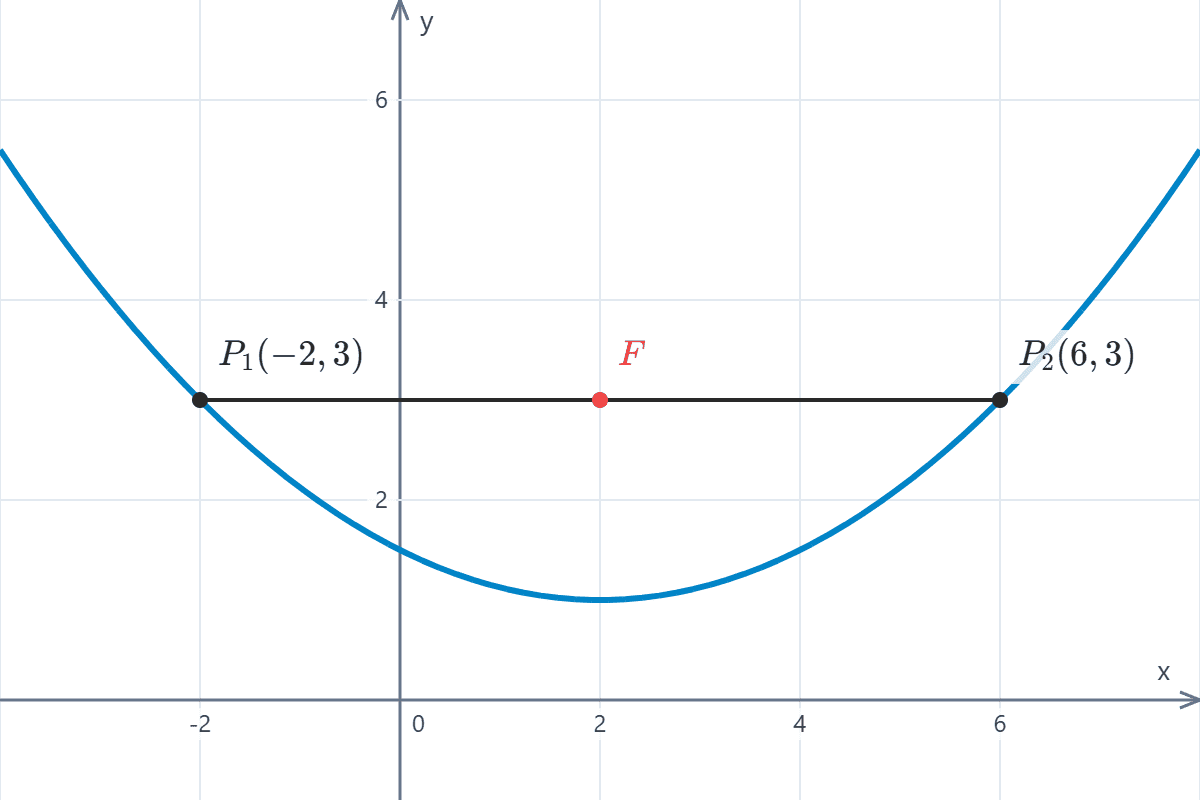
Determine the length and endpoints of the latus rectum of the parabola \((x-2)^2=8(y-1).\)
Result
The length of the latus rectum is:
The endpoints are:
Step-by-step solution
1. Identify the equation and its parameters.
The entered equation corresponds to a parabola:
We extract the coordinates of the vertex, the orientation, the focal parameter, and the focus, as they will be needed for further calculations:
2. Calculate the length of the latus rectum.
The length of the latus rectum is equal to the absolute value of the linear term coefficient (4p), so we can get it directly:
3. Determine the endpoints of the latus rectum.
To find the endpoints, we take the coordinates of the focus and move perpendicularly to the focal axis (axis of symmetry) by a distance equal to half the latus rectum.
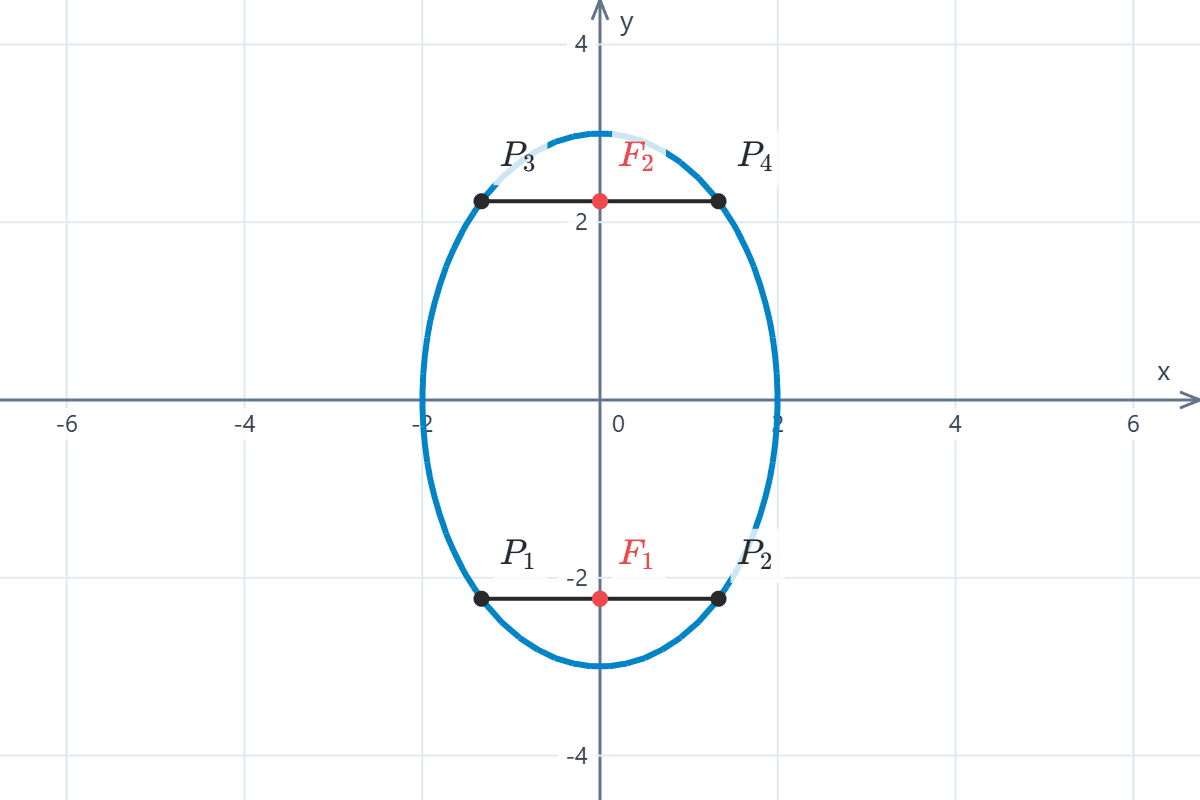
Find the length of the latus rectum of the conic section \( 9x^2+4y^2-36=0. \)
Result
The length of the latus rectum is:
The endpoints are:
Step-by-step solution
1. Identify the equation and its parameters.
The entered equation corresponds to an ellipse:
To extract the parameters of the conic section, we convert the equation to its standard form, completing the square if necessary:
We extract the center, semi-axes, and orientation, and we calculate the coordinates of the foci, as they will be needed for further calculations:
2. Calculate the length of the latus rectum.
We use the latus rectum length formula, substituting the semi-axis values from the equation:
3. Determine the endpoints of the latus rectum.
To find the endpoints, we take the coordinates of each focus and move perpendicularly to the focal axis by a distance equal to half the latus rectum.
For the first focus:
For the second focus:
Obtain the latus rectums of the hyperbola in general form \( x^2-y^2+4x-2y+12=0. \)
Result
The length of the latus rectum is:
The endpoints are:
Step-by-step solution
1. Identify the equation and its parameters.
The entered equation corresponds to a hyperbola:
To extract the parameters of the conic section, we convert the equation to its standard form, completing the square if necessary:
We extract the center, semi-axes, and orientation, and we calculate the coordinates of the foci, as they will be needed for further calculations:
2. Calculate the length of the latus rectum.
We use the latus rectum length formula, substituting the semi-axis values from the equation:
3. Determine the endpoints of the latus rectum.
To find the endpoints, we take the coordinates of each focus and move perpendicularly to the focal axis by a distance equal to half the latus rectum.
For the first focus:
For the second focus:
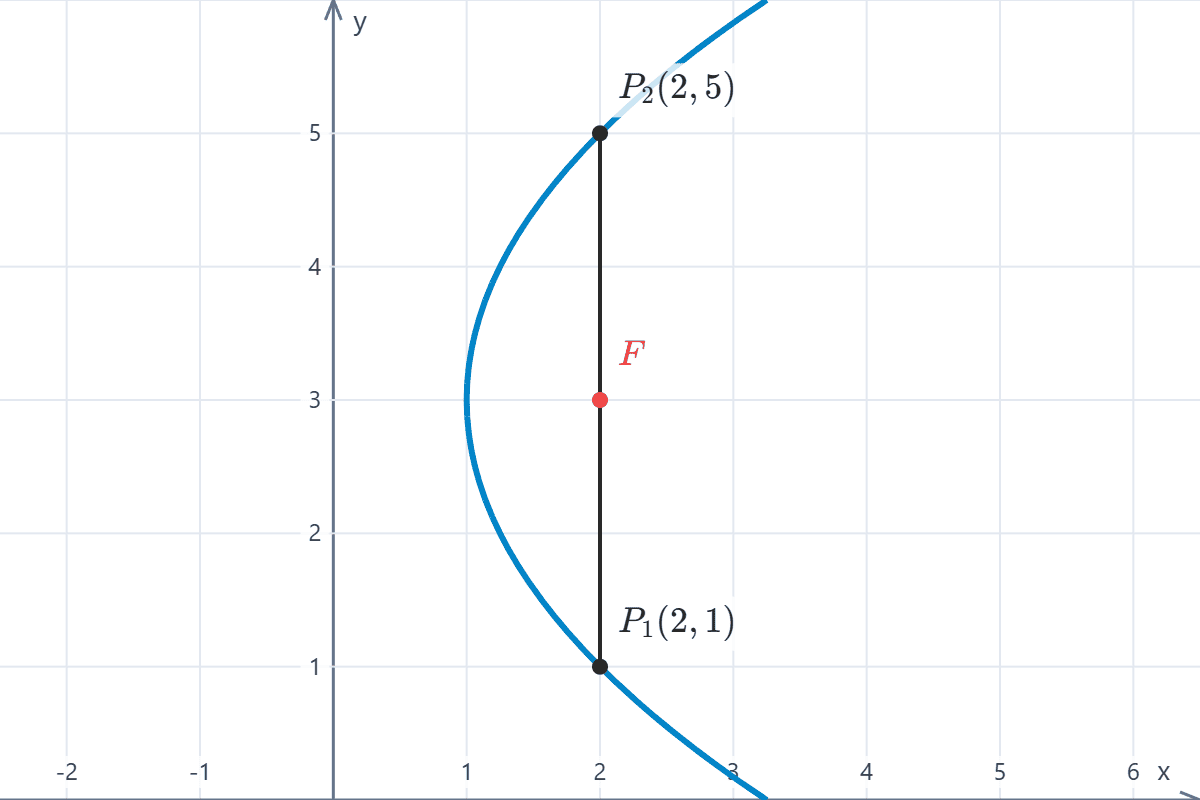
Calculate the latus rectum of the parabola in general form \( y^2-4x-6y+13=0. \)
Result
The length of the latus rectum is:
The endpoints are:
Step-by-step solution
1. Identify the equation and its parameters.
The entered equation corresponds to a parabola:
To extract the parameters of the conic section, we convert the equation to its standard form, completing the square if necessary:
We extract the coordinates of the vertex, the orientation, the focal parameter, and the focus, as they will be needed for further calculations:
2. Calculate the length of the latus rectum.
The length of the latus rectum is equal to the absolute value of the linear term coefficient (4p), so we can get it directly:
3. Determine the endpoints of the latus rectum.
To find the endpoints, we take the coordinates of the focus and move perpendicularly to the focal axis (axis of symmetry) by a distance equal to half the latus rectum.
Related Tools
