
Parallel and Perpendicular Line Equation Calculator
Enter the equation of a line and the coordinates of a point to get the equation of the parallel or perpendicular line passing through that point, along with the step-by-step solution and graph.
Quick Examples
How to Use the Calculator
This online parallel and perpendicular line solver is an analytic geometry tool designed to find the equation of a new line from a reference line and a point. The system not only gives you the final result, but also generates the step-by-step algebraic solution and graphs the situation on the Cartesian plane.
How to enter your data:
- Select the mode: use the dropdown menu to tell the algorithm whether you want to find a parallel line or a perpendicular line.
- Equation of the line: the algebraic engine is highly flexible. You can enter the equation of the original line in any format: slope-intercept form (y = mx + b), general form (Ax + By + C = 0), or even unsimplified, unordered expressions. The solver will automatically group and isolate the terms.
- Point coordinates: enter the x and y values of the point through which your new line must pass. All input fields accept real coefficients: you can use integers, decimals, exact fractions, and irrational roots. Fractions and roots will be kept in symbolic form to prevent rounding errors.
Once the data is processed, the tool will present you with a report structured into three main sections:
Quick answer: an initial box with the direct solution to your problem. Here you will find the equation of the new straight line in slope-intercept form, its equivalent in general form set to zero, and the exact values of its slope (m) and y-intercept (b).
Step-by-step solution: next, the mathematical steps will be displayed. The solver will show you how the slope m1 is extracted from the given equation and how the geometric condition is applied to find the new slope (setting m2 = m1 for parallel lines, or taking the negative reciprocal m1 · m2 = -1 for perpendicular lines). Finally, you will see the substitution into the point-slope formula and the final simplification. The engine detects special cases, adapting the explanation for vertical or horizontal lines.
Cartesian graph: at the end of the report, you will see an interactive Cartesian plane showing the original line, the new line, and the given point. In the case of perpendicularity, the 90° angle will be visually highlighted.
Solved Exercises
The following are examples of problems solved by the calculator.
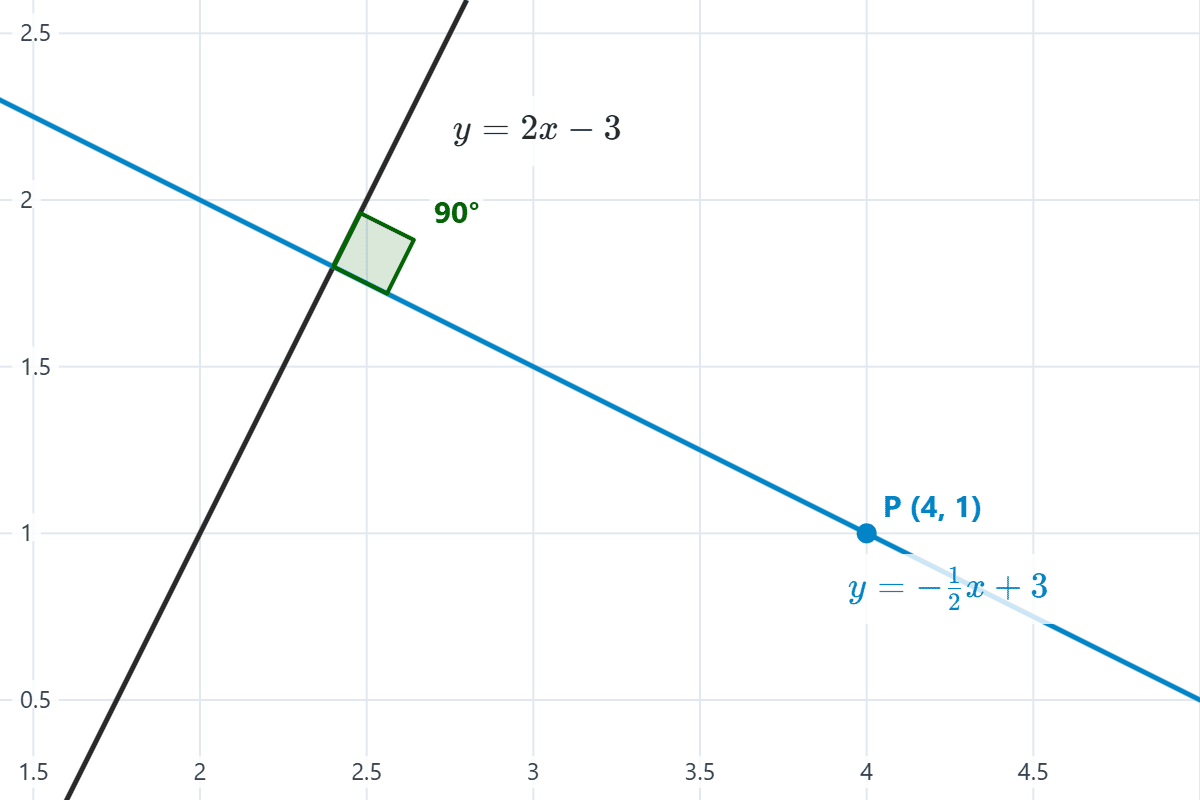
Calculate the equation of the line perpendicular to y = 2x - 3 passing through the point (4, 1).
Result
The equation of the line perpendicular to \( y = 2x - 3 \) and passing through the point \( P(4, 1) \) is:
General form: \( x +2y -6 = 0 \)
Slope: \( m = -\dfrac{1}{2} \)
y-intercept: \( b = 3 \)
Step-by-step solution
1. Identify and calculate the new slope.
The equation and the point to work with are:
We ensure that the given line equation is expressed in slope-intercept form (y = mx + b) and extract its slope (m1):
Since we are looking for a perpendicular line, the geometric condition states that the product of their slopes must equal -1:
Using the formula, we calculate the value of the new slope (m2):
2. Construct the equation of the new line.
We use the point-slope form of the linear equation by substituting the coordinates of the entered point and the obtained slope. Then, we expand and simplify the equation to express it in slope-intercept form:
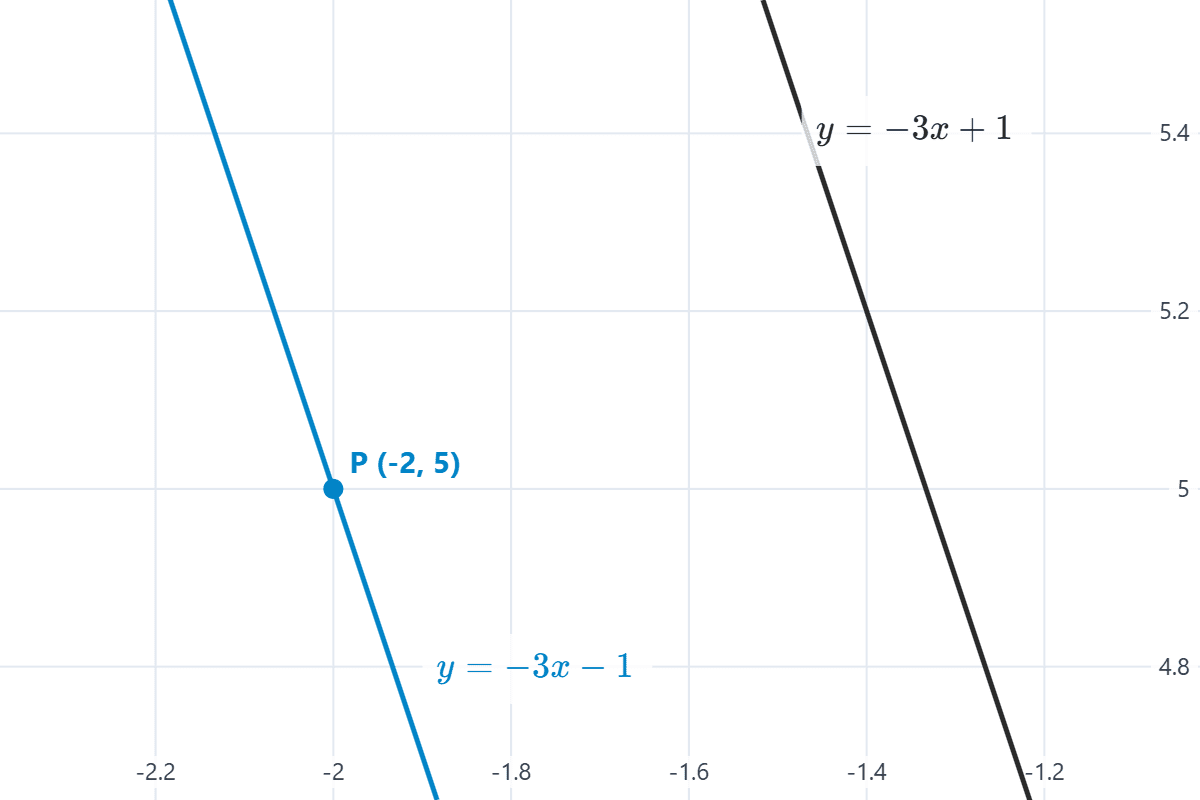
Determine the equation of the line parallel to y = -3x + 1 passing through the point (-2, 5).
Result
The equation of the line parallel to \( y = -3x + 1 \) and passing through the point \( P(-2, 5) \) is:
General form: \( 3x +y +1 = 0 \)
Slope: \( m = -3 \)
y-intercept: \( b = -1 \)
Step-by-step solution
1. Identify the slope of the original line.
The equation and the point to work with are:
We ensure that the given line equation is expressed in slope-intercept form (y = mx + b) and extract its slope (m1):
Since we are looking for a parallel line, by definition, the new line will have exactly the same slope (m2 = m1):
2. Construct the equation of the new line.
We use the point-slope form of the linear equation by substituting the coordinates of the entered point and the obtained slope. Then, we expand and simplify the equation to express it in slope-intercept form:
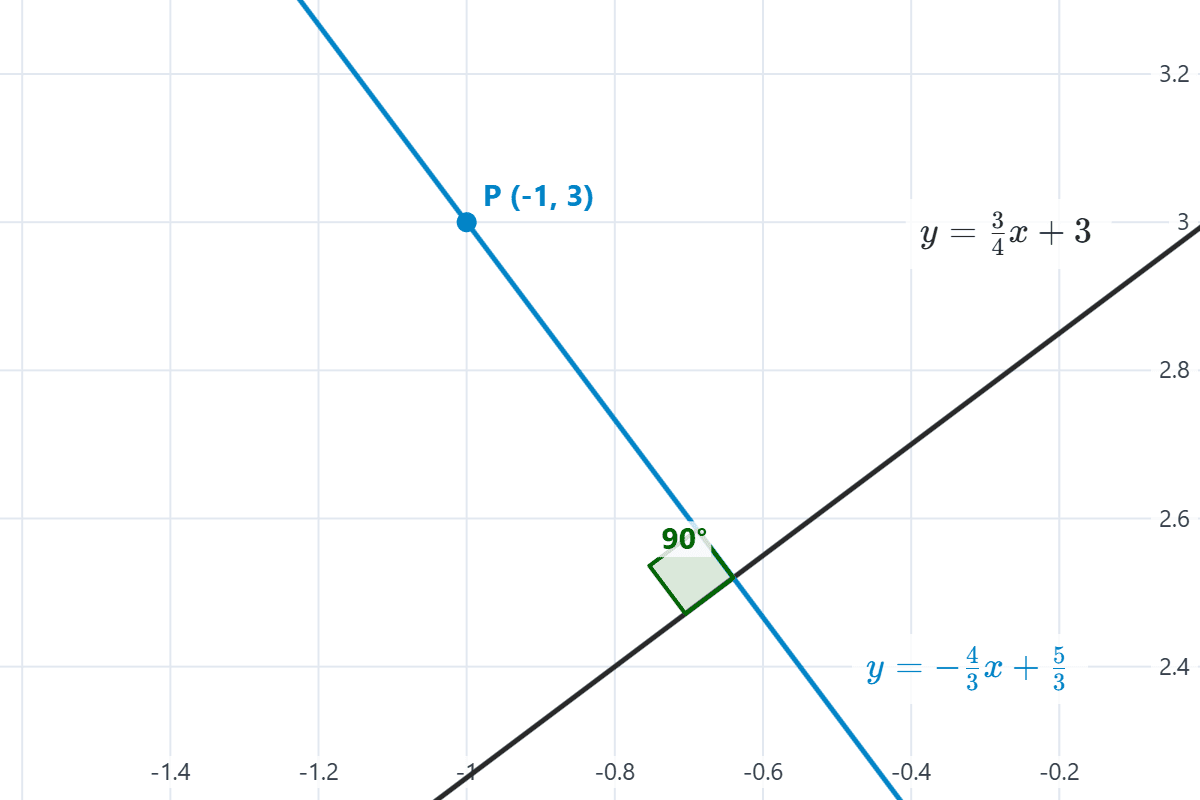
Find the equation of the straight line perpendicular to 3x - 4y + 12 = 0 and passing through the point (-1, 3).
Result
The equation of the line perpendicular to \( 3x - 4y + 12 = 0 \) and passing through the point \( P(-1, 3) \) is:
General form: \( 4x +3y -5 = 0 \)
Slope: \( m = -\dfrac{4}{3} \)
y-intercept: \( b = \dfrac{5}{3} \)
Step-by-step solution
1. Identify and calculate the new slope.
The equation and the point to work with are:
We ensure that the given line equation is expressed in slope-intercept form (y = mx + b) and extract its slope (m1):
Since we are looking for a perpendicular line, the geometric condition states that the product of their slopes must equal -1:
Using the formula, we calculate the value of the new slope (m2):
2. Construct the equation of the new line.
We use the point-slope form of the linear equation by substituting the coordinates of the entered point and the obtained slope. Then, we expand and simplify the equation to express it in slope-intercept form:
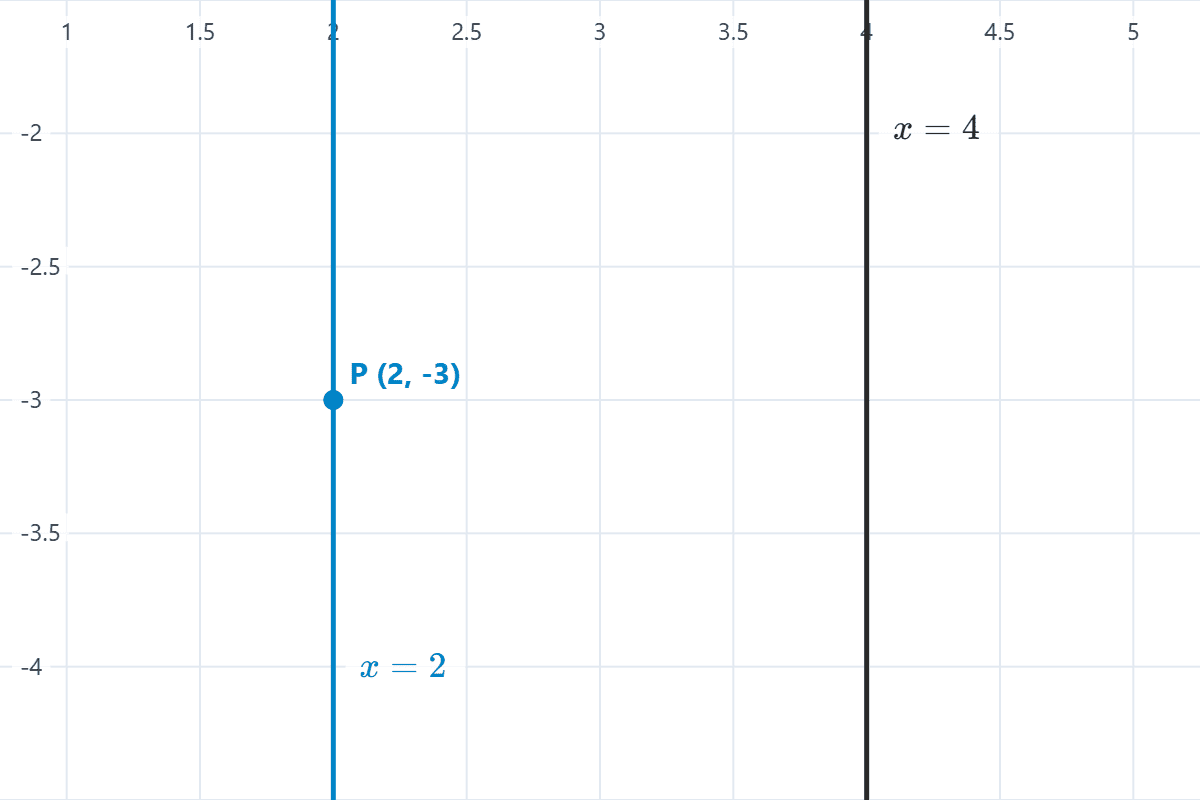
Find the equation of the line that is parallel to the vertical line x = 4 and passes through the point (2, -3).
Result
The equation of the line parallel to \( x = 4 \) and passing through the point \( P(2, -3) \) is:
General form: \( x -2 = 0 \)
Step-by-step solution
1. Identify the slope of the original line.
The equation and the point to work with are:
We note that the given equation represents a vertical line (it has no y-variable), so its slope is undefined.
2. Construct the equation of the new line.
Since we are looking for a line parallel to a vertical line, the new line will also be vertical. Its equation will be of the form x = x0, where x0 is the x-coordinate of the given point.
Related Tools
