
Vector Magnitude Calculator
Calculate the magnitude of a vector in 2D or 3D from its components or endpoints, with step-by-step solution and a graph.
Quick Examples
How to Use the Calculator
This online vector magnitude calculator (also known as the norm or length) is an analytical tool designed to calculate the geometric distance from the origin to the vector's terminal point. The system processes the data to give you the exact answer, generates the step-by-step mathematical work, and supports both the two-dimensional plane (2D) and three-dimensional space (3D).
How to enter your data:
To get started, use the main selector to indicate the dimension you are working in (2D or 3D) and choose the input method your problem requires:
- By its Cartesian components: if you already have the vector in its component form, simply enter the values into the corresponding fields. For a two-dimensional vector, you will use (x, y), and for a three-dimensional vector, you will fill in (x, y, z).
- By its endpoints: if your exercise provides the coordinates of an initial point and a terminal point, select this mode and enter both points. The calculator's engine will automatically subtract the coordinates to build the vector components before calculating its length.
The tool supports the use of integers, decimals, exact fractions, and roots. We recommend entering values in their exact form (for example, as a fraction) so that the mathematical engine operates symbolically and avoids carrying over rounding errors.
Result structure:
Once the information is processed, the algorithm will provide a report structured as follows:
- Direct answer: in a highlighted block at the top, you will get the final value of the vector's magnitude. To guarantee algebraic accuracy, the result will be presented first in its exact form (keeping roots or irreducible fractions if any) and, next to it, its respective decimal approximation will be included if the problem requires it.
- Step-by-step solution: next, the calculation process will be displayed applying the length or Euclidean distance formula: |v| = √(x2 + y2) for 2D vectors, or |v| = √(x2 + y2 + z2) for the 3D case.
- Graphical representation: if you are working in the two-dimensional plane, the report will finish with an interactive graph on the Cartesian plane with the vector drawn.
Solved Exercises
The following are examples of problems solved by the calculator.
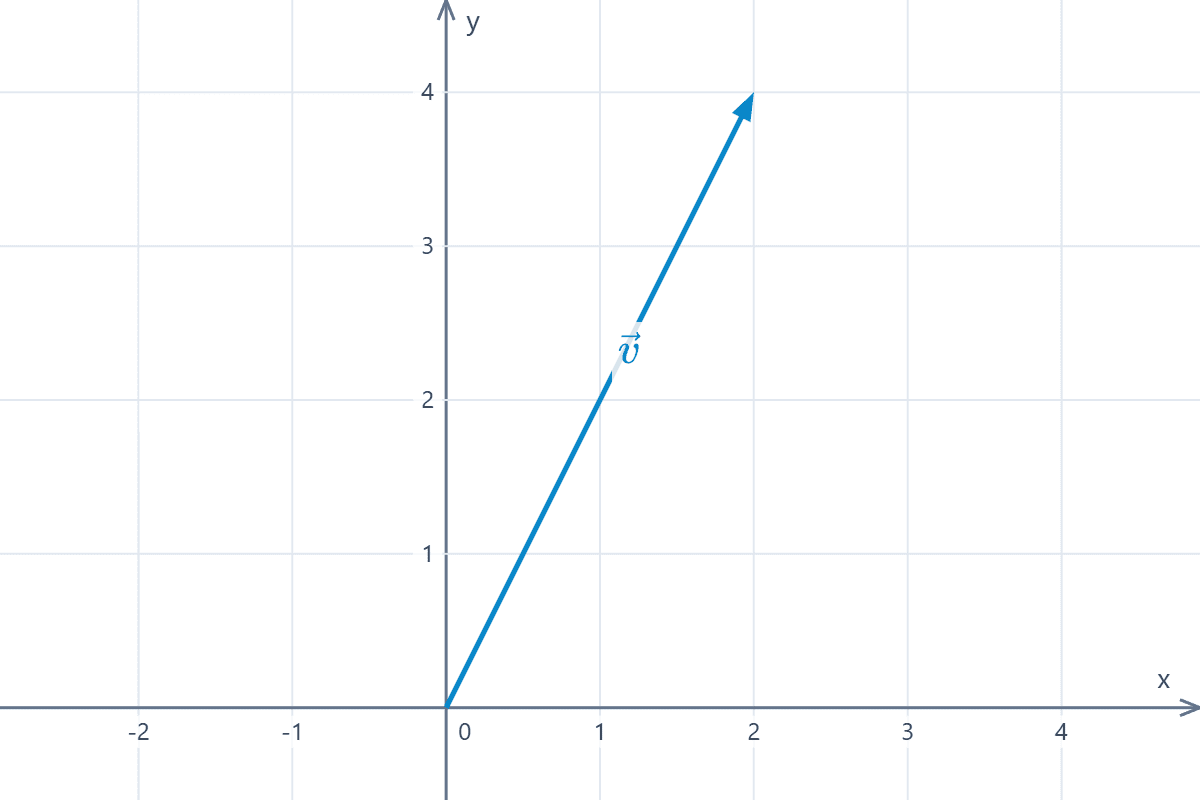
Calculate the magnitude of the vector \(\vec{v}=\langle 2, 4\rangle.\)
Result
The magnitude of the vector \( \vec{v} \) is:
Step-by-step solution
1. Identify the vector components.
The vector to work with is:
Extract the values of its components:
2. Apply the magnitude formula.
The magnitude of a vector is obtained by applying the Pythagorean theorem to its components. Substitute the values into the formula:
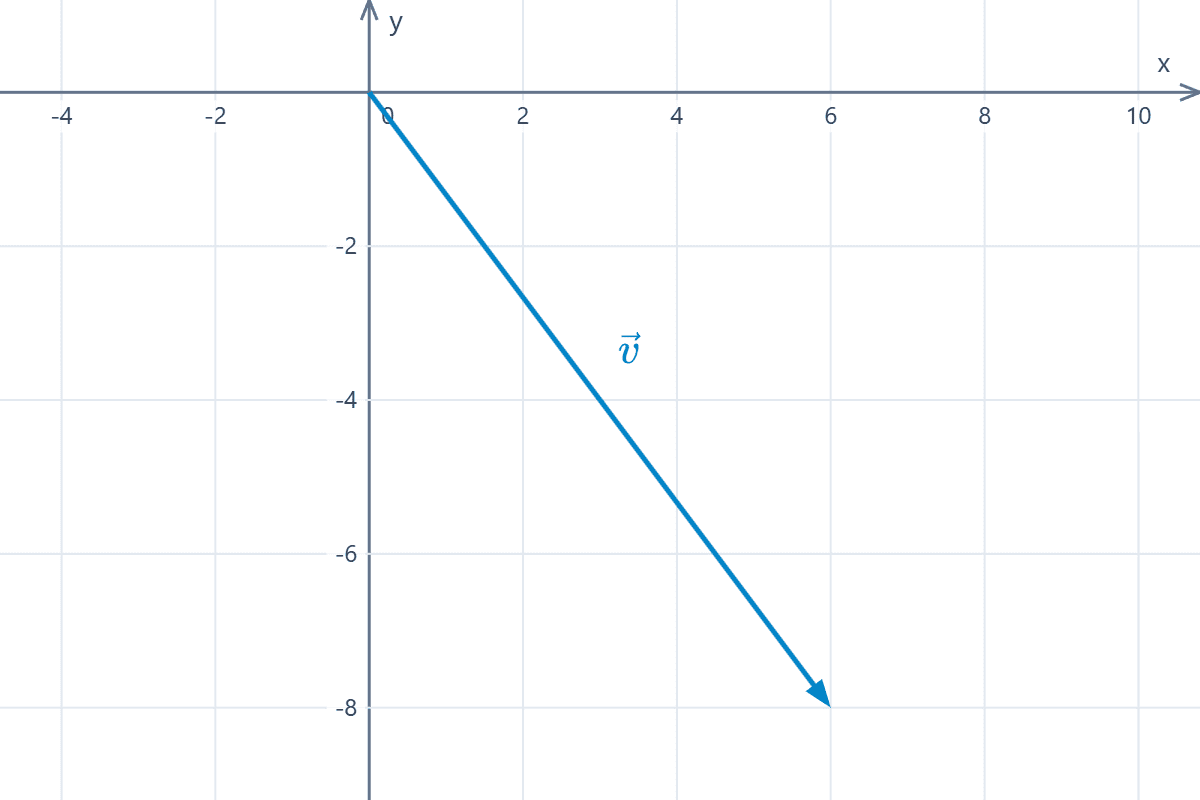
Find the magnitude of the vector defined by the points A(-2, 5) and B(4, -3).
Result
The magnitude of the vector \( \vec{v} \) is:
Step-by-step solution
1. Calculate the vector components.
The entered information corresponds to a vector defined by an initial point and a terminal point. Extract the coordinates of each point:
Obtain the vector components by subtracting the initial point coordinates from the corresponding terminal point coordinates:
Therefore, the resulting vector is:
2. Apply the magnitude formula.
The length of a vector is obtained by applying the Pythagorean theorem to its components. Substitute the values into the formula:
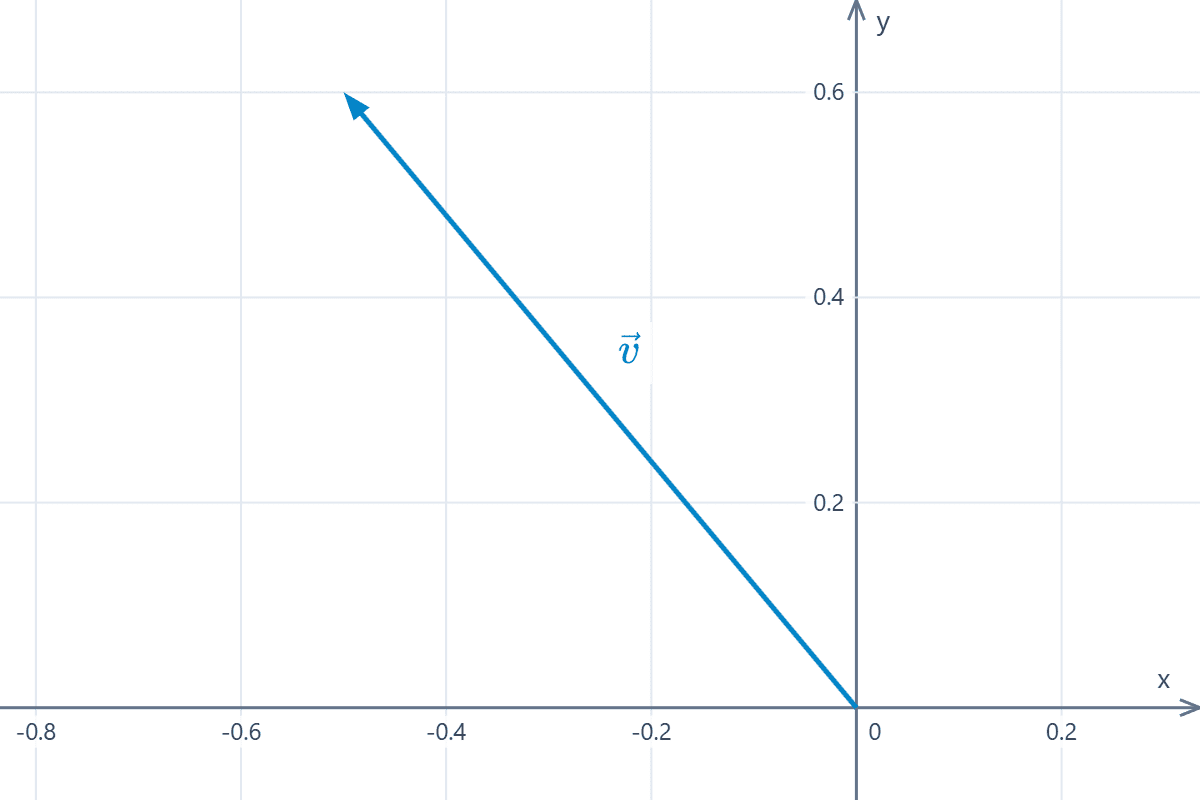
Determine the norm of the vector \(\vec{v}=\left\langle -\dfrac{1}{2}, \dfrac{3}{5}\right\rangle.\)
Result
The norm of the vector \( \vec{v} \) is:
Step-by-step solution
1. Identify the vector components.
The vector to work with is:
Extract the values of its components:
2. Apply the magnitude formula.
The magnitude of a vector is obtained by applying the Pythagorean theorem to its components. Substitute the values into the formula:
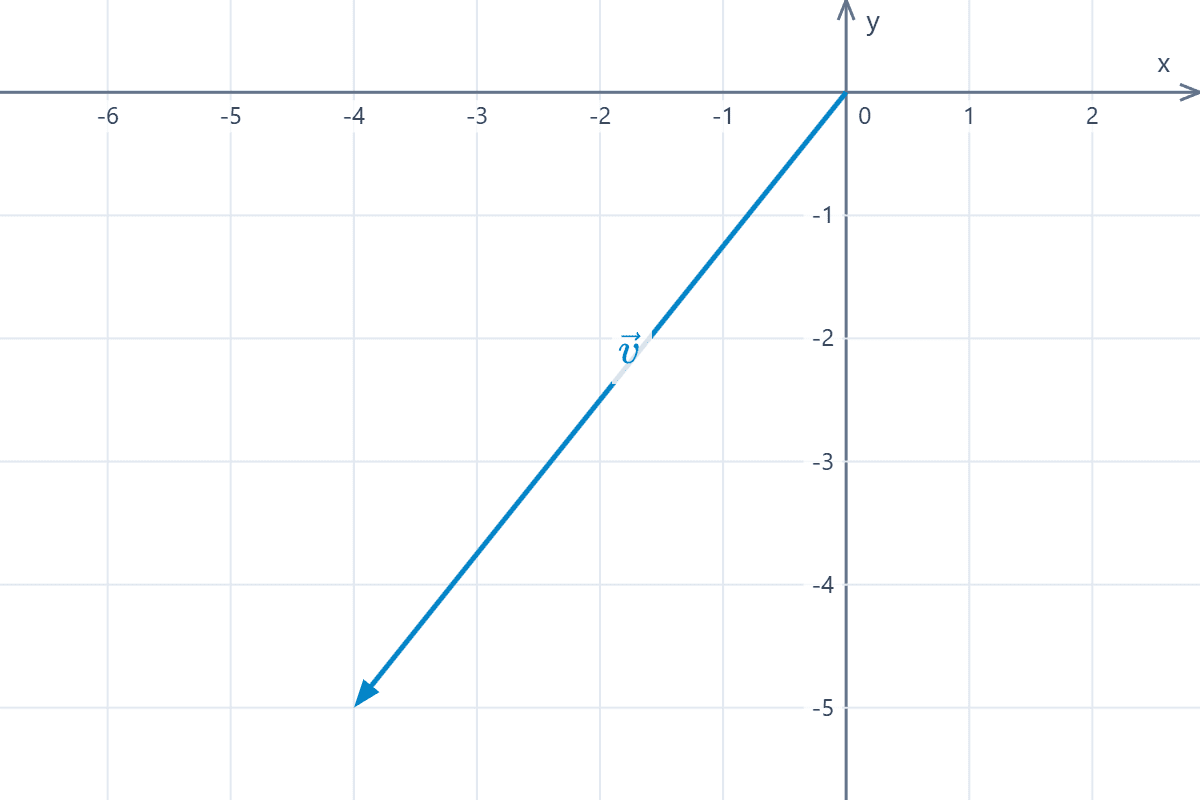
Find the length of the vector whose initial point is (1, 1) and terminal point is (-3, -4).
Result
The length of the vector \( \vec{v} \) is:
Step-by-step solution
1. Calculate the vector components.
The entered information corresponds to a vector defined by an initial point and a terminal point. Extract the coordinates of each point:
Obtain the vector components by subtracting the initial point coordinates from the corresponding terminal point coordinates:
Therefore, the resulting vector is:
2. Apply the magnitude formula.
The magnitude of a vector is obtained by applying the Pythagorean theorem to its components. Substitute the values into the formula:
Calculate the magnitude of the three-dimensional vector \(\vec{v}=\langle 2, -3, 6 \rangle.\)
Result
The vector magnitude of \( \vec{v} \) is:
Step-by-step solution
1. Identify the vector components.
The vector to work with is:
Extract the values of its components:
2. Apply the magnitude formula.
The magnitude of a vector is obtained by applying the Pythagorean theorem to its components. Substitute the values into the formula:
Related Tools
