
Unit Vector Calculator
Calculate the unit vector in the direction of a given vector from its components or endpoints, with a step-by-step solution and graph.
Quick Examples
How to Use the Calculator
This online unit vector solver is an analytical tool designed to carry out the normalization process. Its function is to find a new vector that has a magnitude of exactly 1, while preserving the same direction as the original vector. The system generates the simplified result, shows the algebraic steps, and works for both 2D and 3D vectors.
How to enter your data:
Just like with other vector tools, you must indicate the dimension of your problem (2D or 3D) to the system and choose one of the two available input methods:
- By its Cartesian components: enter your base vector directly into the corresponding fields, using (x, y) for the two-dimensional plane or (x, y, z) for three-dimensional space.
- By its endpoints: if you know two points where the vector begins and ends, select this option. The math engine will determine the vector components before proceeding to normalize it.
The calculator accepts integers, decimals, exact fractions, and expressions with square roots. It is recommended to enter values in their exact form (for example, fractions instead of repeating decimals) so the algorithm can maintain symbolic precision and avoid rounding errors.
Structure of the answer:
Once you enter the data, the tool will process the operation and present a structured report as follows:
- Quick answer: in a highlighted block at the top, you will directly see the components of the resulting unit vector. The solver prioritizes delivering the answer in exact form (with fractions and rationalized roots) and will include its decimal equivalent if applicable.
- Step-by-step solution: below the result, the normalization procedure will be detailed using the formula u = v / |v|.
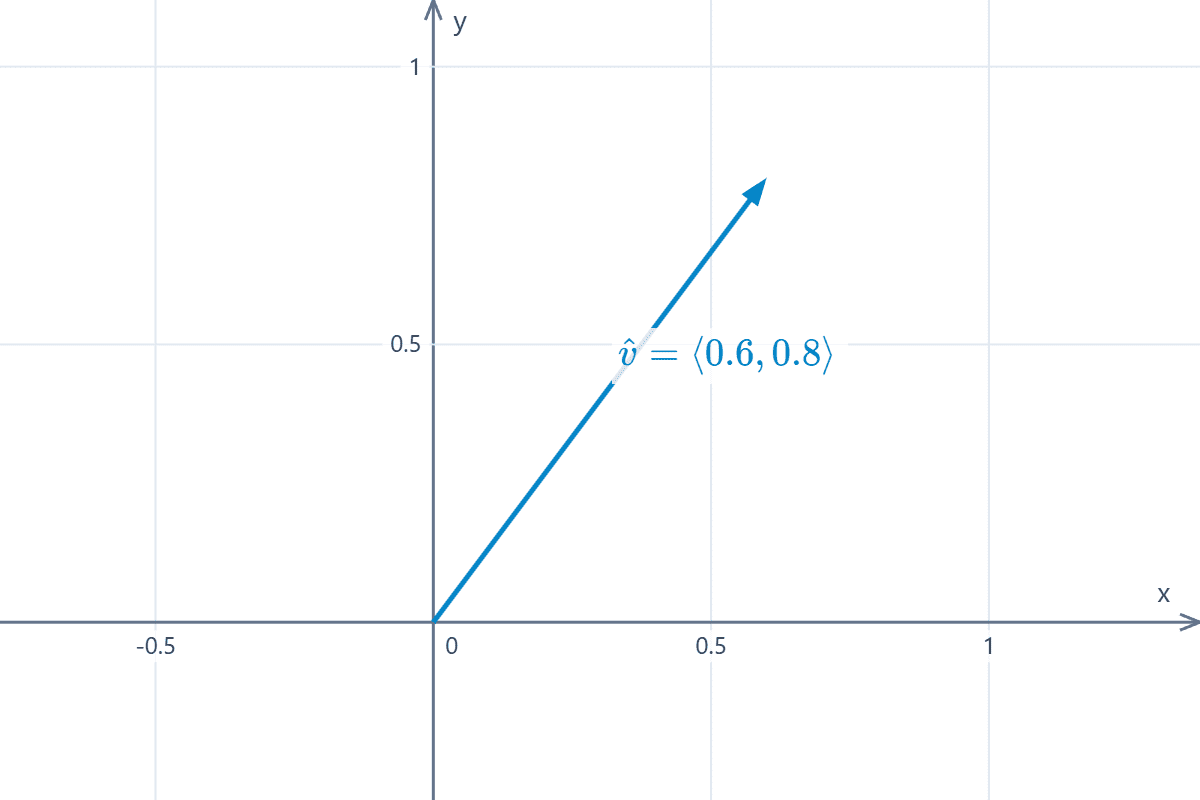
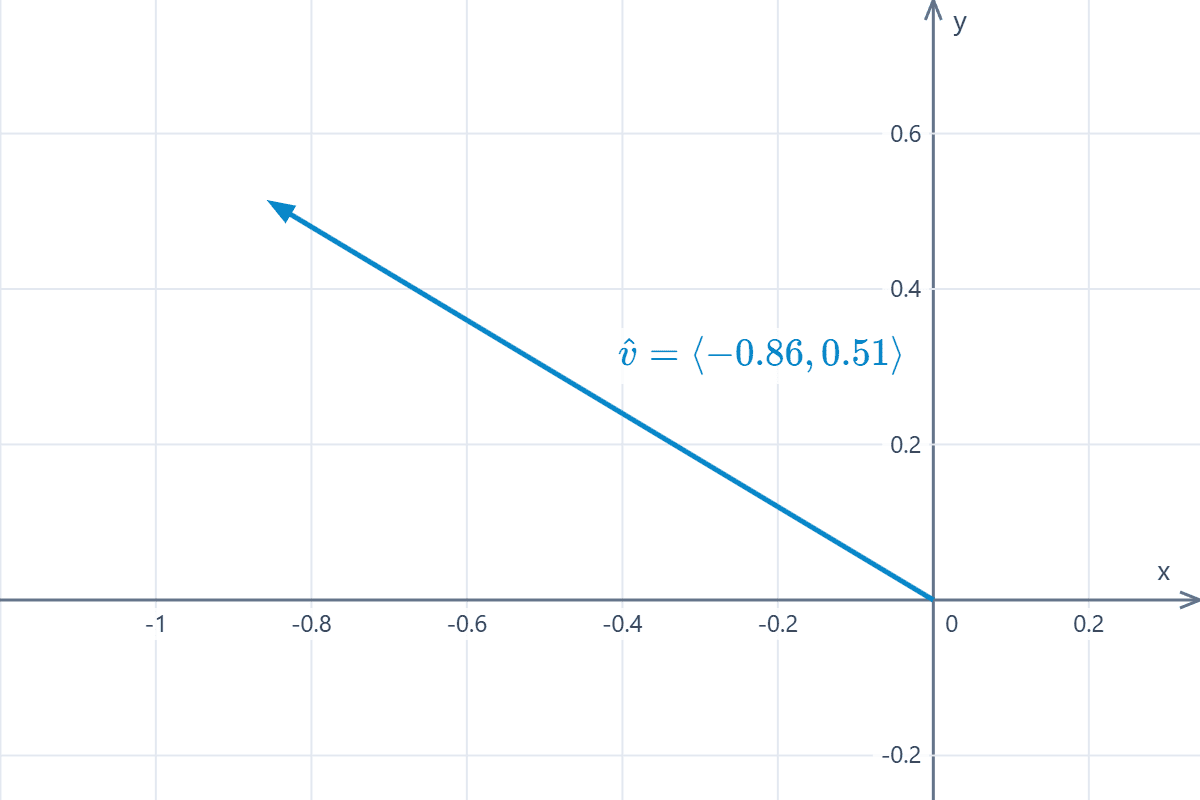
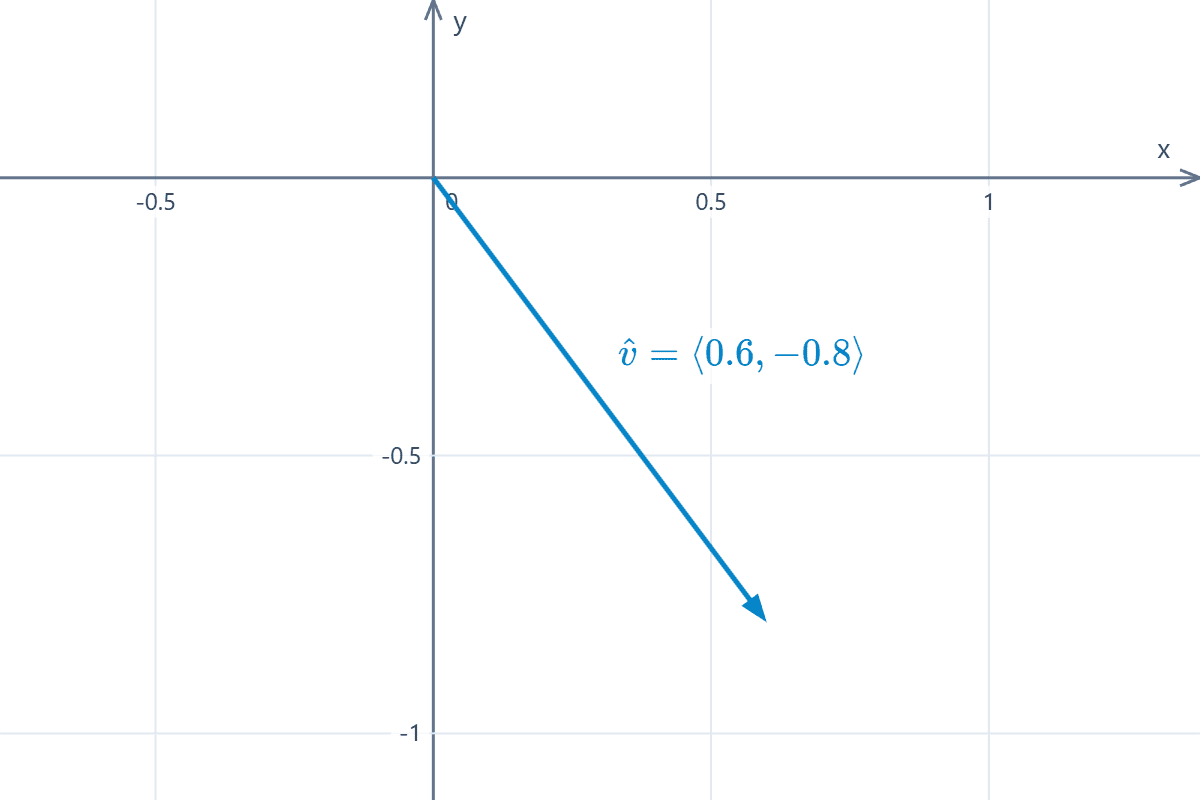
- Graphical representation: if you are working in the Cartesian plane, the report will conclude with an interactive graph where you can see the plotted unit vector.
Solved Exercises
The following are examples of problems solved by the calculator.
Calculate the unit vector in the direction of the vector \(\vec{v}=\langle3, 4\rangle.\)
Result
The unit vector in the direction of the vector \( \vec{v} \) is:
Step-by-step solution
1. Identify the vector components.
The given vector is:
We extract the values of its components:
2. Calculate the magnitude of the vector.
We apply the Pythagorean theorem to obtain the magnitude or length of the vector:
To see the step-by-step process, check the magnitude calculator.
3. Calculate the unit vector components.
We divide each component of the original vector by its magnitude to find the unit vector in the same direction:
Obtain the unit vector corresponding to the vector \(\vec{v}=\langle-5, 3\rangle.\)
Result
The unit vector in the direction of the vector \( \vec{v} \) is:
Step-by-step solution
1. Identify the vector components.
The given vector is:
We extract the values of its components:
2. Calculate the magnitude of the vector.
We apply the Pythagorean theorem to obtain the magnitude or length of the vector:
3. Calculate the unit vector components.
We divide each component of the original vector by its magnitude to find the unit vector in the same direction:
Normalize the vector defined by the points A(-2, 5) and B(4, -3).
Result
The unit vector in the direction of the vector \( \vec{v} \) is:
Step-by-step solution
1. Calculate the vector components.
The input information corresponds to a vector defined by an initial point and a terminal point. We extract the coordinates of each point:
We obtain the vector components by subtracting the coordinates of the initial point from those of the terminal point:
Therefore, the resulting vector is:
2. Calculate the magnitude of the vector.
We apply the Pythagorean theorem to obtain the magnitude or length of the vector:
3. Calculate the unit vector components.
We divide each component of the original vector by its magnitude to find the unit vector in the same direction:
Calculate the unit vector in the direction of the three-dimensional vector \(\vec{v}=\langle 2, -3, 6\rangle.\)
Result
The unit vector in the direction of the vector \( \vec{v} \) is:
Step-by-step solution
1. Identify the vector components.
The given vector is:
We extract the values of its components:
2. Calculate the magnitude of the vector.
We apply the Pythagorean theorem to obtain the magnitude or length of the vector:
To see the step-by-step process, check the magnitude calculator.
3. Calculate the unit vector components.
We divide each component of the original vector by its magnitude to find the unit vector in the same direction:
Related Tools
