
Vector Addition Calculator
Enter the vector components (or their magnitudes and angles) to get the resultant vector of their sum using the step-by-step algebraic method and the graphical method on the Cartesian plane.
Quick Examples
How to Use the Calculator
This online vector addition solver is a mathematical and physical tool designed to operate in both the two-dimensional plane (R2) and three-dimensional space (R3). It is ideal for solving analytical geometry exercises or applied problems, such as the addition of vector forces. In addition to giving you the direct result, the system generates the step-by-step analytical solution and a graphical representation.
Configuration and data entry:
- Select the dimension: use the main selector to tell the tool whether you will work with vectors in R2 (x, y axes) or in R3 (x, y, z axes).
- Add your vectors: the solver allows adding up to 4 vectors simultaneously. Each vector has an individual block where you will enter its numerical values. Additionally, the engine supports the use of exact fractions and whole or decimal numbers.
- R2 mode (2D): for each vector block, you can choose the input format of your data from a dropdown menu. You can enter the vector using its rectangular components (x, y) or using its magnitude and angle (polar coordinates). It is possible to mix formats; for example, entering the first vector by components and the second by its magnitude and direction.
- R3 mode (3D): when working in three dimensions, data entry is done exclusively using components (x, y, z).
Once the data is processed, the tool will structure the answer into three main sections:
1. Quick answer
In the first highlighted block, you will find the direct solution to your problem. Here, the exact resultant vector and its decimal approximation (if applicable) will be shown. The total magnitude and direction will also be detailed.
2. Step-by-step solution
Next, the entire analytical method used to reach the result will be displayed. The algorithm will show you the following logical progression:
- Format conversion: if in R2 mode you entered any vector by its magnitude and angle, the system will show how to use trigonometric functions (sine and cosine) to convert it to its rectangular component form.
- Algebraic addition: you will see the individual sum of each dimension, grouping all the x-components (Rx = ax + bx...), all the y-components, and the z-components if you are in R3.
- Assembly and final calculation: with the sums resolved, the resultant vector will be assembled. Then, the solver will apply the Pythagorean theorem to find the magnitude. Finally, it will calculate the direction; in R2 using the arctangent function, and in R3 by calculating the three direction angles (alpha, beta, and gamma) with respect to each coordinate axis.
3. Interactive graph
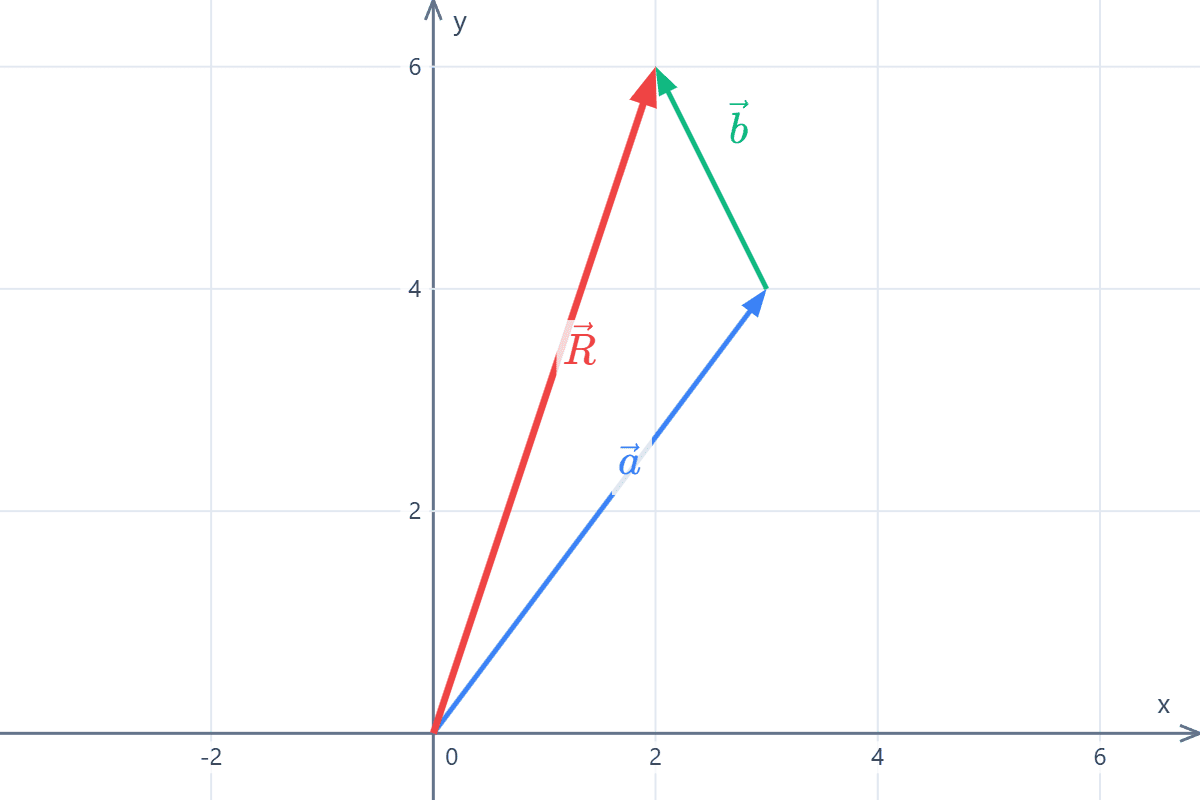
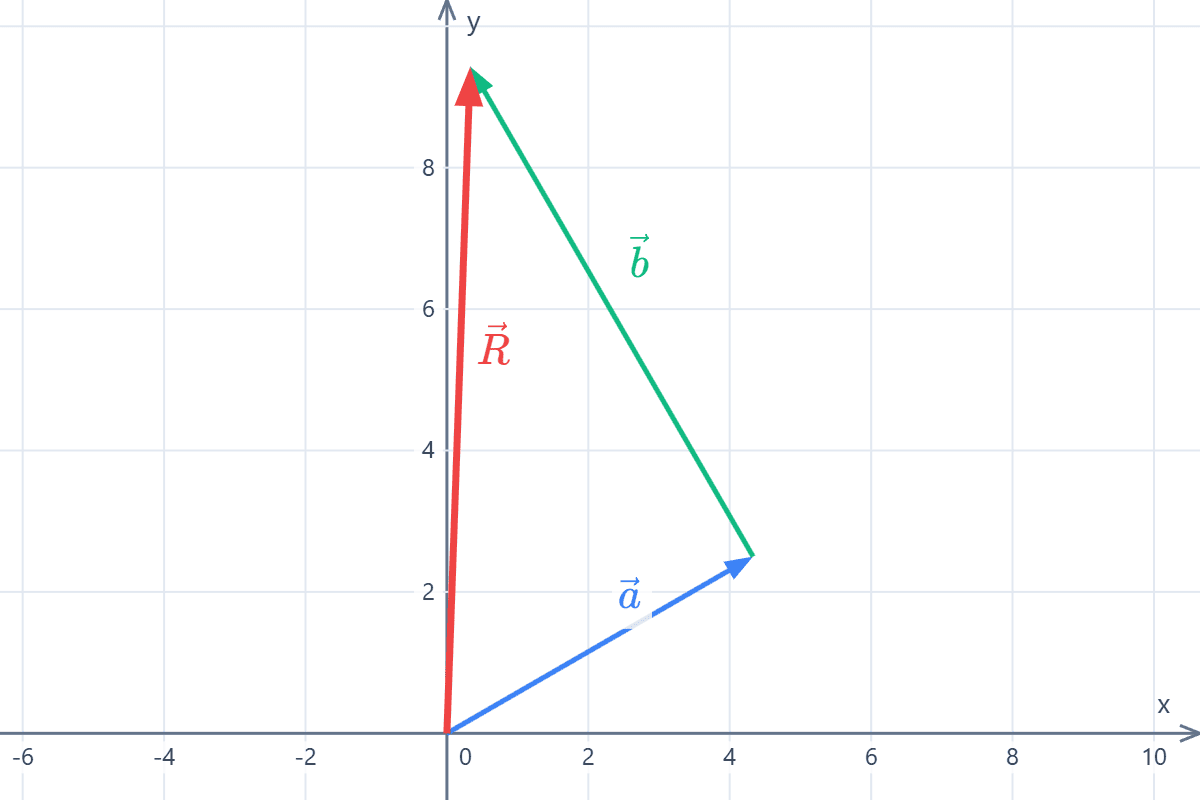
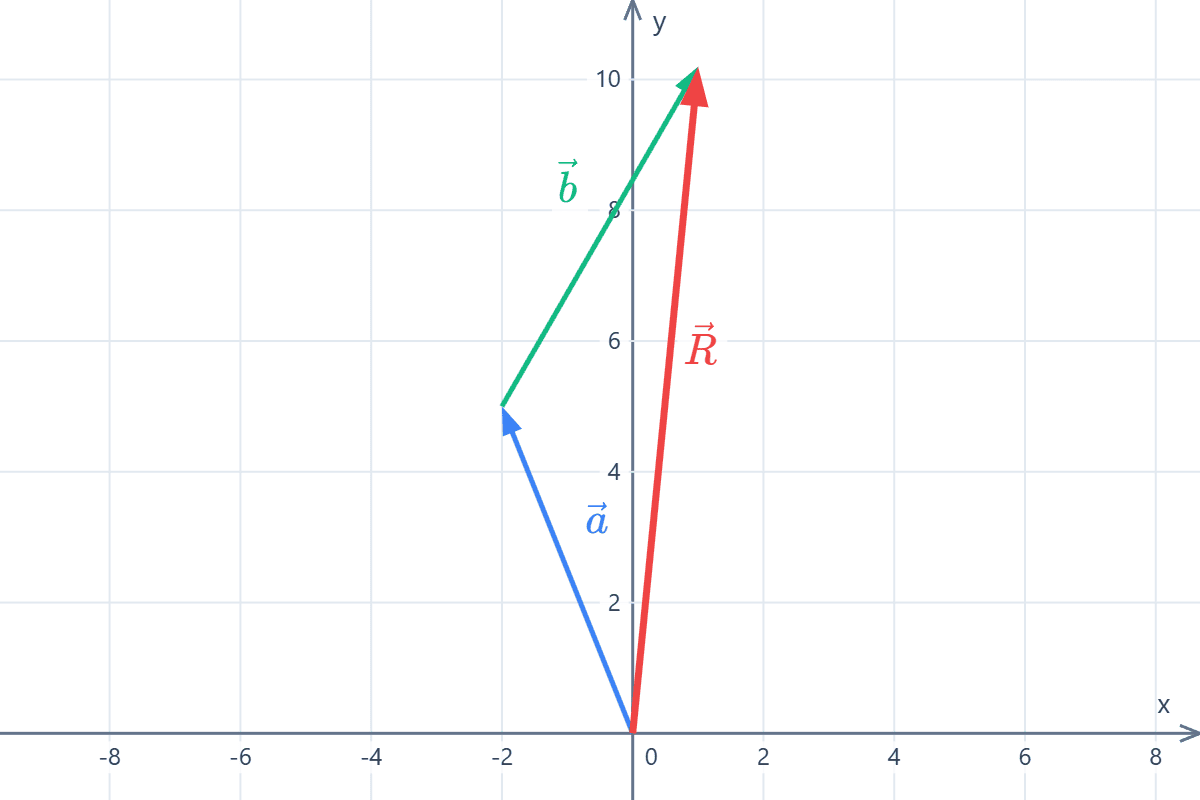
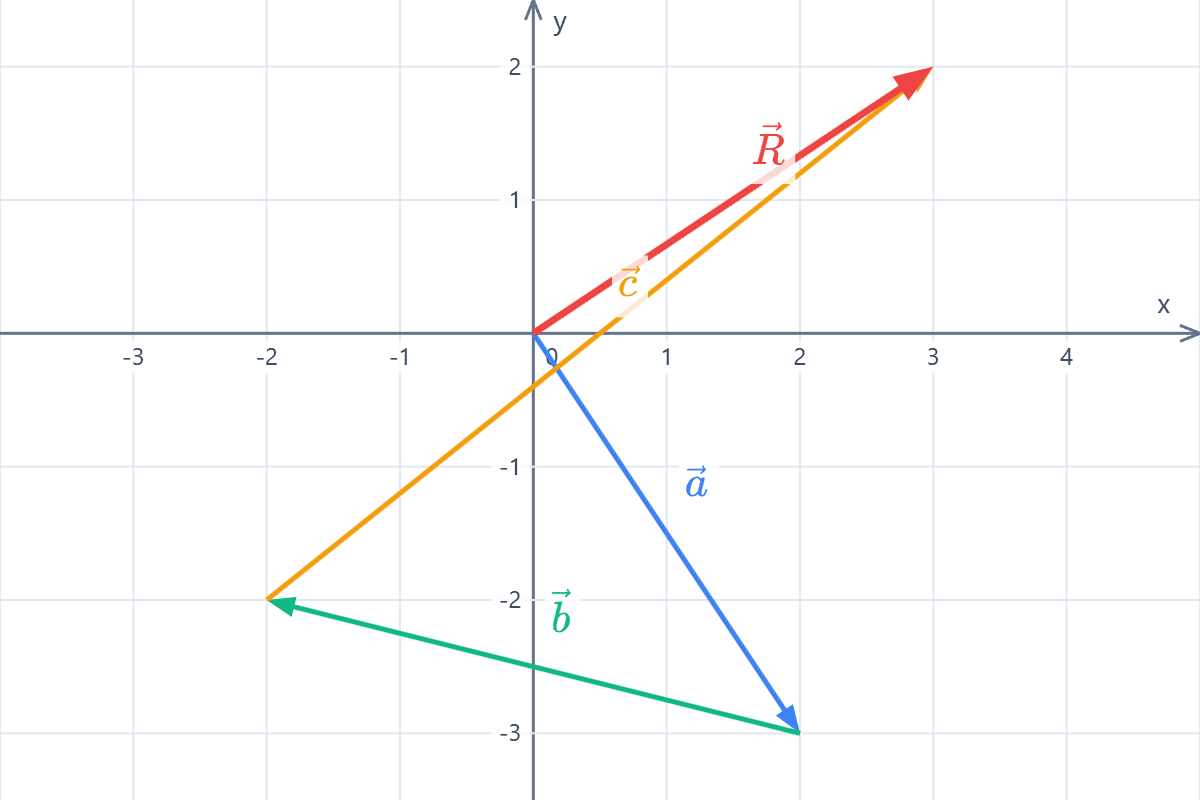
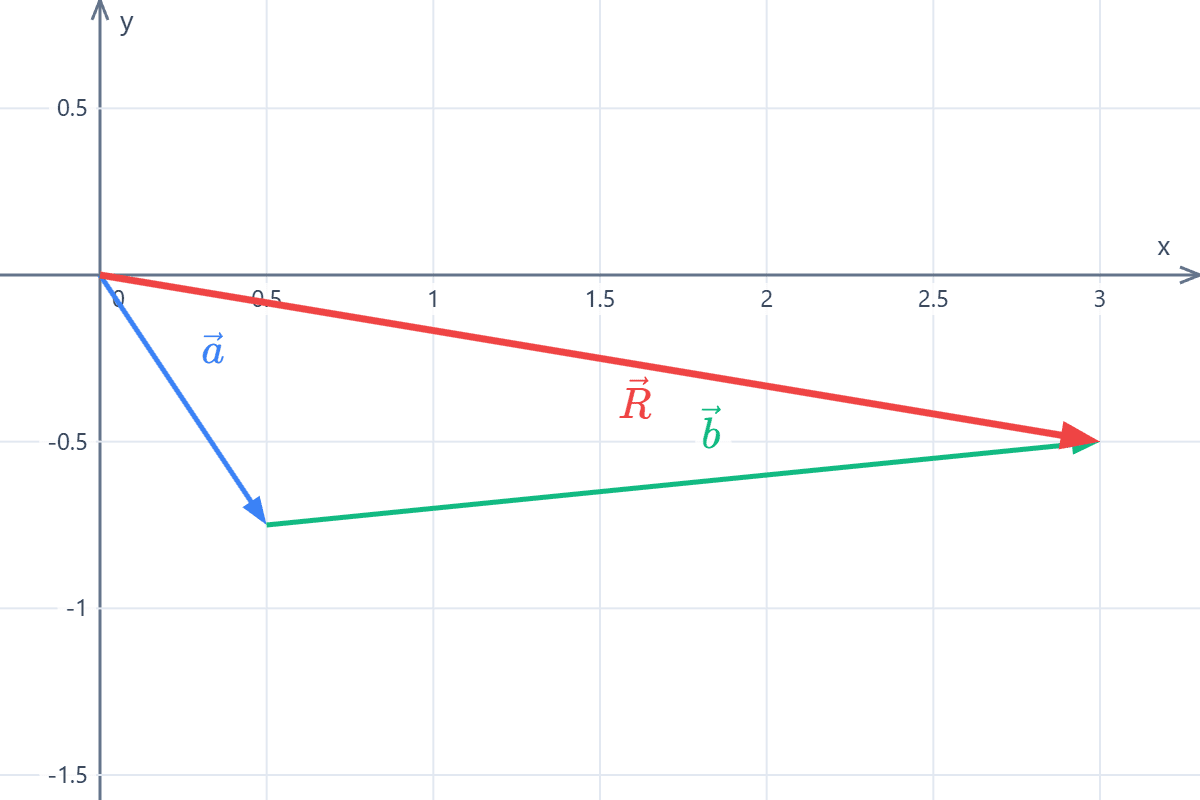
For two-dimensional problems, the bottom of the results will include an interactive Cartesian plane. Here the tool applies the graphical method (polygon method or head-to-tail method). You will see how each vector is drawn starting exactly where the previous one ends, and how the resultant vector is drawn by connecting the origin of coordinates to the tip of the last vector, allowing you to visually verify the geometry of the exercise.
Solved Exercises
The following are examples of problems solved by the calculator.
Calculate the resultant vector of the sum of \(\vec{a}=\langle 3, 4\rangle\) and \(\vec{b}=\langle-1, 2\rangle.\)
Result
The resultant vector of the sum is:
Magnitude: \( |\vec{R}| = 2 \sqrt{10} \approx 6.32 \)
Direction: \( \theta \approx 71.57^\circ \)
Step-by-step solution
1. Identify the components of the vectors.
The given vectors are in rectangular component form. We extract their values directly:
2. Add the vector components.
We algebraically add the corresponding components to obtain the components of the resultant vector:
So, the resultant vector of the sum is:
3. Calculate the magnitude of the resultant vector.
We apply the vector magnitude formula using the obtained components:
4. Calculate the direction of the resultant vector.
We use the arctangent function with the ratio between the vertical and horizontal components of the resultant vector:
Calculate the sum of the vectors given by magnitude and angle |a| = 5, α = 30°; |b| = 8, β = 120°.
Result
The resultant vector of the sum is:
Magnitude: \( |\vec{R}| = \sqrt{89} \approx 9.43 \)
Direction: \( \theta \approx 87.99^\circ \)
Step-by-step solution
1. Identify the components of the vectors.
The vectors are defined by their magnitude and direction:
We decompose each vector into its rectangular components by multiplying the magnitude by the cosine and sine of the respective angle.
We decompose the vector a:
Therefore:
We decompose the vector b:
Therefore:
2. Add the vector components.
We algebraically add the corresponding components to obtain the components of the resultant vector:
So, the resultant vector of the sum is:
3. Calculate the magnitude of the resultant vector.
We apply the vector magnitude formula using the obtained components:
4. Calculate the direction of the resultant vector.
We use the arctangent function with the ratio between the vertical and horizontal components of the resultant vector:
Find the resultant vector of the sum of \(\vec{a}=\langle -2, 5\rangle\) with the vector of magnitude |b| = 6 and angle β = 60°.
Result
The resultant vector of the sum is:
Magnitude: \( |\vec{R}| = \sqrt{\left(3 \sqrt{3}+5\right)^{2}+1} \approx 10.25 \)
Direction: \( \theta \approx 84.4^\circ \)
Step-by-step solution
1. Identify the components of the vectors.
The given vectors are defined in different formats:
We extract the given rectangular components:
We convert the vectors given in magnitude and angle format into rectangular components by multiplying the magnitude by the cosine and sine of the respective angle.
We decompose the vector b:
Therefore:
2. Add the vector components.
We algebraically add the corresponding components to obtain the components of the resultant vector:
So, the resultant vector of the sum is:
3. Calculate the magnitude of the resultant vector.
We apply the vector magnitude formula using the obtained components:
4. Calculate the direction of the resultant vector.
We use the arctangent function with the ratio between the vertical and horizontal components of the resultant vector:
Determine the sum of the three vectors: \(\langle 2,-3 \rangle\), \(\langle -4, 1 \rangle\), and \(\langle 5, 4\rangle.\)
Result
The resultant vector of the sum is:
Magnitude: \( |\vec{R}| = \sqrt{13} \approx 3.61 \)
Direction: \( \theta \approx 33.69^\circ \)
Step-by-step solution
1. Identify the components of the vectors.
The given vectors are in rectangular component form. We extract their values directly:
2. Add the vector components.
We algebraically add the corresponding components to obtain the components of the resultant vector:
So, the resultant vector of the sum is:
3. Calculate the magnitude of the resultant vector.
We apply the vector magnitude formula using the obtained components:
4. Calculate the direction of the resultant vector.
We use the arctangent function with the ratio between the vertical and horizontal components of the resultant vector:
Obtain the sum of the vectors with fractional components \(\vec{a}=\langle 1/2, -3/4 \rangle\) and \(\vec{b}=\langle 5/2, 1/4 \rangle.\)
Result
The resultant vector of the sum is:
Magnitude: \( \displaystyle |\vec{R}| = \frac{\sqrt{37}}{2} \approx 3.04 \)
Direction: \( \theta \approx 350.54^\circ \)
Step-by-step solution
1. Identify the components of the vectors.
The given vectors are in rectangular component form. We extract their values directly:
2. Add the vector components.
We algebraically add the corresponding components to obtain the components of the resultant vector:
So, the resultant vector of the sum is:
3. Calculate the magnitude of the resultant vector.
We apply the vector magnitude formula using the obtained components:
4. Calculate the direction of the resultant vector.
We use the arctangent function with the ratio between the vertical and horizontal components of the resultant vector:
The arctangent function yields a reference angle. By analyzing the signs of the components, we note that the resultant vector lies in the fourth quadrant. To find the true direction with respect to the positive x-axis, we adjust the result by adding 360°:
Calculate the sum of the following vectors in R3: \(\vec{a}=\langle 2, -1, 4\rangle\) and \(\vec{b} =\langle -3, 5, 2 \rangle.\)
Result
The resultant vector of the sum is:
Magnitude: \( |\vec{R}| = \sqrt{53} \approx 7.28 \)
Direction angles: \( \alpha \approx 97.9^\circ, \; \beta \approx 56.67^\circ, \; \gamma \approx 34.5^\circ \)
The value α is the angle with respect to the x-axis, β with respect to the y-axis, and γ is the angle with respect to the z-axis.
Step-by-step solution
1. Identify the components of the vectors.
The given vectors are in rectangular component form. We extract their values directly:
2. Add the vector components.
We algebraically add the corresponding components to obtain the components of the resultant vector:
So, the resultant vector of the sum is:
3. Calculate the magnitude of the resultant vector.
We apply the vector magnitude formula using the obtained components:
4. Calculate the direction of the resultant vector.
We calculate the angles that the resultant vector makes with each of the coordinate axes (x, y, z):
Related Tools
